5 June 2026 · 12 min read
Why Leaflet Distribution Companies Are Confident When Things Go Wrong
You've run a leaflet distribution campaign. The response wasn't what you hoped for. You raised a concern. And the person on the other end of the phone was calm, professional, and completely unrattled. They had an explanation ready. Several, in fact. They talked about the difficulty of the area, about factors affecting response rates, about the nature of the market. They may have offered to revisit a particular zone as a gesture of goodwill.
You finished the call slightly less certain about your concerns than when you started it. But not quite satisfied either.
If that experience sounds familiar, you're not alone - and the calm you encountered is worth examining closely. Because there are two very different reasons a distribution company might be composed when you raise a concern. One of them is that they're genuinely confident the job was done properly and have the evidence to show it. The other is that they've had this conversation many times before and have learned exactly what to say.
These are not the same thing. And learning to tell them apart is arguably the most useful skill a leaflet client can develop. This article is part of the client's guide to not getting burned series - focused on the commercial dynamics most distribution companies will not explain to you because the current arrangements suit them.
The Anatomy of a Practiced Response
A leaflet delivery service company that routinely under-delivers has a structural problem: at some point, clients notice. Response rates come in lower than expected. Someone on the client's team drives through an area and notices the streets look untouched. A neighbour mentions they didn't receive anything. These conversations are predictable. Which means they can be prepared for.
Over time, companies that have built their margins around the accountability gap - the fact that delivery was historically impossible to verify - develop practised responses to client concerns. These responses have specific characteristics that are worth knowing. The patterns are documented in detail in how to prevent dishonest leaflet distributors, which catalogues the specific behaviours that should make you pause.
The first characteristic is that they are always plausible. Everything a good deflection says is technically true. There genuinely are areas that are harder to deliver in. There genuinely are factors that affect response rates. There genuinely is a legitimate non-delivery allowance - industry standard is typically five to ten percent across most residential areas, accounting for "No Junk Mail" signs, inaccessible properties, and genuine access obstacles. These are real, documented features of door to door leaflet distribution.
The second characteristic is that they are never quite responsive to the specific concern you raised. You asked about a particular postcode. You get an answer about the general characteristics of the area. You asked about a specific street. You get a discussion about how density varies across campaign zones. The answer contains true information that is adjacent to your question, delivered with authority - but it doesn't actually address what you asked.
This is not an accident. It is a technique. And it works, repeatedly, because the client is in the position of someone questioning expertise they don't have. The company knows more about distribution than the client does. The authority imbalance is real. The way to flatten that imbalance is to come into the conversation with your own data - letterbox counts, demographic targeting evidence, planned coverage maps. The how to plan a successful leaflet campaign framework covers how to build that data foundation before the campaign starts, so you're never in the position of arguing against expertise you can't verify.
The Report That Looks Like Evidence
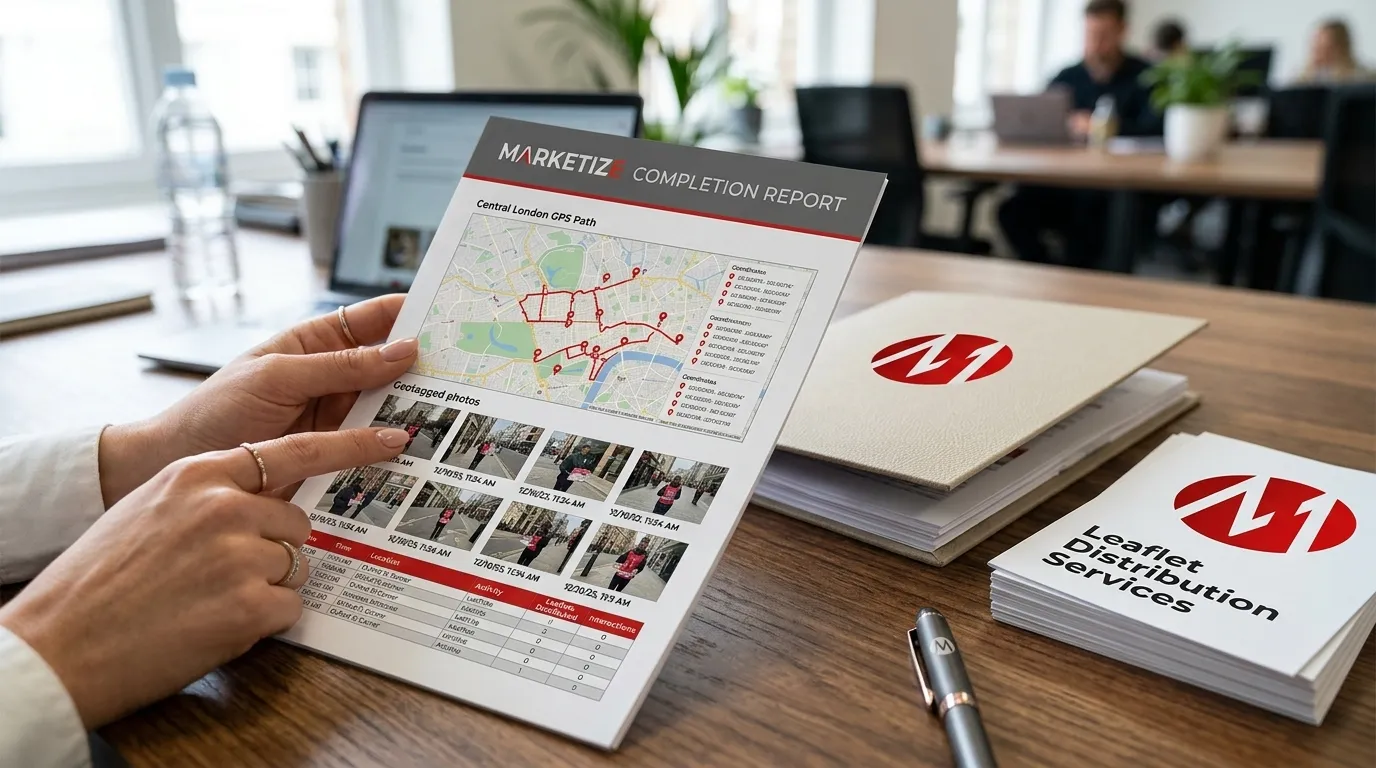
One of the most effective tools in this arsenal is the completion report. Not a genuine completion report - those contain specific, verifiable information and we'll come to what that looks like shortly. But a report that has the appearance of rigour without its substance.
A typical version looks something like this. Twelve pages. A coverage map showing the agreed area coloured in comprehensively. GPS trail data overlaid. Timestamps. A table with aggregate delivery statistics. Photographs - a handful, taken at the beginning of the first day's distribution.
A client receiving this document has, understandably, a different reaction to one receiving a single paragraph saying the job was done. The volume of information communicates competence. It communicates professionalism. It implies that an organisation this thorough, this well-documented, couldn't possibly have cut corners on your campaign.
But look at what the report actually doesn't contain. It doesn't show you what percentage of the households in your target area actually received a leaflet - for that, you'd need the delivery count cross-referenced against verified letterbox totals, the kind of figure produced by letterbox counting tools rather than self-reported by the company. It doesn't include a non-delivery log with specific addresses and reasons. The GPS trail shows a device travelled through an area - it doesn't confirm leaflets were being carried, or posted through letterboxes, rather than being carried and returned. The photographs show a distributor at the start of a shift, not continuous evidence of delivery throughout.
The twelve pages substitute volume for verifiability. They create the impression of accountability without providing it. For a full breakdown of what makes a genuine audit trail - and the specific fraud tactics that incomplete reports are designed to hide - how to avoid leaflet theft and false delivery claims covers every element.
The Goodwill Gesture Trap
When a plausible explanation doesn't fully satisfy a persistent client - when they have specific evidence they're not prepared to let go of, or a postcode that produced literally zero response and they want to understand why - the next move tends to be the goodwill gesture.
"We'll revisit that area. At no additional cost to you."
This is positioned as generosity. As a mark of the kind of committed client relationship the company values. It implies that something extra is being provided - something beyond what the original agreement required.
In many cases, what it actually is is the original delivery finally happening, late, in response to a complaint. The area that was covered thinly or not at all the first time gets covered now. The second delivery is then logged as attentive client service. The complaint becomes the mechanism that triggers the job that should have been done initially - and then that response to the complaint is used as evidence of the company's professionalism.
The client ends the exchange feeling partially heard. The company has avoided any admission of inadequate delivery. The relationship continues. And the next campaign, if there is one, starts from the same position - because nothing about the dynamic has actually changed. The conversation looks entirely different when you have GPS proof of delivery data on hand from day one. The data either supports the original delivery claim or it doesn't, and there's no negotiation about what happened.
What Genuine Confidence Looks Like
There is a version of calm, confident response to client concerns that is entirely legitimate. It sounds like this: here is the GPS record for your campaign, accessible directly through the platform. Here is the non-delivery log, with specific addresses and the reasons recorded for each one. Here is the pace data showing the movement through your area, which you can compare against the known letterbox density of those streets. If there is a gap you want to discuss, show me where it is in the data and we will look at it together.
That conversation is about reality. It involves specific, verifiable information. The confidence in it comes from having nothing to hide - not from having practised the alternative. For a complete explanation of what GPS-tracked leaflet delivery actually captures and how the audit trail is built - coordinates, timestamps, offline data storage, photo metadata - that guide covers every technical element.
The difference between these two versions of confidence is the willingness to point directly at evidence. A company that genuinely delivered your campaign will invite you into the data rather than talking around it. One that did not will give you plausible adjacent information with authority, delivered in a way that makes questioning it feel unreasonable.
Marketize's approach is built around this distinction. Real time delivery tracking with offline data storage means GPS routes don't have false blank spots from signal gaps. Non-deliveries are logged at the address, at the time, using a dedicated button in the app - not reconstructed retrospectively. Geotagged photos appear as pins on the GPS map at the precise location they were taken. All of this is available to the client directly, without any intermediary having had the opportunity to compile it into a summary that tells a more convenient story. For the broader analytical layer that turns this verification data into campaign intelligence - saturation mapping, area-response correlation, route efficiency - how to use GPS tracking for campaign analysis covers the full picture.
Why Clients Stop Asking
One of the things that makes this dynamic so persistent is that clients learn to stop raising concerns. Not because their concerns were resolved. Because the conversations were consistently unsatisfying without being conclusive.
The pattern tends to play out like this. A business owner runs a campaign and it underperforms. They raise a concern and receive a confident, plausible explanation. They're not entirely convinced, but they have no alternative data to put against it. The conversation ends without resolution. They run another campaign. The same thing happens. By the third time, raising the concern feels pointless - the company always has an answer, the answer is always reasonable-sounding, and nothing ever changes.
What has happened, over those conversations, is that the client has absorbed the company's framing of what "normal" looks like in leaflet distribution. Low response rates are explained as market characteristics. Gaps in coverage are attributed to area difficulty. The unspoken conclusion - that leaflet distribution simply doesn't work very well - becomes the operating assumption, even though the actual problem may have been that the delivery didn't happen properly.
This is the compounding harm of practised client management: it doesn't just protect the company from accountability for one campaign. It shapes the client's entire understanding of what the medium can do, built on information that may never have been accurate. For context on what good response rates actually look like across business types - and what mature campaigns should produce when distribution is verified - what is a good leaflet ROI gives you the industry benchmarks to recalibrate against. And how to measure leaflet campaign performance covers the full measurement framework that prevents the slow drift toward accepting under-delivery as normal.
How to Protect Yourself Before the Campaign Starts
The most effective time to deal with this dynamic is before you commission a campaign, not after. A company's response to the question "how can I verify what was actually delivered?" tells you almost everything you need to know.
If the answer involves a detailed report you'll receive on completion, ask what specific data that report will contain. Can you see the GPS trail at street level? Is there a timestamped non-delivery log with specific addresses? Are photos geotagged and distributed throughout the route, or provided as a handful of images from the start of the day? For a side-by-side comparison of which leaflet delivery tracking apps and platforms actually provide each of these elements, that guide gives you a structured way to evaluate any company's verification claims.
If the answer is vague, or involves terms like "comprehensive coverage documentation" without specifics, treat that as informative. Genuine accountability isn't vague about what evidence it produces. The technology behind modern leaflet distribution offline GPS storage, photo metadata, letterbox count cross-referencing, escrow-linked payment release - is well-established by 2026. A company that won't or can't talk about which of these its operation uses is a company that's keeping the accountability gap open on purpose.
Escrow-style payment protection - where funds are held securely and only released on verified completion - also changes the dynamic significantly. A company being paid after verified delivery has a different relationship to evidence than one that has already received the full fee. This is the structural shift that turns plausible explanations into provable claims: the financial incentive aligns with verification rather than against it. The full mechanics of how escrow-linked payment works alongside GPS and photo verification are covered in payment systems for leaflet distribution teams - which explains why the upfront-payment industry norm has persisted, and what changes when it doesn't.
Which brings us to the question of why upfront payment was, and in many cases still is, the industry norm. That's worth a separate conversation - and it's covered in the next article in this series.
Confidence Isn't Evidence
The confidence you encounter when raising a concern with a leaflet delivery service company isn't evidence that everything is fine. Sometimes it is. But often it's the output of a set of techniques that were developed specifically to manage clients who noticed something was wrong - developed because, for a long time, there was no direct way to check. The industry's bad habits persist because the accountability gap that sustained them hasn't been fully closed everywhere.
Understanding the techniques doesn't require cynicism about every operator. It requires knowing what genuine evidence looks like, and what to ask for. For the broader picture of how leaflet distribution in 2026 is being reshaped by GPS verification, escrow payment, and platform-based accountability, that guide gives you the strategic landscape - including how the channel's measurability is closing the gap with digital alternatives.
Ready to commission a campaign where the data does the talking? View campaigns on Marketize - GPS-verified delivery, geotagged photo proof, letterbox count cross-referencing, and escrow-style payment protection are included as standard, not as a premium feature.