8 May 2026 · 15 min read
Payment Systems for Leaflet Distribution Teams: Fair Structures That Protect Everyone
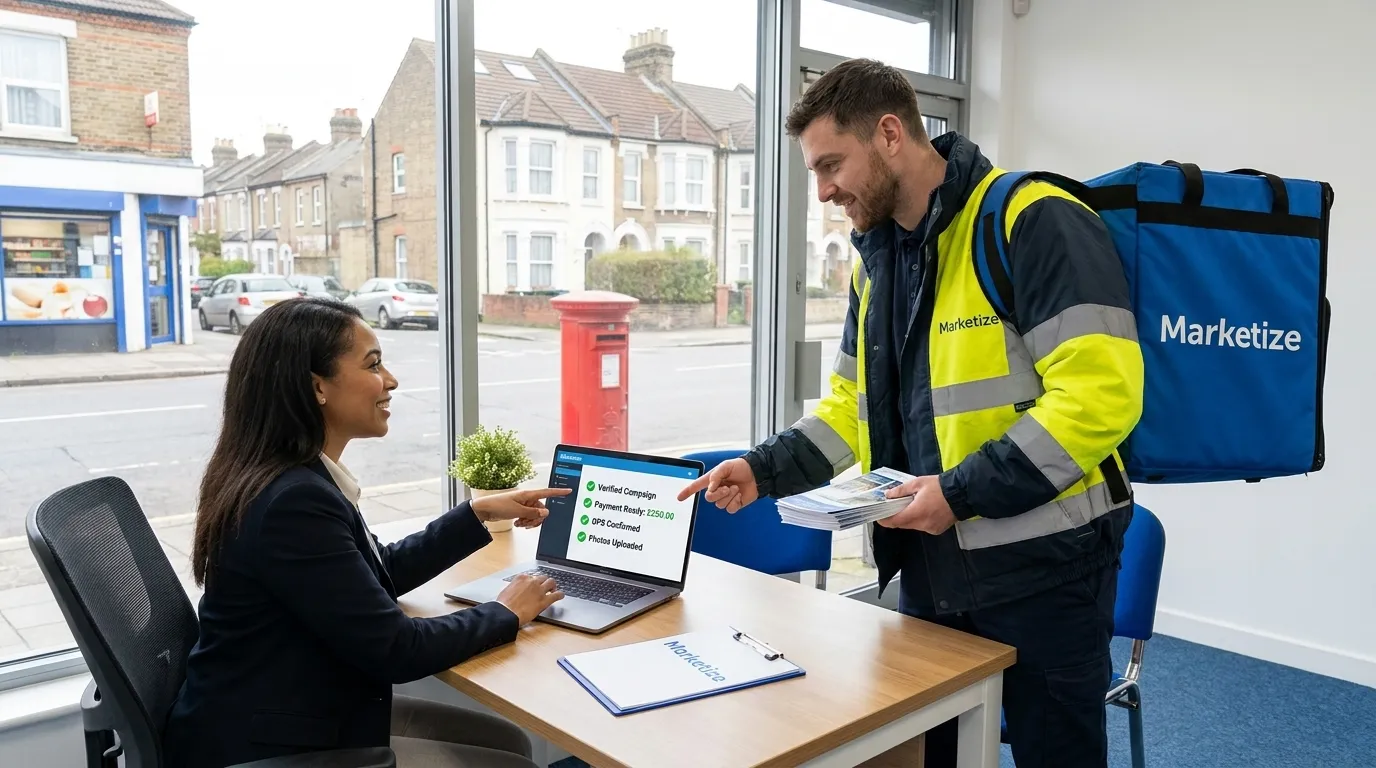
Get payment wrong and your distribution business falls apart quickly. Pay too slowly and reliable distributors leave for agencies that pay promptly. Pay before verifying completion and you'll fund campaigns that never happened. Confuse tax obligations and you'll face HMRC problems down the line.
Payment systems for leaflet distributor jobs need to balance competing priorities: distributors want fair rates and prompt payment, agencies need protection against paying for incomplete work, and both parties need clarity about tax obligations and dispute resolution.
The old model - cash on completion, no verification, trust-based payment - created problems for everyone. Distributors couldn't prove they'd done honest work, so agencies withheld payment based on suspicion. Dishonest distributors got paid for campaigns they'd binned. Nobody had protection.
Modern payment systems solve this through structured rates, escrow-style protection, verification-linked release timing, and clear frameworks for handling disputes. This article sits within the broader operations and distributor management framework - alongside hiring, verification, and performance tracking systems that all connect to payment as the final step in the campaign lifecycle.
Whether you're a distributor wanting to understand how you'll get paid for door to door delivery jobs, or an agency building payment processes that scale, these systems create fairness through transparency rather than hoping trust works out.
Here's how payment systems actually work in professional leaflet distribution, what rates are standard, how timing affects both parties, and how to structure payment that protects everyone involved.
Payment Structures: How Distributors Get Paid
Most UK leaflet distribution operates on per-thousand pricing, though variations exist. For a comprehensive breakdown of what these rates look like across the full market - from both the agency and client perspective - the UK leaflet distribution prices guide for 2026 gives you reliable benchmarks for every campaign type and area.
Per Thousand Leaflets (Standard Industry Model)
Distributors earn fixed amounts per thousand leaflets delivered. Rates vary based on distribution type, area density, and difficulty.
Shared distribution (leaflet bundled with 2-3 non-competing businesses): £25–40 per thousand. Lower rate reflects that distributors carry fewer total leaflets but clients pay less.
Solus distribution (leaflet delivered alone): £35–50 per thousand. Premium rate because distributors carry full quantities and clients pay premium for exclusive delivery.
Area adjustments:
- High-density urban (150–200 letterboxes per hour possible): £25–35 per thousand
- Suburban (100–150 per hour): £30–40 per thousand
- Rural or low-density (50–100 per hour): £40–50+ per thousand
Difficulty premiums:
- Standard residential streets: Base rate
- Flats with entry systems: +£5–10 per thousand (access takes longer)
- Areas requiring driving between streets: +£5–10 per thousand (vehicle costs and time)
- Hilly or physically demanding areas: +£5–10 per thousand
This pricing structure means a distributor covering 5,000 leaflets in a dense suburban area at £35 per thousand earns £175 for roughly 6–8 hours work (£22–29 per hour equivalent). For distributors comparing this against other leaflet distribution jobs near me or gig work options, becoming a leaflet distributor in 2026 covers the full picture of earnings, working conditions, and what to expect before taking on your first job.
Hourly Rates (Rare, Used for Specific Situations)
Some agencies pay hourly (£11–15 per hour typically) for hand-to-hand distribution in high-footfall public areas or when exact quantities are uncertain. This works less well for letterbox distribution because it creates no incentive for efficiency. Someone paid hourly might walk slowly to maximise hours. Someone paid per thousand works efficiently to maximise earnings.
Hybrid Models
Rare but occasionally used: minimum hourly guarantee plus per-thousand bonuses. "£12 per hour minimum, or £35 per thousand if you complete faster - whichever is higher." This protects slow but thorough distributors while rewarding efficient ones. Complex to administer, so most agencies stick with per-thousand pricing.
Payment Timing: When Money Actually Changes Hands
How quickly distributors get paid affects recruitment, retention, and cash flow for both parties. Understanding how leaflet distribution works end-to-end - from job acceptance through to verified completion and payment release - gives both agencies and distributors the context to understand why verification-linked timing is now the industry standard.
Same-Day or Next-Day Payment (Immediate Cash)
Some small agencies pay cash immediately upon completion. Distributor finishes at 4pm, returns undeliverable leaflets, gets cash same day.
- Advantages for distributors: Immediate money, no waiting, great for people needing quick income.
- Advantages for agencies: Attracts distributors who value immediate payment, builds goodwill.
- Disadvantages: No time to verify completion properly. You're paying based on trust before checking GPS trails, photos, or letterbox count verification. If work was incomplete, you've already paid and need to claw money back (difficult and awkward).
Only works with distributors you trust completely after months of proven performance.
Payment After Verification (Industry Standard)
Most professional operations pay 24–48 hours after verifying GPS trails, photos, and coverage match job requirements.
Process:
- Distributor completes distribution and uploads verification (GPS trail, photos)
- Agency reviews within 24 hours: Does GPS cover specified streets? Are photos spread throughout route? Does letterbox count match claimed delivery?
- If verification confirms completion, payment releases
- If issues arise, agency contacts distributor for explanation before making payment decision
Advantages for distributors: Payment is secured and waiting - you know money exists once verification passes. Fair protection against false accusations because payment releases automatically when proof confirms proper work.
Advantages for agencies: Don't pay for incomplete campaigns. Verification review catches problems before money leaves. Escrow systems automate this, holding client funds securely and releasing to distributors once verification thresholds are met.
Weekly or Monthly Batched Payment
Some larger agencies batch payments weekly or monthly. Simpler accounting, but drives distributors to competitors paying within 48 hours. Unless you're a large established company where people accept monthly pay cycles, batched payment loses you distributors to agencies paying faster.
Escrow-Style Payment Protection: How It Works
Traditional payment: client pays agency, agency pays distributor, everyone hopes it works out. Escrow payment: client funds are held securely by a neutral third party, released to the distributor only after verified completion, protecting both parties. For a full explanation of how the verification layer that triggers payment release works - GPS trails, geotagged photos, letterbox count cross-referencing - what is GPS tracked leaflet delivery covers every element.
How Platform Escrow Works
- When client posts a job: Funds get verified and held in escrow immediately. Distributor knows payment exists and is secured before lifting a single leaflet.
- When distributor accepts: They can see payment is held and waiting. No risk of completing work then discovering client has no money.
- When distribution completes: Distributor uploads GPS trail and photos. Client reviews verification and either confirms completion or raises concerns.
- If client confirms: Payment releases to distributor automatically, usually within 24–48 hours of completion.
- If client raises concerns: Platform reviews GPS data, photos, letterbox counts, and communications as neutral third party. Makes binding determination: payment releases fully, partially (proportional to verified work), or gets refunded if distributor clearly didn't complete job.
Why This Protects Distributors
- Payment can't disappear. Money is secured before you start. Client can't change their mind or claim they can't pay.
- Fair dispute resolution. If a client falsely accuses you of incomplete work, neutral review of GPS trails and photos proves you did the job properly. You're not arguing with the client directly - evidence determines outcome.
- Protects against clients who can't afford campaigns. Escrow means funds were verified upfront. No risk of working then discovering the client has no money.
Why This Protects Agencies
- Don't pay for binned campaigns. If GPS shows the distributor never went to the distribution area, or letterbox counts prove they skipped entire streets, payment doesn't release.
- Partial payment for partial work. Distributor completes 3,000 of 5,000 leaflets then can't finish? Pay proportionally for verified work rather than all-or-nothing arguments.
- Client trust. Clients know they're not paying until GPS, photos, and coverage confirm delivery happened. This makes leaflet distribution a trustworthy marketing channel rather than an act of faith. For a complete breakdown of the fraud tactics that escrow payment prevents - and the specific verification methods that catch each one - how to avoid leaflet theft and false delivery claims covers the full picture.
Tax and Employment Status: Critical Considerations
How distributors get classified affects tax obligations for everyone. This applies whether you hire leaflet distributors directly or work through a leaflet distributor marketplace - the self-employed contractor model is standard across the industry.
Self-Employed Contractors (Standard Model)
Most leaflet distributors are self-employed contractors, not employees. They:
- Register as self-employed with HMRC
- Complete Self Assessment tax returns annually
- Pay Income Tax and National Insurance on earnings above personal allowance
- Can claim business expenses (mileage if using vehicle for distribution, phone costs for GPS app usage, distribution bags if purchased)
- Work flexibly for multiple agencies without exclusivity
- Receive payment gross (no tax deducted at source by agency)
Agency obligations: None beyond paying gross amounts agreed. Don't deduct tax, don't provide employment benefits, don't owe employer National Insurance. Keep records of payments made in case HMRC ever queries contractor status.
Distributor obligations: Track all earnings, file Self Assessment by 31 January, pay tax owed. Failure to register as self-employed or file returns creates HMRC penalties - entirely distributor's responsibility.
When Employment Status Gets Murky
If distributors work exclusively for one agency, must work set hours, use agency-provided equipment, and have no freedom to refuse jobs, HMRC might reclassify them as employees. This triggers employer National Insurance obligations, holiday pay, PAYE deductions, and potential backdated tax bills.
How to maintain clear self-employed status:
- Distributors work for multiple agencies, not exclusively
- Accept or refuse jobs freely without penalty
- Set their own working hours and methods
- Provide their own equipment (smartphone, distribution bag)
- Invoice for work completed rather than receiving wages
Platform-based distribution naturally maintains contractor status because distributors choose which jobs to accept from multiple clients, work independently, and use their own equipment. For distributors new to self-employment, how to become a leaflet distributor in 2026 covers HMRC registration, tax filing, and what expenses you can legitimately claim.
Cash-in-Hand Considerations
Some distributors prefer cash payment without documentation. This creates tax evasion risks for everyone involved. All income must be declared for tax purposes, whether paid by bank transfer, cheque, or cash. Professional operations pay via bank transfer creating automatic documentation - this protects agencies and makes legitimate tax filing easier for distributors.
Handling Payment Disputes Fairly
Despite clear payment structures, disputes occasionally arise. The letterbox counting tools that establish agreed quantities upfront eliminate the most common dispute source before jobs even start - but when disagreements do occur, this framework resolves them fairly.
Common Dispute Scenarios
"I completed the job, where's my payment?" Usually happens when distributors don't understand verification review takes 24–48 hours. Solution: set expectations during hiring. "Payment releases 24–48 hours after we verify your GPS trail and photos confirm completion."
"You're only paying me for 4,200 leaflets but I delivered 5,000!" Distributor delivered to all accessible properties, but letterbox count shows their GPS route only covered streets containing 4,200 letterboxes (accounting for the 5% undeliverable allowance). Solution: use letterbox counting tools before jobs start. Show distributors "this area contains approximately 4,950 deliverable letterboxes" so everyone agrees on the baseline before distribution begins.
"Client is refusing payment claiming I didn't deliver, but I have GPS proof I did!" Classic dispute requiring neutral third-party review. Platforms review GPS trails, photos, letterbox counts, and communications, then make a binding determination based on evidence - not on who argues most forcefully.
Fair Dispute Resolution Process
- Step 1: Distributor submits verification (GPS, photos)
- Step 2: Client reviews within 24–48 hours, either confirms or raises specific concerns
- Step 3: If concerns raised, distributor gets chance to respond with evidence
- Step 4: If disagreement persists, neutral platform review examines all evidence objectively
- Step 5: Binding determination based on what GPS, photos, and letterbox counts show - payment releases appropriately
Setting Fair Rates That Attract Quality
Pay too little and you'll only attract people willing to cut corners. Pay fairly and you build teams that stick around. The rate question directly affects your ability to find leaflet distributors - in competitive local markets, payment speed and rate competitiveness are the two factors most often cited by distributors when choosing which agencies to work with.
Researching Market Rates
Ask other agencies what they pay (many will share ballpark figures). Consider:
- What do food delivery platforms pay per hour equivalent in your area?
- What do other walking-based gig work options pay?
- What's minimum wage (£11.44 from April 2024) and how does your per-thousand rate compare hourly?
If distributors covering 5,000 leaflets at your rate earn less than minimum wage equivalent, you'll struggle to recruit anyone reliable.
Paying Premium for Premium Performance
Don't pay everyone identically regardless of performance history. Tier your rates:
- Tier 1 (Proven - 15+ campaigns, perfect verification): £40–50 per thousand for standard work, premium jobs first, occasional bonuses
- Tier 2 (Developing - 5–15 campaigns, generally good): £35–40 per thousand
- Tier 3 (New/probationary): £30–35 per thousand for small test jobs
For the full performance tiering framework - how to assign jobs by tier, what triggers movement between tiers, and how team leads factor into the rate structure - how to manage leaflet distributors covers the complete operational layer.
Transparency About Rates
Be upfront about what you pay. "Shared distribution: £30–35 per thousand depending on area density and your experience. Solus: £40–45 per thousand." Hidden rates or "we'll discuss payment later" creates distrust. Distributors want to know what they'll earn before accepting jobs.
Cash Flow Management for Agencies
Payment systems affect your cash flow significantly. The leaflet distribution software that powers modern platform operations handles client payment collection, escrow management, distributor payment release, and reporting in one system - eliminating the manual processes that create cash flow gaps at scale.
Client Payment Collection
Ideally, collect client payment before distribution starts. This ensures money exists to pay distributors, you're not funding campaigns from your own cash then chasing client payment, and escrow systems can hold client funds securely. Platforms require client payment upfront, holding it in escrow until verified completion. This eliminates cash flow gaps where you've paid distributors but clients haven't paid you yet.
Float Requirements
If you pay distributors before collecting client payment, calculate float requirements carefully. Paying out £5,000 weekly to distributors while waiting for client payments creates real cash flow pressure. Options: collect client payment upfront (best solution), use revolving credit to cover float (expensive), or batch distributor payments weekly rather than per-job (distributors dislike waiting).
Platform Processing Fees
Factor in payment processing costs. Bank transfers, PayPal, or platform payment systems charge fees (typically 1–3% for card payments, minimal for bank transfers). These eat into margins if not accounted for. Either absorb them as business costs or incorporate into pricing.
Building Payment Systems That Scale
One distributor paid cash after each job is manageable. Ten distributors across twenty weekly campaigns requires systems. For the complete operational infrastructure - job assignment, verification review, performance tracking, and payment processing all working together - the operations and distributor management hub covers everything as an integrated system.
Automated Payment Processing
Manual bank transfers for every completed job become unmanageable at scale. Options:
- Platform automated payment: Verification triggers payment release automatically. No manual processing per job.
- Batch processing tools: Collect all due payments weekly, process in one batch rather than individually.
- Accounting software integration: Sync payment data to Xero, QuickBooks, or similar automatically rather than manual entry.
Payment Tracking and Records
Keep detailed records for:
- Tax purposes (prove business expenses)
- Distributor disputes (show exactly what was paid when)
- Client billing (demonstrate distributor costs justify campaign pricing)
- Performance analysis (track distributor earnings over time)
Platforms with built-in payment tracking and reporting automate this. For a side-by-side comparison of which platforms provide the strongest payment automation, verification integration, and records management, the best leaflet delivery tracking apps guide gives you an honest breakdown before committing to a system.
Distributor Payment Portals
Rather than distributors messaging "did my payment go through?", provide self-service visibility: dashboards showing completed jobs and payment status, automatic notifications when payment releases, payment history accessible anytime. This reduces support burden and gives distributors confidence their money is tracked and coming.
Payment Clarity Protects Everyone
Payment systems for leaflet distribution teams work best when they're transparent, fair, and protect both parties through verification-linked release rather than blind trust. Per-thousand pricing provides clear earnings expectations, escrow-style protection ensures payment security for distributors while preventing agencies from paying for incomplete work, and neutral dispute resolution uses evidence rather than arguments to determine fair outcomes.
Whether you're a distributor searching for leaflet delivery jobs near me, an agency looking to hire leaflet distributors reliably, or an established operator building systems that scale - the payment framework described here creates the fairness that keeps good distributors working with good agencies long-term.
For distributors exploring opportunities, whether student leaflet distribution jobs in 2026, leaflet distribution jobs for over 60s, or leaflet delivery jobs near you - understanding how payment works before you start means no surprises when your first job completes.
For detailed guidance on the verification systems that payment structures depend on - GPS tracking, photo proof, letterbox counting - technology in leaflet distribution covers how all the technical layers work together. And for the complete operational picture of leaflet distribution in 2026, including how payment accountability has transformed the industry's credibility as a marketing channel, that guide gives you the full strategic context.