29 January 2026 · 7 min read
How Leaflet Distribution Works - A Detailed Guide
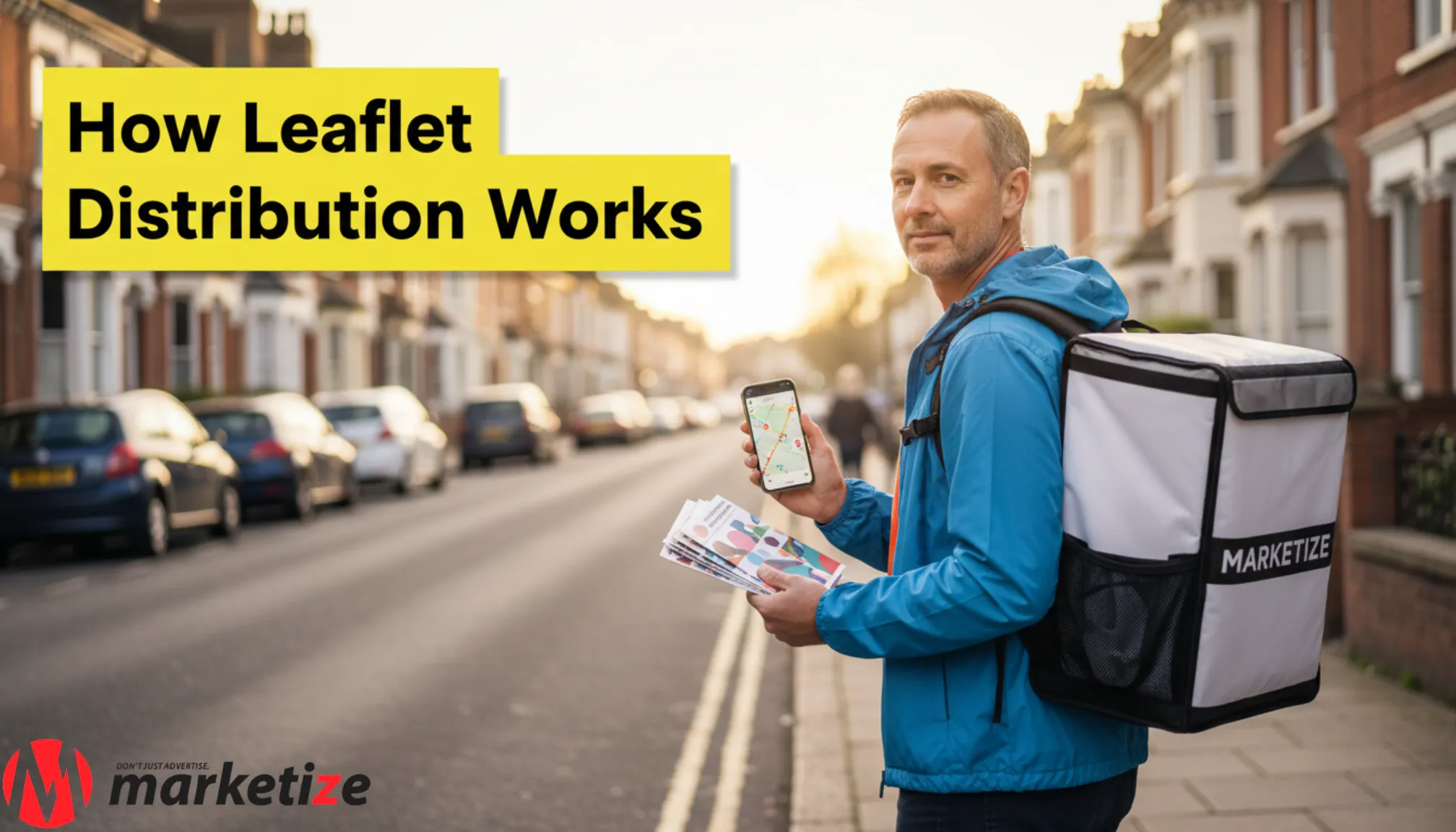
We have already covered the fact that leaflet distribution is one of the most effective ways for businesses to reach local audiences directly through their letterboxes in previous articles. However, if you're new to this channel, start with the leaflet distribution fundamentals because while delivering leaflets sounds simple, the actual process is structured, strategic, and supported by planning, mapping, and tracking technology.
Whether you're a business owner planning your first campaign or someone interested in how distributors work behind the scenes, this guide is meant to inform by breaking down the entire leaflet distribution process step-by-step.
1. Campaign Goal Setting & Briefing
Every leaflet distribution campaign starts with establishing clear goals:
For example - A new rental real estate agent company will want to find clients who are willing to allow them to rent their homes thus their focus will be on certain popular neighbourhoods/streets within their catchment area which would need to be leafletted regularly to reinforce their presence, increase awareness and trust.
If you are unsure of how and where your leaflet distribution should take place, the experienced distributor or flyer distribution company will generally be able to assist you if you provide the following details:
Common goals:
- Increase local awareness
- Promote a new service or product
- Drive foot traffic to a physical location
- Generate leads or website visits
- Support a time-sensitive promotion
What the client provides:
- Business background
- Campaign goal
- Desired general delivery area - ie Kennington, Ashford, Kent
- Quantity of leaflets
- Timeline
This information forms the campaign brief, which guides every stage that follows.
2. Audience & Area Selection
Once the goals are set, the distributor can help select the best geographic areas to target provided they have the tools, data and experience/expertise necessary to do so.
This stage often includes:
- Mapping postcodes, sectors, or neighbourhoods
- Estimating household counts - or in the case of platforms such as Marketize and some distribution companies - postcode sectors letterbox counts as well as map drawing letterbox counting tools
- Identifying demographic-relevant areas - this is again something that Marketize and some distribution companies may offer to help refine your campaign - for example - you may want to target an area of young families - using demographic data, you would be able to identify the postcode sectors with a majority of young families and thus focus your distribution there.
- Avoiding non-deliverable zones (business parks, non-residential areas, gated communities)
There are different types of distributors that use mapping software, letterbox counting tools, and demographic data to refine delivery routes but not all of them have the acumen necessary to acquire or use these tools. Which is where platforms like Marketize come in and simplify the process as well as put these tools at the service of all distributors and distribution agencies working through Marketize, free of charge.
All these little tweaks and tools are meant to maximize the return of your investment into leaflet distribution and ensure you get the most out of your campaign.
3. Scheduling & Delivery Planning
After the delivery area is chosen, the distributor schedules the campaign.
At this stage:
- A delivery week or delivery interval is requested
- Work is allocated to individual distributors or teams(depending on the structure of your chosen distributor)
- Routes are broken down into manageable sections - generally 1-3,000 leaflets per distributor to be carried out at a rate of approximately 1000 per day, depending on the household density of the distribution area.
- GPS tracking devices are prepared (if provided) - these are generally offline loggers which can be tampered with or live tracking expensive devices which are susceptible to losing connection and thus leading to blank spots in the tracking systems.
- Supervisors plan oversight checks or, in Marketize's case, have them embedded directly into the distribution route - through real time live GPS tracking via a mobile app and the possibility of taking timestamped and geostamped photos on their route which will be displayed as pop-up icons on the gps tracked map.
Planning is critical, particularly for Solus and even more so for Consultation distribution because the client expects timely, accurate coverage.
4. Leaflet Collection or Printing
Before delivery begins, the distributor must collect or receive the leaflets.
Options include:
- Client provides the printed leaflets
- Distributor handles printing for the client
- Leaflets are dropped off at a central depot
- Leaflets are collected directly by distributors
Leaflets are then:
- Counted - generally through the weighing method
- Bundled or batched in lots of 1000 for standard A6 - A4 leaflets generally
- Assigned to delivery rounds
Proper batching ensures accuracy and prevents shortfalls.
5. Distribution Team Briefing & Equipment Preparation
Distributors are briefed on:
- Delivery expectations
- Area boundaries
- Safety guidelines
- Whether it's solus, shared, or partially shared
- Use of GPS devices (if applicable)
- Oversight/back checking requirements (depending on provider)
They also receive:
- Leaflet bundles
- GPS tracker (or just an app in Marketize's case)
- Route map
- Any supervisor notes
This ensures everyone knows exactly what to deliver, when, and where.
6. On-Foot Delivery to Households
This is the most visible and critical part of the process, but there is more structure than first meets the eye.
The delivery process includes:
- Walking assigned streets in sequence - similar to how a postman does - covering one side of the road and then walking back the other side.
- Posting leaflets through accessible residential letterboxes
- Avoiding obvious "no-junk-mail" signs (depending on policy and local rules)
- Documenting obstacles or inaccessible properties
- Following the mapped route for consistent coverage
Professional distributors also avoid:
- Delivering to businesses unless specified
- Skipping difficult terrain
- Taking shortcuts that cause missed homes
This is where reliability matters and where professional distributors make the difference.
7. GPS Tracking, Auditing & Proof of Delivery
Modern leaflet distribution relies heavily on GPS tracking to provide reassurance, transparency and oversight.
GPS tracking typically shows:
- Route taken
- Time spent in each area
- Start & end times
- Confirmation that every targeted road was walked
- Delivery density and coverage patterns
Some companies that employ supervisors or team leaders also perform:
- Random spot checks
- Route audits
- Distribution quality reviews
Clients usually receive one or all of the below:
- A GPS tracking link
- A coverage map
- A completion summary
- Photos taken along the route
Proof of delivery is now a standard expectation for professional distributors who must be capable of demonstrating they carried the full distribution.
8. Campaign Completion & Reporting
Once all routes are completed and verified, the distributor produces the final campaign report.
A report typical includes:
- Confirmation of completion - this is done verbally or via email
- Proof of GPS data - can be done online or offline
- Notes from distributors or supervisors (if necessary)
- Any missed or inaccessible areas
- Recommendations for future campaigns
Optional metrics may include:
- Estimated reach
- Engagement suggestions
- Suggested repeat campaigns
This bring the distribution cycle full circle and provides transparency
9. Post-Campaign Follow-Up & Analysis
A well-run leaflet campaign doesn't end when the leaflets are delivered.
Post-campaign analysis may include:
- Response rate tracking
- Lead, call or website visits measuring
- Comparing results of each area vs past campaigns
- Calculating ROI
- Planning follow-up drops to reinforce the message - brand consistency
Leaflet distribution works best when it's consistent, not a one-and-done style campaign. Repeated exposure solidifies brand awareness and increases conversions.
Summary: How Leaflet Distribution Works
In conclusion, as highlighted in the article above, the leaflet delivery process involves far more than simply placing flyers through letterboxes.
The full workflow includes:
- Campaign goal setting
- Audience and area selection
- Route planning & scheduling
- Picking up or printing leaflets
- Distributor briefing
- On-foot delivery
- GPS tracking & auditing
- Final reporting
- Post-campaign analysis
This structured approach ensures that each campaign is targeted, accountable, and optimised for results making leaflet distribution one of the most reliable forms of direct marketing for local businesses provided it has all the necessary tools integrated. With platforms such as Marketize - these are made available to every single distributor, no matter how big or small their business is.
Thus enabling every single one of them to offer first class services with full safety, accountability and traceability.