18 March 2026 · 16 min read
How Leaflet Distribution Software Works: The Technology Behind Modern Distribution
Twenty years ago, leaflet distribution software didn't exist. The industry ran on phone calls, paper maps, handshake agreements, and trust. Lots of trust.
You'd ring a distributor, explain where you wanted coverage, agree a price, hand over your leaflets, and hope for the best. Maybe they delivered them. Maybe they didn't. You had no way of knowing.
Today, the entire process runs through software platforms that track every step, verify every delivery, manage every payment, and connect clients with distributors in real time. Rather than being a digitization of an old process, it actually is a fundamental change in the way leaflet distribution works.
In the process of planning or running a leaflet distribution business, the understanding of how this software works will help you and your clients avoid the pitfalls that people still get caught in.
What Leaflet Distribution Software Actually Is
Although the technology has been around for a while, the leaflet distribution industry has been one of the more stubborn adoptees of it - thus the drive behind creating the first such leaflet distribution software - Marketize, arose. It is meant to connect three things through a transparent system - businesses that need leaflets distributed, the distributors who deliver those leaflets, and verification technologies as well as payment protection for both parties.
It is an Uber-style marketplace but for leaflet distribution where businesses post jobs or browse available distributors. For the latter to see opportunities in their area or close by and quote for work. Once a job is accepted, the software manages everything with minimal input from the users - route planning(based on your selected area), live tracking, proof collection, payment processing, and dispute resolution if issues arise.
This software is a buffer between the client and distributor, providing access to infrastructure neither party needs to build/secure themselves with clients gaining access to verified distributors and accountability tools as well as safe payment and distributors gain access to clients, payment safety and an entire suite of systems and tools that make them much more competitive.
Platforms like Marketize were built by people who spent 44 years working in leaflet distribution and saw these problems firsthand. They knew what was broken and how technology could fix it.
The Core Components: What the Software Does
Leaflet distribution software handles several distinct functions. Some platforms focus on one or two; comprehensive ones integrate everything.
Job Posting and Matching
The process starts when a client needs distribution and define their requirements through the software: target area, quantity, distribution type (solus or shared), timing, and any special instructions.
The platform uses this information to match them with suitable distributors. Thus allowing clients to browse distributor profiles-seeing ratings, completion history, coverage areas, and pricing. Others work more like a tender system where distributors submit quotes and clients choose.
The software is set up to filter options based on location, capacity, availability, and track record. Instead of scrolling through every distributor in the UK-you're seeing the ones who can actually deliver in Croydon next Tuesday.
Campaign Planning Tools
Coverage planning is the first vital step prior to commencement of distribution. This is where letterbox counting and map-drawing tools come in.
Traditional planning involved guesswork: "I reckon there are about 5,000 homes in this area, so we'll need 5,000 leaflets." Often wrong, sometimes wildly so.
Modern leaflet distribution software integrates mapping data that shows exactly how many letterboxes exist in any drawn boundary. You trace your target area on a digital map, and the system counts deliverable addresses automatically. It excludes businesses, construction sites, and non-residential properties. The number you see is what you'll actually reach (accounting for the standard 5% undeliverable allowance due to "No Junk Mail" signs or inaccessible properties).
This precision prevents over-ordering leaflets you won't use or under-ordering and leaving gaps in coverage. It also allows accurate cost calculation before you commit.
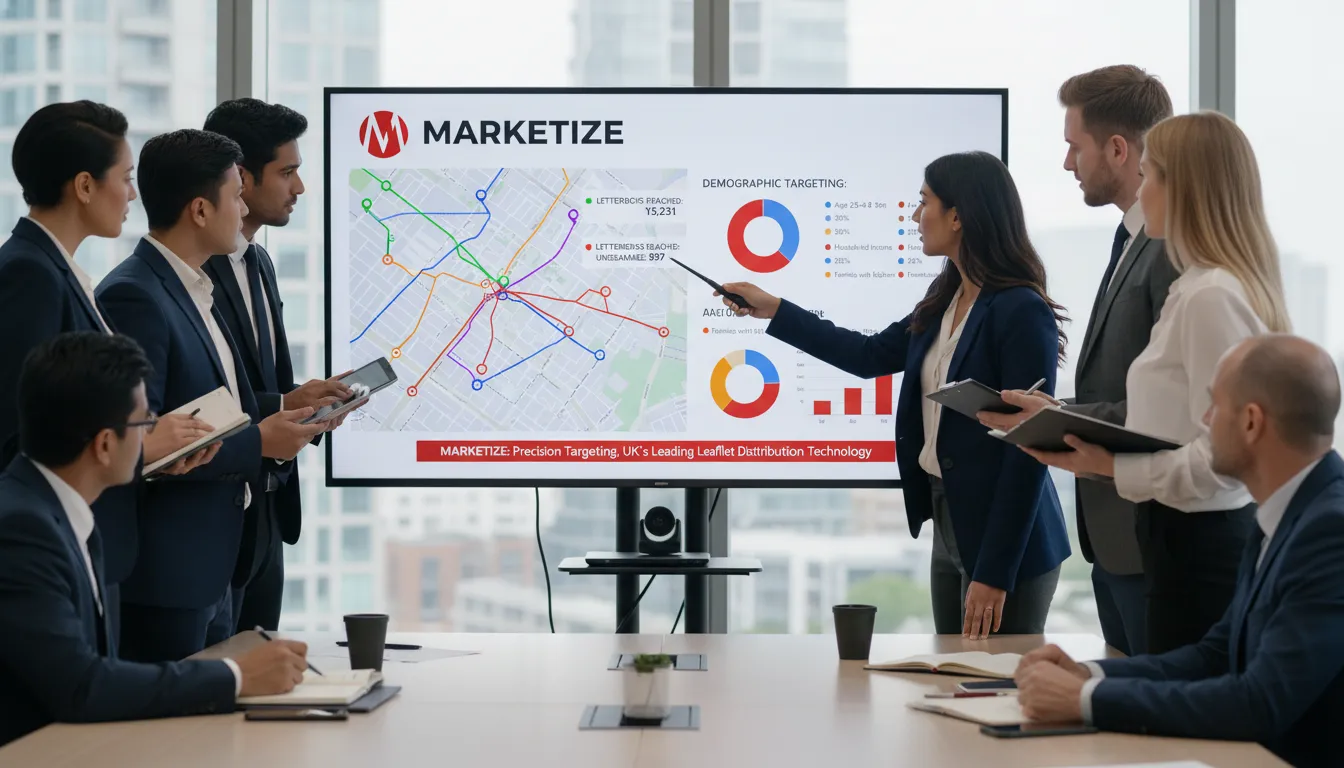
Some platforms, including Marketize, layer demographic data onto these maps. You can filter areas by household income, age demographics, property type, or family composition. Planning a campaign for premium services? Filter to show only areas with median income above £50k. The software highlights which postcodes match your criteria and tells you exactly how many homes that represents.
GPS Tracking Infrastructure
This is where leaflet distribution software gets technical-and powerful.
When a distributor starts a job, they open the app on their smartphone and press "Start Tracking". The software begins recording GPS coordinates continuously, typically every few seconds, creating a digital trail of everywhere they walk.
The technology stores this data locally on the phone if mobile signal is unavailable, then syncs it to the platform when connection returns. This matters more than it sounds. Rural areas, basements in urban buildings, and dense housing can create signal dead zones. Software that only records when signal is available produces gaps in the route map. Platforms like Marketize use offline storage specifically to eliminate these blank spots--you get a complete trail regardless of signal quality during distribution.
The GPS data gets processed and displayed as a route overlay on a map. Clients can watch distribution happen in real time if they want, or review the complete route afterwards. Either way, they see exactly which streets were covered, when, and how long the distributor spent in each area.
Photo Verification Systems
GPS shows where someone walked. It doesn't prove they posted leaflets.
That's why leaflet distribution software integrates photo verification. Distributors take timestamped, geo-stamped photos during distribution-typically every 50-100 letterboxes. These photos show either a leaflet going into a letterbox or the distributor holding leaflets at a recognizable location.
The software captures the GPS coordinates and exact time each photo was taken. On platforms like Marketize, these appear as clickable pins on the GPS map. Click a pin, see the photo taken at that location. It's visual proof layered directly onto location proof.
The system checks that photos are genuinely geotagged (not uploaded from a camera roll later) and that timestamps match the distribution timeframe. You can't fake this by taking 50 photos at home before leaving.
Letterbox Count Verification
This is where the real fun begins and the versatility of the software surfaces - The software knows how many letterboxes exist on every street in the coverage area. It can see which streets the distributor's GPS trail covered. So it calculates based on the route actually walked, how many letterboxes should have been reached?
If a distributor claims to have delivered 5,000 leaflets but their GPS route only covered streets containing 3,200 letterboxes, the math doesn't work. Either they skipped properties, or the reported quantity is wrong.
This cross-referencing happens automatically. Platforms like Marketize highlight discrepancies immediately, allowing clients or the platform itself to query completion before releasing payment.
Payment Processing and Escrow-like systems
Leaflet distribution software solves this with escrow-style payment protection. The client pays the platform upfront(unless otherwise agreed). The platform holds those funds securely via their payments partners - Stripe. Once the distributor completes the work and submits full proof (GPS trail and photos). Completion is verified automatically by the software. Only then does payment release to the distributor.
Traditional leaflet distribution ran on trust regarding payment too. Clients worried about paying upfront and not getting delivery. Distributors worried about completing work and not getting paid.
If there's a dispute—say the client reckons coverage was incomplete, or the distributor insists the instructions couldn't be followed—the platform steps in as neutral referee. It reviews the GPS data, photos, communication logs, and any other evidence, then makes a fair determination. Funds are released, partially released, or held pending resolution.
Trust doesn't come into it anymore. Both sides have protection: hard data and someone neutral calling the shots.
Communication Hubs
Through all of this, people still need to talk to each other. The software provides messaging systems, notification alerts, and documentation storage.
Clients message distributors directly through the platform—clarifying instructions, asking for updates, raising issues. Distributors flag problems as they happen: road closures they didn't expect, streets already saturated with competitor leaflets, houses with territorial dogs.
All these conversations stick to the job record. When disputes come up later, the platform can pull up exactly who said what and when. Everything is documented, timestamped, and stored.
How It Works From the Client's Perspective
Let's walk through an actual campaign using leaflet distribution software.
You log into the platform-Marketize, for example-and start planning. You use the map tools to draw your target area: a three-mile radius around your restaurant. The software instantly shows this covers 8,247 residential letterboxes.
You apply demographic filters: household income £30k+, exclude student areas. The count drops to 6,130. That's your actual target market. You decide on solus distribution to maximize impact.
You post the job: 6,200 leaflets (accounting for the standard 5% that won't be deliverable), solus letterbox distribution, done within five days. Upload a PDF of your leaflet so distributors see what they're handling.
A few hours pass. Three quotes come in: £372, £403, and £387. You check their profiles. The middle one has the strongest rating—4.9 stars across 127 jobs—plus the most experience in your specific area and the fastest turnaround times. You pick them.
Payment processes immediately. The £403 moves from your account to the platform's escrow, where it sits securely until completion is verified.
Two days later, you receive a notification: "Distribution has started". You open the app and see a live GPS dot moving through your target streets. Over the next six hours, you can watch the route build in real time if you're curious. Most clients don't-they check it once or twice, then review everything after completion.
That evening: "Distribution complete. Please review proof of delivery." You examine the GPS route. Every street you specified is covered. The trail shows logical, thorough movement through the area. You click through the 78 geotagged photos-all showing leaflets going into letterboxes, all timestamped correctly, all spread evenly across the route.
The software's automated verification has already confirmed the GPS route covered streets containing 6,214 letterboxes, closely matching the 6,200 leaflets distributed. Everything checks out.
You confirm completion. The £403 releases from escrow to the distributor's account. Done.
You've just run a fully verified, accountable leaflet campaign without a single phone call, face-to-face meeting, or moment of uncertainty about whether delivery actually happened.
How It Works From the Distributor's Perspective
Same campaign, different view.
You're a distributor registered on Marketize. You've set your coverage areas (South Manchester, where you live and work) and your standard rates. You've completed 127 jobs with strong ratings because you do the work properly and the GPS trail proves it every time.
A notification appears: new job available in your area. You review what's needed: 6,200 leaflets, solus distribution, five-day window, restaurant promotion. The coverage map shows streets you know—mostly residential, decent letterbox access, nothing tricky.
You work out your time: seven, maybe eight hours at your normal pace. Quote £403. That covers your hourly rate, travel time to collect the leaflets, and a bit extra for solus work. You submit the quote.
You're selected.The job shows up in your dashboard with everything: where to collect leaflets, coverage map, special instructions (none this time), deadline, payment sitting in escrow.
You grab the leaflets, chuck them in your trolley, head to the area. First street: open the Marketize app, press "Start Tracking". GPS starts logging your route.
You work through it methodically—every letterbox you can reach gets a leaflet. Every 80-odd letterboxes, you stop and snap a geotagged photo. Hand pushing a leaflet through a slot, or holding the stack somewhere recognizable. The app timestamps and geocodes each photo automatically.
Around 5% of properties display "No Junk Mail" signs or have no accessible letterbox (flats with broken entry systems, houses under renovation). You note these but don't force delivery--that's normal and expected.
After seven hours, you've covered every street. You press "Complete Distribution" in the app. The GPS trail uploads fully (it was syncing in the background, but this confirms final submission). The photos appear as pins on the route map. The platform's verification system cross-references your route against letterbox data and confirms coverage matches the reported quantity.
Within 24 hours, the client confirms completion. The £403 releases from escrow into your account. You can withdraw it immediately or let it accumulate across multiple jobs.
The job adds to your completion record, strengthening your profile for future work. The GPS trail and photos get archived permanently. If anyone ever questions it, the proof sits there.
You've just made £403 for a day's work. Payment was protected the second you started, and the proof means nobody can argue about whether you did the job.
The Technology Stack Behind It
Most people don't need to know what happens behind the scenes. But understanding the technical side explains why some platforms actually work while others fall over
Leaflet distribution software runs on several integrated systems:
Mapping APIs: Platforms pull data from services like Google Maps, OpenStreetMap, or Ordnance Survey to provide accurate UK street maps, calculate distances, and count properties. This is why you can draw a boundary and get an instant letterbox count-the software is querying against databases that already know every address in the UK.
GPS data processing: Raw GPS coordinates from phones get run through algorithms that clean up the mess—stripping out obvious errors, smoothing the route where signal bounce created jitter, working out actual useful numbers like distance, speed, time spent in each area. All of this happens on the server after upload.
Image metadata extraction: When distributors upload photos, the software pulls the EXIF data baked into the image file. This contains GPS coordinates, timestamp, device information, and sometimes even compass heading.If that data's missing or doesn't match where they claim to have been, the photo gets flagged.
Payment gateway integration: Escrow-style functionality means plugging into payment processors—Stripe, GoCardless, or proper escrow services. Funds move from client to platform account (escrow), then from platform account to distributor account upon verified completion.
Demographic databases: The targeting tools pull from census data, consumer databases, and property registries to overlay demographic information onto maps. This data gets updated periodically as new census results or market research becomes available.
Platforms like Marketize bundle all of this into interfaces designed for non-technical users. You don't see APIs or EXIF metadata-you see a map, a route, and photos. But that simplicity rests on sophisticated technical infrastructure running behind the scenes.
What the Software Can't Do
For all its power, leaflet distribution software has limitations worth understanding.
It can't force someone to read your leaflet. It proves delivery to the letterbox, not engagement with content. If your campaign underperforms despite verified distribution, the issue is with your offer, design, targeting, or timing-not the distribution.
It can't override the standard 5% undeliverable properties. Some homes will always be inaccessible due to "No Junk Mail" signs, broken letterboxes, construction, or temporary vacancy. Software can't change physical reality.
It can't make hand-to-hand distribution as verifiable as letterbox distribution. When someone stands on a busy high street handing out leaflets, GPS shows they were there, but it can't prove exactly how many leaflets they handed out or whether pedestrians accepted them. The verification is presence-based, not delivery-based.
It can't eliminate all disputes, though it reduces them dramatically. Occasionally, GPS data is ambiguous, photos are unclear, or client expectations were unrealistic. The software provides evidence for resolution, but human judgment still applies in edge cases.
Why This Software Matters
Moving from trust-based distribution to software-verified distribution changed everything about how this industry works - the economics, the professionalism, all of it.
Honest distributors can finally prove they did the work and charge what it's worth. Before, they competed with con artists on price because clients had no way to tell them apart. Now the software shows verified track records. Professionals stand out. Chancers get exposed.
Clients can put money into leaflet campaigns knowing they'll actually get what they're paying for. Before, the uncertainty around delivery made the whole thing feel dodgy. Now, the risk is in your creative execution and targeting, not whether distribution actually happened.
The industry as a whole attracts better people and more serious businesses because professional standards are enforceable. You can't dump leaflets and claim completion-the GPS trail gives you away immediately. This raises the floor of acceptable performance.
And it's accessible to businesses of all sizes. Small companies running 500-leaflet campaigns get the same verification tools as national brands distributing 100,000. The software democratizes accountability.
Choosing Software That Actually Works
Not all leaflet distribution platforms are created equal.Some platforms obsess over client-facing features but give distributors rubbish tools. Others build everything for distributors and make client verification a nightmare.
You want platforms that actually balance both. Distributors need offline GPS storage, simple photo uploads, clear job specs, payment protection. Clients need intuitive planning tools, real-time visibility, comprehensive proof archives, and dispute resolution. If either side has a poor experience, the system breaks down.
Free tools matter more than you'd think. Some platforms charge distributors subscription fees or take large commission cuts. This pushes costs up for clients and squeezes distributors, making the marketplace less competitive. Marketize provides all tools free to distributors and agencies specifically to keep costs down and participation high.
Third-party dispute resolution is essential. Software that lets clients and distributors argue directly rarely reaches fair outcomes-one party has more leverage or better negotiation skills. Platforms that review evidence neutrally and make binding determinations solve disputes faster and more fairly.
Educational resources separate platforms that want transactions from platforms that want successful campaigns. If a platform provides guides, articles, and planning advice alongside its software tools, it's invested in outcomes, not just volume.
For more detail on campaign planning and verification, Marketize's website offers comprehensive guides built from decades of industry experience. The software is the infrastructure. The knowledge is what makes it work.
The evolution from phone calls and paper maps to GPS tracking and automated verification happened remarkably fast. Ten years ago, none of this existed in leaflet distribution. Today, it's standard practice.
The software doesn't just make distribution easier-it makes it measurable, accountable, and professional. That changes who participates, how campaigns are planned, and what results you can expect.
Understanding how the technology works helps you use it effectively, whether you're distributing leaflets or running campaigns. The black box is open now. The data is there. The accountability is real.