4 May 2026 · 16 min read
How to Avoid Leaflet Theft and False Delivery Claims: Protection for Distributors and Agencies
Claims: Protection for Distributors and Agencies
For decades, leaflet distribution operated on trust. Distributors collected leaflets Monday, claimed they'd delivered them by Friday, got paid. No proof required, no verification possible.
This created two problems.
Dishonest distributors could bin entire campaigns and pocket payment. Businesses lost thousands paying for distribution that never happened.
But honest distributors faced the opposite problem: false accusations. Complete a job properly, hand back undeliverable leaflets from properties with "No Junk Mail" signs (the standard 5% allowance), then get accused of theft because the client expected 100% delivery of their 5,000 leaflets and only 4,750 were distributed.
Both scenarios — actual theft and false accusations — damaged the industry. Businesses couldn't trust distributors. Distributors couldn't prove they'd done honest work.
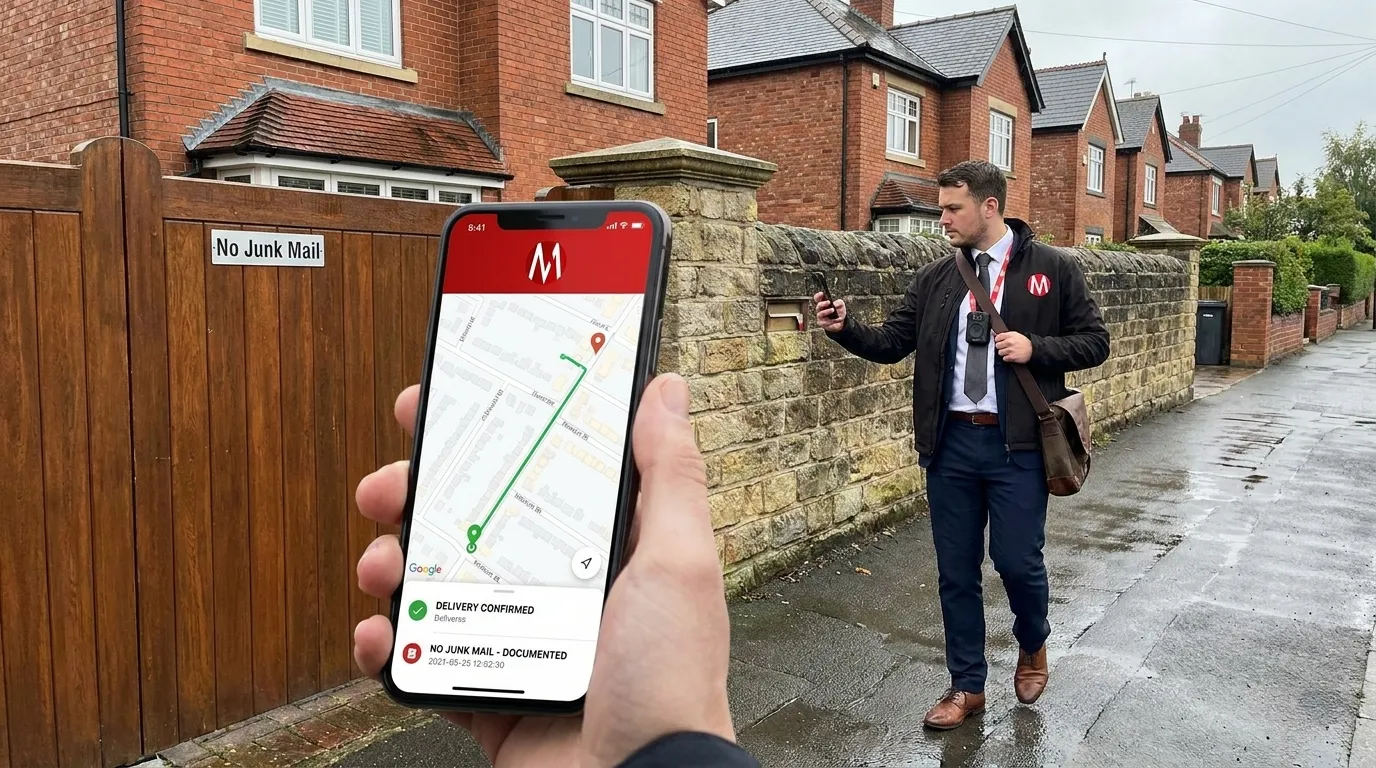
GPS proof of delivery, geotagged photos, and letterbox count cross-referencing make actual theft essentially impossible while protecting honest distributors from baseless accusations. This is part of the broader transformation covered in technology in leaflet distribution — tools that were once unavailable now make the truth automatic, objective, and permanent.
How to avoid leaflet theft and false delivery claims isn't about assuming everyone's dishonest — it's about building systems where the truth is visible, leaflet distribution proof is automatic, and both parties are protected. This article sits within the operations and distributor management framework, alongside the full guide on how to manage leaflet distributors — which covers hiring, onboarding, and performance tracking systems that prevent problems before they reach the verification stage.
Here's how it works from both perspectives: agencies preventing fraud, and distributors protecting themselves from false accusations.
What Leaflet Theft Actually Looks Like
Understanding the problem helps you recognise why leaflet distribution tracking matters. For a comprehensive guide to every fraud tactic and the exact technology that catches each one, how to prevent dishonest leaflet distributors covers the full picture. Here's the operational summary:
Complete Non-Delivery (The Bin Job)
The classic scam: collect 5,000 leaflets, drive to an industrial estate, dump everything in a skip, claim completion, request payment. Before GPS proof of delivery became standard, this was shockingly common. No proof meant no way to verify whether distribution happened at all. Some distributors built entire operations around this — collecting multiple jobs per day, binning them all, processing payments faster than clients could figure out they'd been scammed.
Partial Delivery
More sophisticated: deliver to easy residential streets with good letterbox access, skip flats with entry systems or areas requiring parking and walking, claim complete coverage. They've done maybe 60% of the work but charge for 100%. Without leaflet distribution proof, clients never know which streets got missed.
Selective Property Skipping
Even subtler: walk the complete route but deliberately skip properties that slow them down. Houses requiring long driveway walks, flats behind security doors, anywhere inconvenient. The route looks complete on basic tracking, but they've only delivered to 70–80% of properties rather than the expected 95%. This is exactly what advanced route tracking for leaflet delivery is designed to catch — letterbox count cross-referencing reveals the gap between streets walked and properties actually reached.
Speed Rushing for Multiple Jobs
Accept three campaigns scheduled for the same day, rush through each in half the proper time by shoving leaflets halfway into letterboxes or leaving them in communal hallways rather than delivering to individual flats. Technically the leaflets went to the area, but quality is so poor most get binned before anyone reads them.
What False Accusations Look Like
Honest distributors face different problems: being blamed for theft they didn't commit.
Unrealistic Expectations About the 5% Allowance
A client orders 5,000 leaflets for an area. The distributor delivers to 4,750 properties and returns 250 undeliverables — properties with "No Junk Mail" signs, broken entry systems they genuinely couldn't access, one house with an aggressive dog. The client sees 250 returned leaflets and accuses them of theft. But 5% undeliverable is normal in every area. The distributor did honest work and returned leaflets they couldn't legitimately deliver rather than dumping them.
Using letterbox counting tools before a job starts solves this entirely — clients see upfront that their area contains 4,950 deliverable letterboxes (5% allowance built in), so 4,750 delivered is verifiably complete coverage, not suspicious shortfall.
Misunderstanding Geographic Coverage
Client specifies "all of SW19 postcode." Distributor delivers to residential streets but excludes the commercial district (shops and offices where letterbox distribution doesn't apply) and a gated private estate they couldn't access. Client accuses them of incomplete delivery because their coverage map looks patchy. The distributor delivered everywhere deliverable but can't prove which areas were legitimately excluded — without real time delivery tracking data and photo documentation.
Timing Mismatches Creating Suspicion
Distributor completes a 5,000-leaflet job in five hours. Industry benchmarks suggest 150–200 letterboxes per hour in high-density urban areas, so 5,000 in five hours seems realistic for good conditions. But the client sees five hours and thinks "that's too fast, they must have rushed." Without leaflet distribution tracking showing they genuinely worked efficiently in a dense area with excellent access, the distributor can't prove they did thorough work quickly.
Payment Withholding Based on Suspicion
Worst scenario: distributor completes legitimate work, client suspects (without evidence) that it wasn't done properly, refuses payment. Without GPS trails, photos, and letterbox count verification, it devolves into the distributor's word against the client's suspicion. GPS tracked leaflet delivery eliminates this entirely — payment releases based on verifiable data, not disputed memory.
GPS Tracking: The Foundation of Verification
Real time delivery tracking with offline data storage prevents both theft and false accusations by creating an objective record of exactly where distributors went. For a detailed explanation of what GPS data captures — coordinates, timestamps, route patterns, signal gap handling — what is GPS tracked leaflet delivery covers every element.
How It Protects Agencies from Theft
- Complete non-delivery becomes impossible. If someone bins leaflets and claims completion, GPS shows they never visited the distribution area. The trail is either blank or shows them driving to an industrial estate and back.
- Partial delivery gets caught. Letterbox counting tools show how many deliverable properties exist on each street. If the GPS trail only covers streets containing 3,500 letterboxes but they claimed 5,000 delivery, the numbers expose the gap.
- Suspicious speed gets flagged. Someone claiming six hours of work with a GPS trail showing two hours of movement warrants investigation. Either the tracking malfunctioned (rare with offline storage) or they rushed through inadequately.
How It Protects Distributors from False Accusations
- Proves you went where you claimed. Your GPS trail shows you covered every street in the specified area. Client can't claim you skipped entire sections when the data proves otherwise.
- Timestamps show realistic completion times. Five hours covering 5,000 high-density letterboxes with your trail showing continuous movement proves you worked steadily, not suspiciously fast.
- Demonstrates effort on difficult areas. GPS shows you spent 30 minutes attempting to access a gated estate before moving on, proving you tried rather than just skipping it.
Platforms like Marketize use GPS tracking with offline data storage specifically because it eliminates the "no signal in that area" excuse while protecting both parties with objective location proof. To see how this fits into the full leaflet distribution system — from job assignment to payment release — that guide walks through every step.
Photo Verification: Visual Proof of Delivery
GPS shows where you went. Photos prove you carried leaflets and delivered them. Together, they form complete leaflet distribution proof that neither party can reasonably dispute.
What Proper Photo Verification Looks Like
- Geotagged and timestamped automatically. Every photo embeds GPS coordinates and timestamp into the image metadata. This data is nearly impossible to fake convincingly.
- Spread evenly throughout the route. Photos taken every 500–1,000 leaflets show continuous progress rather than batch photography before starting distribution.
- Show recognisable locations. Street signs, house numbers, distinctive buildings prove photos were taken where GPS data says they were.
- Ideally include leaflets being delivered. Photos showing leaflets in your hand approaching letterboxes or actually being posted provide the strongest proof.
How It Prevents Fraud
- Catches photo fraud immediately. Someone taking 50 photos at home before distributing gets exposed when photo geotags show all images came from the same location despite GPS trail claiming they covered multiple streets.
- Prevents empty-handed route walking. Walking the route without leaflets to generate GPS trails doesn't work when photos must show actual leaflet delivery.
- Creates audit trail for disputes. When clients question coverage, photos provide visual evidence: "Here's a photo from Oak Street at 2:15pm, here's one from Maple Drive at 2:40pm, here's one from Birch Road at 3:05pm."
How It Protects Distributors
- Proves you carried leaflets throughout. Photos showing leaflets in multiple locations throughout your route prove you didn't deliver half then bin the rest.
- Demonstrates access attempts. Photo of an entry system with "Unable to Access" note in your records shows you tried, didn't just skip difficult properties.
- Provides defence against false speed claims. Photos spread across five hours with visible progress prove you worked the claimed duration, not rushed through in two hours.
Platforms that display photos as clickable pins on GPS maps — like Marketize does — make verification visual and immediate. For a comparison of which leaflet delivery tracking apps provide the strongest photo verification integration, that guide gives an honest breakdown of what each platform actually delivers.
Letterbox Count Cross-Referencing: The Maths That Catches Fraud
This is sophisticated verification most people don't know exists — and it catches fraud that GPS and photos alone might miss. Letterbox counting tools are the backbone of this layer, giving both agencies and distributors an objective, data-driven baseline before any job starts.
How It Works
The platform knows exactly how many deliverable letterboxes exist on every street in the coverage area, based on Royal Mail Postcode Address File data and property databases. When you upload your GPS trail, the system calculates which streets you actually walked and how many letterboxes those streets contain.
If you claimed 5,000 delivery but your route only covered streets containing 3,500 letterboxes (accounting for the 5% allowance), the maths exposes the discrepancy immediately. Not sure how many leaflets you should be ordering for an area in the first place? How Many Leaflets Do I Need? works through the calculation so you go into every job with the right baseline.
Why It Matters for Fraud Prevention
- Catches selective street skipping that GPS alone wouldn't reveal. Your trail might cover the geographic area, but if you walked main roads and skipped side streets, letterbox counting reveals you missed hundreds of properties.
- Validates legitimate 5% undeliverable allowances. The system knows an area contains 5,000 deliverable letterboxes. You deliver to 4,750 and return 250 undeliverables. The maths confirms this is the expected allowance, protecting you from false theft accusations.
- Identifies areas genuinely undeliverable. Gated estate with 200 properties you couldn't access? The system can document those letterboxes as legitimately inaccessible based on your GPS showing access attempts.
Escrow-Style Payment Protection: Fair for Everyone
Payment structures that protect both parties eliminate the worst disputes. Before setting payment terms, the UK leaflet distribution prices guide for 2026 gives you reliable market benchmarks for what both agencies and distributors should expect to pay and receive.
How It Protects Agencies
- Don't pay for undelivered work. Funds release only after GPS, photos, and letterbox count verification confirm completion. No more paying someone who binned your campaign.
- Partial payment for partial work. If someone completes 3,000 of 5,000 leaflets then can't finish, verification shows exactly what got delivered. Pay proportionally rather than arguing about it.
- Dispute resolution with evidence. When disagreements arise, neutral third-party review of GPS data, photos, and letterbox counts makes fair determinations based on facts.
How It Protects Distributors
- Payment is secured before you start. Escrow systems hold client payment from the moment they post the job. You know the money exists and is waiting for you upon verified completion.
- Can't be refused payment for legitimate work. If you complete the job properly with full verification, payment must release. Client can't withhold payment based on suspicion or change their mind.
- Fair resolution when disputes arise. Platforms like Marketize review evidence objectively and make binding determinations. You're not arguing with the client directly, which often becomes heated and unfair.
- Protects you from clients who can't pay. Escrow means money was verified and held before you lifted a single leaflet. No risk of completing work then discovering the client has no funds.
Best Practices for Distributors: Protect Yourself
If you're the one actually delivering leaflets, these practices prevent false accusations. Whether you found work through leaflet distribution jobs near you, student leaflet distribution opportunities in 2026, or leaflet distribution jobs for over 60s — the verification standards are the same regardless of how you came to the role.
- Start GPS tracking before leaving home. Don't forget to activate it, and keep the app open during distribution. Offline storage syncs data when signal returns, so poor coverage isn't an excuse.
- Take photos generously. Minimum one photo per 500–1,000 leaflets, but taking more (every 300–400) provides even stronger proof. Show street signs, house numbers, leaflets in hand.
- Document access issues immediately. Gated estate you can't enter? Take a photo of the gate and entry system, note the time, move on. This proves you attempted access rather than skipping it.
- Return genuinely undeliverable leaflets. Don't dump leaflets from "No Junk Mail" properties. The 5% allowance is standard and expected — returning these leaflets proves honesty.
- Communicate problems during distribution. Discover an entire street is inaccessible due to road closure? Message the client immediately with photo evidence. Don't just skip it and hope they won't notice.
- Review verification before submitting. Check your GPS trail looks complete, photos uploaded properly, timing seems reasonable. Submit clean verification that answers questions before they're asked.
- Keep records of completion. Screenshot your GPS trail and photo uploads before submitting. If disputes arise later, you have your own backup evidence.
For a full guide on what agencies look for when hiring and what professional distribution standards involve, becoming a leaflet distributor in 2026 covers the complete picture from signup through to your first verified completed job.
Best Practices for Agencies: Prevent Fraud Without Assuming Dishonesty
If you're running a distribution business, these systems prevent fraud while treating honest distributors fairly. The full operational framework — including hiring standards, onboarding, performance tiers, and payment structures — is covered in how to manage leaflet distributors. Here's the verification-specific layer:
- Make verification requirements clear from hiring. Explain GPS tracking, photo requirements, and letterbox count cross-referencing during onboarding. Distributors who resist verification are waving red flags.
- Provide the tools distributors need. Ensure they understand how GPS apps work, when to take photos, what counts as proper verification. Training prevents problems that look like fraud but are actually confusion.
- Review verification promptly. Don't leave distributors waiting days to get paid while you eventually check their GPS trail. Review within 24–48 hours and release payment for verified work.
- Set realistic expectations about the 5% allowance. Explain to clients that 4,750 of 5,000 delivered is normal, not theft. Educate them about "No Junk Mail" signs and inaccessible properties being factored into planning.
- Use letterbox counting before jobs start. Show clients that their specified area contains 4,950 deliverable letterboxes (5% allowance included). When the distributor delivers to 4,950, no one's surprised. This is one of the primary reasons letterbox counting tools prevent disputes before they start — both parties agree on the number upfront.
- Handle disputes fairly. When questions arise, review GPS data, photos, and letterbox counts objectively. Don't automatically side with paying clients over distributors — evidence determines outcomes.
- Build distributor reputation systems. Track completion rates, verification quality, and client feedback. Tier 1 proven distributors get premium jobs and trust. Tier 3 probationary distributors get small test jobs with close monitoring.
- Ban fraudsters permanently. When verification clearly shows dishonesty — GPS proves they never went to the area, photos are demonstrably faked, letterbox counts expose massive gaps — remove them immediately and share evidence with other agencies through platform systems.
Why Proper Systems Benefit Everyone
The honest truth? Comprehensive verification systems make life better for everyone involved. This is central to the argument for leaflet distribution in 2026 as a viable, measurable marketing channel — the accountability problem that always muddied attribution has been solved.
- Honest distributors love verification because it proves they did the work properly. No more arguing with suspicious clients, no more payment withheld based on hunches, no more being lumped together with dishonest distributors who damage the industry's reputation.
- Professional agencies love verification because it eliminates the constant worry about whether campaigns actually happened. They can promise clients verified delivery and actually deliver on that promise.
- Clients love verification because they know they're getting what they paid for. GPS trails, photos, and letterbox count confirmation turn leaflet distribution from an act of faith into a documented, verifiable marketing channel.
- Fraudsters hate verification because it makes theft unprofitable. To generate acceptable GPS trails, photos, and letterbox counts, they'd have to actually do the work — at which point scamming becomes pointless.
The technology exists now. GPS tracking with offline storage, geotagged photo verification, letterbox count cross-referencing, escrow payment protection, and neutral dispute resolution are standard features on platforms like Marketize. And where is all this heading? The future of technology in leaflet distribution points toward AI-powered photo analysis, real-time anomaly detection, and automated quality scoring — making honest work even easier to prove and fraudulent work even harder to conceal.
The question isn't whether these systems work — they demonstrably do. The question is whether you're using them to protect yourself, or still operating on trust and hope. For context on how leaflet distribution software handles all of this — from GPS data storage to photo metadata verification to escrow payment processing — that guide explains the technical architecture in plain English.
The Truth Is Now Visible
GPS proof of delivery shows where you actually went, photos prove you carried and delivered leaflets, route tracking for leaflet delivery validates coverage matches claimed quantities, escrow payment protects both parties, and dispute resolution uses evidence rather than suspicion.
These systems don't assume everyone's dishonest — they create environments where honest work gets rewarded, dishonest work gets caught, and false accusations get disproven with data rather than arguments.
For clients planning campaigns, how to plan a successful leaflet campaign covers how to build verification requirements into every campaign from the outset — so you're never in the position of having to dispute delivery after the fact.
For detailed guidance on distributor management, payment systems, and building verification into your operations, Marketize's website offers resources built from decades of industry experience. The fundamentals of leaflet distribution have been transformed by verification technology — what was once a trust-based industry is now an accountable, measurable one. Use the systems available.