17 September 2026 · 11 min read
Consultation Distribution vs Standard Door Drop: Key Differences
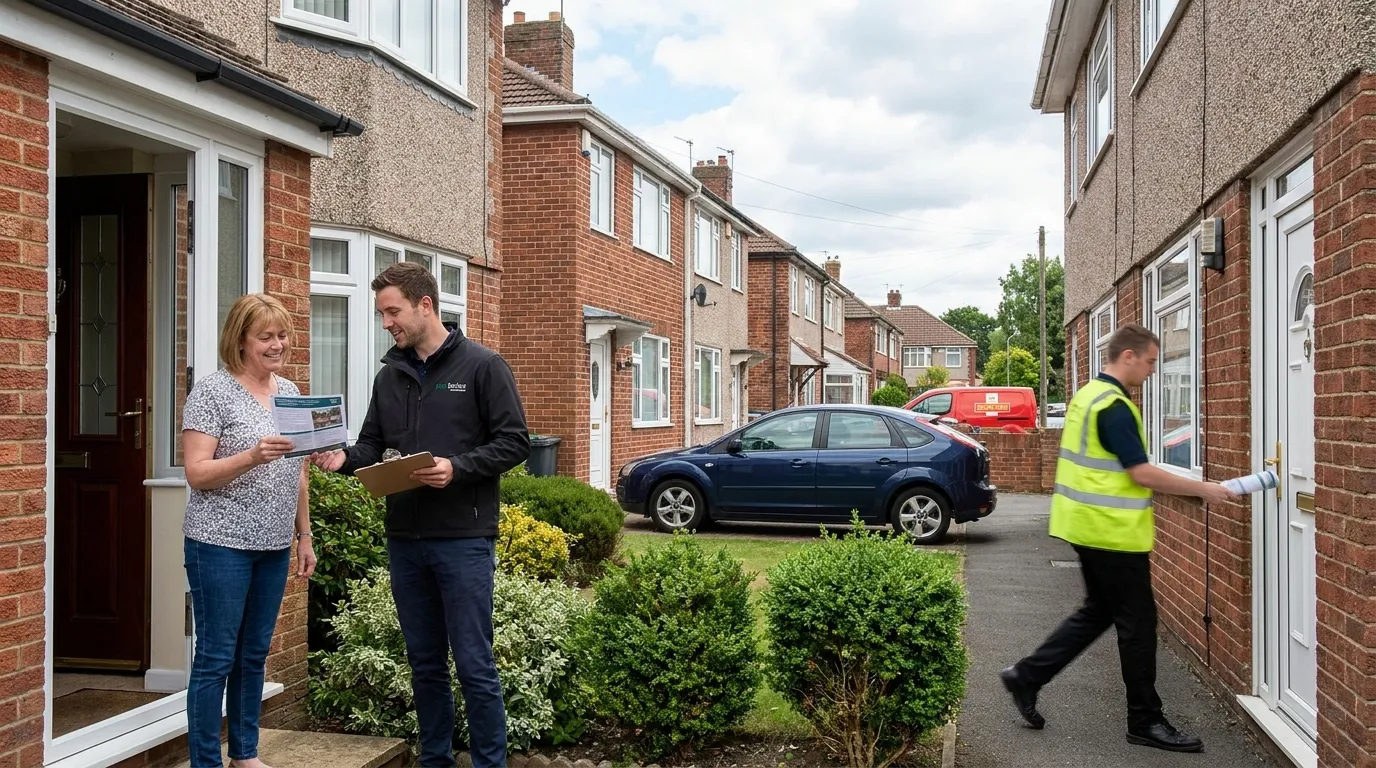
On the surface, they look like the same job. A distributor picks up material, walks residential streets, and posts items through letterboxes. The physical act is identical. But consultation leaflet distribution and commercial door drop campaigns are different services with different standards, different documentation requirements, different effort thresholds, and different consequences when things go wrong.
Most distribution companies can run commercial door drops. Fewer can run consultation distributions to the standard they actually require. And the gap between the two - in terms of what's delivered, what's documented, and what the client receives at the end - is significant enough that confusing them, or commissioning one when you need the other, creates real problems.
This article covers the differences systematically: what each type of campaign is for, how they differ in practice, and why the distinctions matter whether you're commissioning the work or running it. It's the fourth article in the consultation and civic distribution series, which covers the full range of requirements for what consultation distribution is, its legal and procedural framework, and non-delivery documentation standards.
Purpose and Context
The first and most fundamental difference is why each type of distribution happens.
A commercial door drop is a marketing exercise. Its purpose is to generate response - to put your offer, your business, or your message in front of potential customers and move a proportion of them toward a commercial action. The success metric is response rate. The accountability standard is whether the job was done thoroughly enough to produce meaningful results.
Consultation distribution is a notification exercise. Its purpose is to ensure that every property within a defined area receives specific information - typically about a planning application, proposed development, civic change, or public engagement process - so that residents and stakeholders have the opportunity to respond if they wish. The success metric is coverage: did every property in the defined zone receive the material? The accountability standard is evidential: can you demonstrate that the process was conducted properly, with specific records for any property that wasn't reached?
This difference in purpose cascades through every other aspect of how the two campaign types work.
Coverage Standards
In a commercial door drop, a non-delivery rate of five to ten percent is normal and expected. Properties displaying "No Junk Mail" signs, genuinely inaccessible addresses, and gated properties account for a predictable proportion of any residential area. Campaigns are planned and priced around this allowance. The client knows that 9,000 to 9,500 of a 10,000-leaflet campaign will typically reach letterboxes, and they factor this into their response rate expectations. The full breakdown of how non-delivery allowances work in commercial campaigns - and the verification standard for each category - is covered in how to avoid leaflet theft and false delivery claims.
Consultation distribution operates to a different coverage standard. Every address in the notification zone must be attempted. "Attempted" means a genuine, reasonable effort to deliver - not a drive-by assessment that the property looks difficult to access. Where a commercial distributor might pass a gated property with a note in their records, a consultation distributor is expected to try the intercom, look for a post box or communal letterbox facility, and only record the property as undeliverable after exhausting reasonable options.
"No Junk Mail" signs, which legitimately justify non-delivery in commercial campaigns, are generally not a valid reason for non-delivery in consultation work. The material being distributed is not commercial solicitation - it's a notification about something that may directly affect the recipient's property, neighbourhood, or local environment. The resident's right to be informed takes precedence over their preference not to receive commercial material.
This higher coverage standard has direct implications for how campaigns are staffed, how long they take, and how they're priced. Before either type of campaign starts, letterbox counting tools that cross-reference the target boundary against deliverable address data produce an accurate household total - the starting point for both quantity planning and non-delivery rate monitoring.
Effort at Each Property
The effort expected at each property is more demanding in consultation leaflet distribution than in commercial campaigns.
For a commercial door drop, a reasonable approach to a difficult property is brief. A gated front entrance with no accessible letterbox gets a quick assessment, a non-delivery note, and the distributor moves on. The economics of commercial distribution - and the reality that full delivery to every single property in a campaign area isn't the expectation - make this appropriate.
For consultation distribution, the effort threshold is higher at every type of difficult property. If there's an intercom, it should be used. If there's a concierge or reception desk, approach them. If there's a communal letter facility that wasn't immediately obvious - a bank of letterboxes inside an accessible lobby, a post room - find it before recording the property as undeliverable.
This additional effort adds time per property that has no equivalent in commercial distribution. It needs to be factored into scheduling, workload planning, and pricing. The capacity figures for standard commercial suburban delivery - typically 600 to 800 letterboxes per day - reduce meaningfully for consultation work in the same area type due to the higher effort threshold and real-time documentation requirement. The full capacity breakdown by area type is covered in how many letterboxes a distributor can realistically deliver in a day. Briefing distributors to understand the consultation-specific standards before they start is covered in how to manage leaflet distributors.
Documentation Standards
The documentation produced by commercial and consultation distributions serves different purposes and must meet different standards.
A commercial completion report demonstrates that distribution happened: here's the GPS coverage, here's the delivery count, here are photographs from the route. The report supports the claim that the campaign was executed and provides context for response rate analysis. It's primarily a client-facing document that closes the campaign cycle. The full breakdown of what a well-structured commercial completion report should contain is covered in how to read a leaflet distribution completion report.
A consultation completion report is a formal process document. It may be submitted to a local planning authority as part of a planning application's supporting information. It may be included in a Statement of Community Involvement. It may need to withstand scrutiny if the consultation process is challenged by objectors or their legal representatives.
This means the documentation needs to contain specific elements that commercial reports don't typically prioritise:
- Address-specific non-delivery records. Every property not reached must be individually identified with a specific reason. An aggregate non-delivery percentage isn't adequate; a list of specific addresses with specific documented reasons is. The non-delivery documentation standard in full is covered in the consultation non-delivery documentation guide.
- Embedded timestamps. Generated automatically at the point of recording, not added retrospectively. A timestamp embedded at the property has evidential weight that a manually compiled list doesn't.
- Geotagged photographs of access barriers. For properties where the reason for non-delivery is a physical obstruction, a photograph taken at the address adds significant weight to the record. For the technical explanation of how platform-generated GPS data, timestamps, and photo metadata interconnect, what is GPS tracked leaflet delivery covers every element.
- Street-level GPS coverage. Confirming which specific streets within the notification zone were walked, at a resolution sufficient to verify coverage of the defined area. The analytical framework that uses pace data alongside GPS trail to confirm delivery - not just route walking - is covered in GPS tracking for campaign analysis.
Pricing Differences
Consultation distribution costs more than commercial door drop campaigns of equivalent geographic scope. Not arbitrarily - for specific reasons that reflect the additional work involved.
Higher effort per property increases time per thousand delivered. Where a commercial distributor might achieve 700 to 800 letterboxes per day in standard suburban conditions, consultation distribution - with the additional effort at difficult properties and the real-time documentation requirement - typically produces a lower daily delivery count for the same area type. That reduced throughput increases the cost per thousand.
Real-time non-delivery logging takes time. Each non-deliverable property requires the distributor to stop, record the address, enter the reason, potentially photograph the access barrier, and ensure the record is captured before moving on. Post-distribution documentation assembly is also more involved, with address-level records organised for formal submission rather than summarised into a commercial completion report.
For clients comparing consultation distribution quotes against commercial door drop quotes for the same area, the price differential can look like a premium. It's actually a reflection of genuine additional work. Any consultation distribution quote that matches or comes close to commercial door drop pricing for the same area probably isn't planning to deliver to the consultation standard. The cost component breakdown - labour, overhead, and what each one implies about delivery completeness - is covered in what leaflet distribution actually costs.
Consequences When Things Go Wrong
The consequences of inadequate delivery diverge significantly between commercial and consultation campaigns.
For a commercial campaign, the consequence of inadequate delivery is a disappointing response rate and a wasted budget. Real costs, but bounded ones. The client may not repeat with the same company. The campaign may be judged unsuccessful. But the damage is financial and reputational rather than procedural.
For a consultation campaign, the consequences of inadequate delivery - or inadequate documentation of what was delivered - can be procedural and legal. A planning application where the consultation process was found to be deficient may face challenge. Objectors' representatives may argue that residents weren't properly notified, that the coverage was incomplete, or that the documentation doesn't demonstrate adequate consultation. A planning appeal or legal challenge that hinges partly on whether consultation was properly conducted can create significant delay and cost.
These aren't theoretical risks. Planning processes are contested with some regularity, and the adequacy of community notification is one of the areas that gets examined when applications are challenged. A well-documented, GPS-verified consultation distribution record is the defence against these challenges. An undocumented or inadequately documented one is a vulnerability.
What Each Type of Campaign Requires From a Distribution Partner
The operational requirements for consultation distribution mean that not every commercial distribution company is equipped to run them - even those with otherwise professional operations.
For a commercial door drop, you need a distributor who covers the agreed area thoroughly, maintains GPS records, and produces a completion report. These are the baseline standards of professional commercial distribution.
For consultation distribution, you additionally need:
- A platform that logs non-deliveries in real time with embedded timestamps and location data - not a process that relies on manual log compilation after the fact.
- GPS tracking with offline storage, so coverage records don't have gaps in areas with poor mobile signal. This matters more for consultation campaigns because any gap in the GPS record creates a question about whether those streets were actually covered. The technology that eliminates this - offline-first GPS that syncs when connection returns - is covered in the technology behind modern leaflet distribution.
- Geotagged photography capability, with photographs appearing on the GPS map at their capture coordinates rather than as a disconnected folder of images.
- A completion report format that includes address-level non-delivery records and is structured for formal submission rather than as a client-facing summary.
- Distributors who understand the higher effort threshold at difficult properties and have been briefed on what consultation work requires. The hiring and briefing standards that put the right people on consultation campaigns - and the screening process that identifies distributors capable of the documentation standard - are covered in best practices for hiring leaflet distributors.
For the full commissioning framework that builds each of these requirements into the campaign from day one - what to specify, how to evaluate a provider's capability, and what payment structure ensures the documentation is available before the process closes - how to commission a leaflet campaign so poor delivery has nowhere to hide covers every structural decision. Applied to consultation work, the stakes at each decision point are higher.
Different Categories, Not Different Degrees
The distinction between consultation leaflet distribution and commercial door drop isn't a matter of degree - it's a matter of category. They share the physical mechanism of delivery but differ in purpose, coverage standard, effort threshold, documentation requirements, and the consequences of getting it wrong.
For anyone commissioning or running consultation distributions, understanding those differences before the campaign starts is what determines whether the process produces documentation that withstands scrutiny or documentation that creates vulnerability. For the performance tracking framework that confirms whether distributors are executing to consultation standards during the campaign rather than after, how to track distributor performance covers the specific metrics that distinguish verified consultation-grade delivery from standard commercial work.
Ready to commission consultation distribution that meets the evidential standard the process demands? View campaigns on Marketize - real-time non-delivery logging, GPS tracking with offline storage, geotagged photographs, and completion records structured for formal planning and civic submission.