16 June 2026 · 12 min read
How Many Letterboxes Can a Distributor Realistically Deliver in a Day?
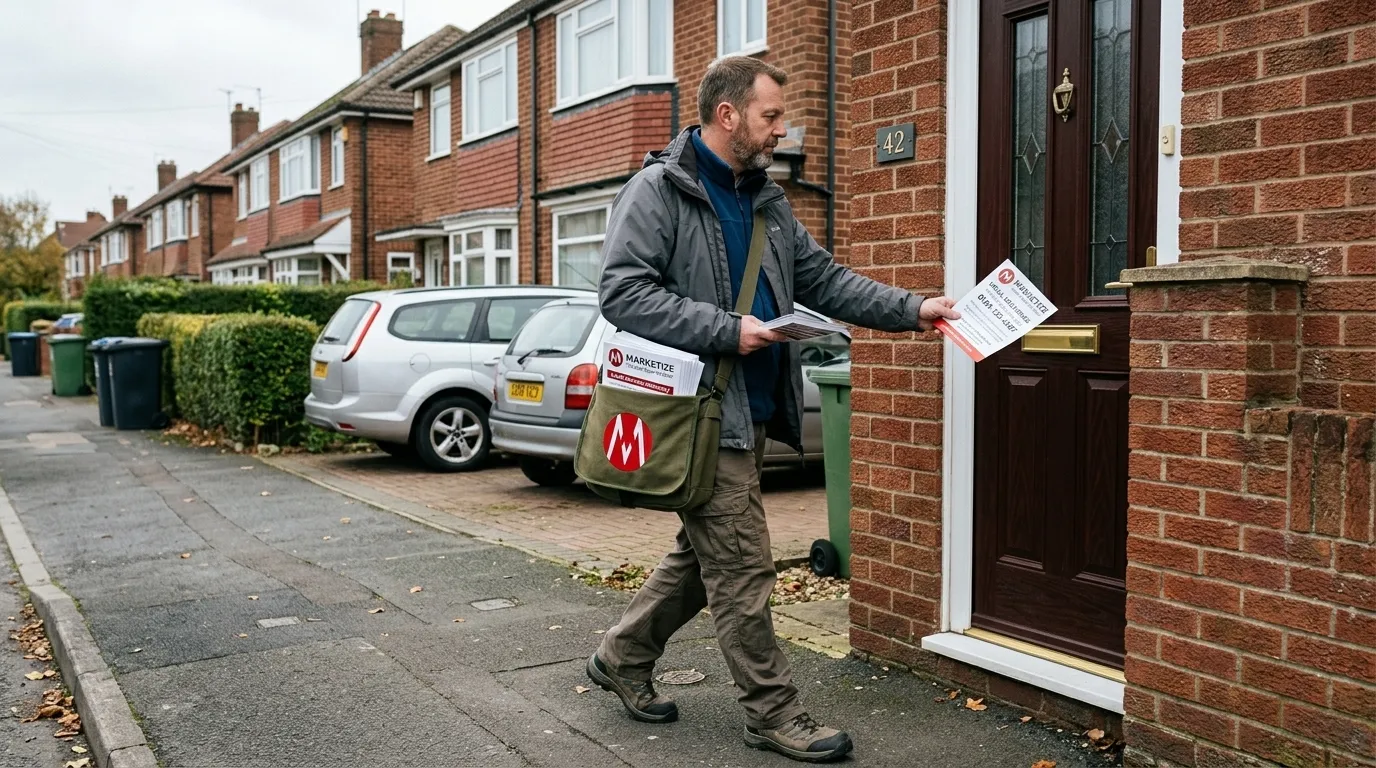
This is one of those questions that sounds like operational detail but is actually economic intelligence. Because once you know what a distributor can realistically achieve in a working day - by area type, by terrain, by property access - you have a benchmark for almost everything else in leaflet distribution. You can evaluate whether a quote is viable. You can understand why rural campaigns cost more than urban ones. You can spot, before the campaign starts, whether the numbers you've been given make sense.
The figures exist. They're not mysterious industry secrets. But they rarely get communicated to clients, which means clients end up comparing quotes without the reference point they'd need to interpret them. This article is part of the Economics of Honest Distribution series - which covers the pricing realities of leaflet distribution that most companies don't explain upfront, and sits within the broader client's guide to not getting burned. So let's cover it properly.
The Honest Baseline
For a distributor working a full day - eight hours, carrying leaflets, walking residential streets - the realistic delivery range across most standard environments is 600 to 1,000 letterboxes. That's the honest number. Not the number that appears in optimistic sales pitches, and not the number implied by aggressively cheap leaflet distribution quotes. The number that reflects what a person walking streets, stopping at each property, managing a bag, and doing the job properly can realistically achieve across a working day.
Within that range, density and terrain determine where you sit. In highly dense urban areas with compact terraced housing - the kind of back-to-back street layout found in many northern cities and parts of inner London - an experienced distributor who is physically fit and working efficiently might reach 1,200 to 1,300 in a full day under optimal conditions. That's the upper ceiling, and it requires good conditions: consistent letterbox access, minimal steps or long driveways, no particularly stiff letterboxes, minimal access complications, good weather.
At the other end of the scale, in rural or semi-rural areas where properties are spaced out and significant walking or driving distance separates each letterbox, 300 to 600 is a more realistic daily figure. Sometimes lower. The walking time between properties in a village or dispersed rural setting can easily match or exceed the time spent at each letterbox - which means the ratio of productive delivery time to transit time is fundamentally worse than in urban areas.
The Figures by Area Type
The delivery capacity figures below reflect what an honest, experienced distributor can achieve across a full working day. They're not adjusted for optimism or pessimism. They're the numbers that experienced operators use when pricing door to door leaflet distribution jobs properly - and the numbers that GPS-tracked campaign analysis confirms when pace data is cross-referenced against letterbox density.
High-Density Urban (Compact Terraced Streets)
In areas like inner city residential zones with tight terraced housing - think closely packed streets with small front gardens or directly pavement-fronting doors - a distributor can typically achieve 800 to 1,000 letterboxes per day, with exceptional conditions and an experienced operator potentially reaching 1,200 to 1,300.
What makes this area type efficient is physical compactness. The distance between letterboxes is small. The time spent at each property is short. A distributor walking steadily through good terraced streets can maintain a rhythm that keeps pace high across the full shift. The constraint is physical stamina more than walking time. For a city-specific guide to how housing density affects distribution planning in the UK's highest-density urban market, leaflet distribution in London covers the inner vs outer borough dynamics in detail.
Standard Suburban (Mixed Semi-Detached and Detached)
Suburban residential areas - the kind of streets you'd find in most UK towns, mixing semi-detached and detached housing with modest front gardens - produce daily capacities in the region of 600 to 800 letterboxes.
The key difference from high-density urban is approach distance. A ten-metre front path at each property sounds minor. Multiply it across 600 letterboxes and you've added kilometres of walking that don't appear in any map of the streets covered but absolutely appear in the distributor's legs. Add the occasional long driveway, properties set back from the road, or gated front gardens, and the productive hours decrease meaningfully compared to terraced street delivery.
Low-Density Suburban and Village Environments
Lower-density suburbs, market town residential areas, and village streets produce daily figures of 400 to 600. The housing is typically spaced further apart, the approach distances are longer, and properties are often more varied in their letterbox placement.
There's also a factor that's easy to underestimate: decision-making time. In high-density urban areas, every property gets a leaflet (with the exception of the five to ten percent standard undeliverable allowance for "No Junk Mail" signs and genuinely inaccessible addresses). In mixed rural areas with more variation in property type, a distributor has to assess each address, which adds small but cumulative time across a full shift. Letterbox counting tools that cross-reference your target area against deliverable address data are particularly valuable in lower-density areas precisely because the gap between apparent coverage area and actual deliverable properties is harder to estimate by eye.
Rural and Dispersed
Rural delivery is an entirely different calculation. When properties are separated by significant road distances - whether a distributor is walking between them, cycling, or moving by vehicle between clusters - the daily capacity can drop to 200 to 400. In some remote areas, even lower.
This is why rural campaigns require separate pricing. The time-per-letterbox figure that drives most urban pricing models simply doesn't apply when a distributor might spend 15 minutes travelling between two clusters of five properties each. The UK leaflet distribution prices guide for 2026 covers rural difficulty premiums and what they should realistically look like - so you can evaluate whether a quote is reflecting the genuine cost of rural delivery or simply treating it identically to suburban work.
What Else Affects Daily Capacity
The area type figures above assume standard conditions. In practice, several additional factors push capacity up or down within those ranges.
Letterbox Access and Difficulty
Stiff letterboxes, letterboxes at unusual heights or angles, properties with aggressive dogs visible at doors, long driveways, sloped approaches, communal entry systems that require waiting or intercom use - all of these add time at individual properties that compounds across a full day. An area with unusually difficult letterbox access will come in at the lower end of its range regardless of housing density.
Leaflet Format and Weight
A heavier, thicker leaflet format - premium card stock, large format, or multiple items being delivered together - slows insertion, adds weight to the distribution bag, and can require two-handed posting technique at every letterbox. This consistently reduces daily capacity compared to a standard A5 at typical paper weights. It's why agencies sometimes quote separately for premium or bulky formats: it's not just print cost, it's delivery rate.
Time of Year and Conditions
A distributor covering the same route in July and January is covering very different experiences. Cold hands slow letterbox technique. Poor weather requires more caution on icy paths. Short winter daylight hours limit the working window, particularly since professional distributors typically work morning to before-dark for resident comfort and safety reasons. Seasonal capacity variation is real and worth accounting for in winter campaign planning. Timing strategies for leaflet delivery covers the seasonal demand patterns that inform not just response rates but also the practical logistics of when distribution is fastest and most reliable.
Experience and Physical Condition
An experienced distributor who has done this work for years develops a route efficiency and letterbox technique that a first-time distributor doesn't have. The difference in capacity between someone who has learned to read street layouts, identify efficient crossing points, and handle letterboxes smoothly versus someone learning on their first shift can be 20 to 30 percent. This is one reason why using experienced, GPS-verified distributors through a platform with performance history matters: you can see completion records and coverage data from previous campaigns, not just take a company's word for it. How to track distributor performance covers the specific metrics - speed accuracy, verification quality, completion rate - that give you an objective picture of any distributor's capability before you assign them a campaign.
Why These Numbers Matter for Clients
The honest truth is that these figures exist to protect you as a client - not just as operational benchmarks.
Here's the logic. If a distributor in a standard suburban area can realistically deliver to 700 letterboxes in a day, and needs to earn a reasonable rate for a demanding physical job, then the minimum viable leaflet distribution cost has a floor. Work out what a fair day rate looks like for physically demanding outdoor work, divide by the number of thousands that can realistically be delivered, and you have the minimum honest price per thousand for that area type. For the full calculation - and the pricing benchmarks by area type that let you apply it - the UK leaflet distribution prices guide for 2026 covers every variable.
Any quote significantly below that floor has a limited number of explanations. Perhaps the company has an unusually efficient operation that allows them to absorb lower margins without cutting delivery. Possible, but rare. Or - and in our experience this is the most common explanation at quotes well below viable rates - the delivery is not going to happen in full. The quote is priced around a delivery percentage that isn't the one you agreed to.
This is why a low quote for leaflet distribution is different from a low quote for most other services. In most service categories, a company that has found efficiencies can genuinely offer a lower price for the same service. In leaflet distribution, the core constraint - a person walking streets for eight hours - can only be made so efficient before the delivery starts to suffer. A quote that seems to defy the economics usually does so by planning, quietly, to deliver less than was agreed. The specific tactics used to make partial delivery look like complete delivery - and the verification data that catches them - are documented in how to prevent dishonest leaflet distributors.
For context on what response rates and ROI you should expect when delivery actually happens at the volumes you paid for - so you can evaluate whether a quote's economics make sense against the returns you're planning for - what is a good leaflet ROI gives you the industry benchmarks by business type and campaign maturity.
What This Means for Distributors
If you're a leaflet distributor - whether you're starting out, scaling a team, or reassessing your pricing - these figures are the foundation of honest pricing.
The capacity ranges above are what an honest day produces. Pricing below them either means you're underpaying yourself for demanding physical work, or you're building in a delivery shortfall to make the economics work. Neither is sustainable. Underpaying yourself leads to burnout or corner-cutting. Building in planned shortfall damages your professional record, and on platforms with GPS verification, it's detectable.
Pricing your work on accurate capacity figures - adjusting for the area type you're covering, the format you're delivering, the season you're working in - is the basis of running a distribution operation that is financially sound and professionally defensible. When your GPS record shows completion times and coverage patterns consistent with the capacity benchmarks for the area, your evidence and your pricing tell the same story. For a full guide to building a sustainable distributor career on these foundations, becoming a leaflet distributor in 2026 covers how platforms work, how verification protects your earnings, and what good-faith distribution looks like in practice.
Letterbox counting tools that cross-reference your coverage area against deliverable address counts help you plan accurate job volumes before you accept the work. That planning protects you from accepting jobs priced at volumes your area can't support - a trap that turns an honest distributor into an under-deliverer through no dishonest intent, just through inaccurate capacity assumptions.
The Numbers That Change How You Read Every Quote
The numbers in this article are not complicated. They're the product of what a person walking residential streets, in typical UK conditions, carrying a standard leaflet bag, can physically accomplish across a working day. They vary by area type for reasons that are entirely logical. And once you have them as a reference point, the economics of any leaflet delivery service quote become much easier to evaluate - whether you're the one receiving the quote or the one producing it.
For the full picture on area selection - how to use demographic data, letterbox density, and local geography to choose where your campaign will perform best - how to choose leaflet distribution areas covers the methodology. And for an understanding of how many leaflets to order once you've settled on your area, the capacity figures in this article feed directly into the calculation covered in how many leaflets do I need?.
Ready to commission a campaign where the delivery rate is verified, not assumed? View campaigns on Marketize - GPS-verified coverage with pace analysis confirms actual delivery rates match the capacity benchmarks for your area type.