30 May 2026 · 13 min read
Leaflet distribution in London - Complete guide
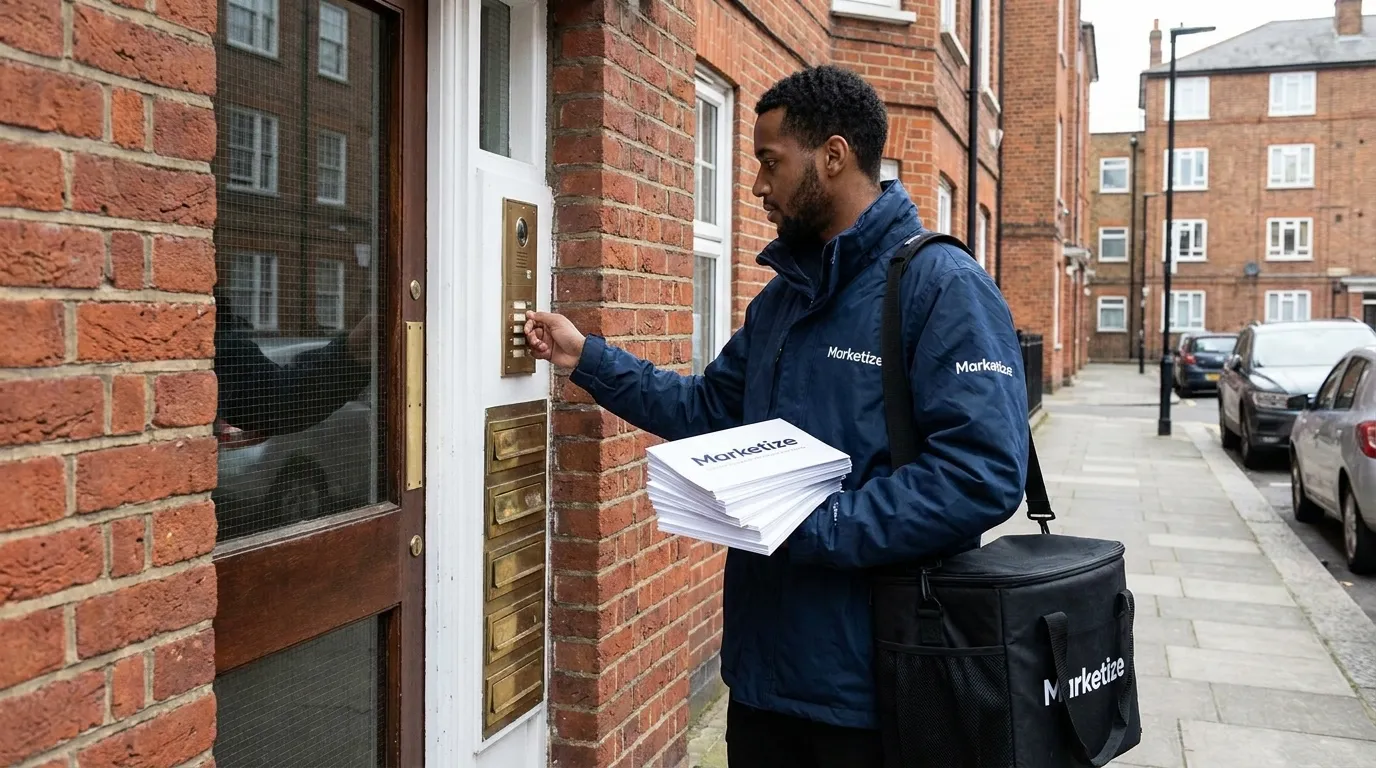
London is the UK's most complex, most rewarding, and most demanding city for leaflet distribution. Eight million households spread across 33 boroughs, each with its own demographic character, housing density, and access profile. Dense terraced streets in Lewisham sit alongside gated riverside developments in Battersea. Affluent family homes in Richmond are nothing like the high-rise flats of Poplar. Getting flyer distribution London right means understanding that no two areas are the same - and planning accordingly.
This guide covers everything you need to know about planning and running a leaflet delivery service campaign in London: how the city's geography affects your strategy, which areas suit which business types, what distribution options are available, how much campaigns typically cost, and what makes London campaigns succeed where others fail.
Before diving into London specifically, if you're new to how leaflet campaigns work end-to-end - from booking and area selection through to verified completion - how leaflet distribution works covers the full process. For context on how leaflet distribution in 2026 compares as a marketing channel against digital alternatives, including ROI benchmarks by industry, that guide gives you the strategic picture before you commit budget.
Why London Is Different From Every Other City
Most UK cities can be planned on a fairly straightforward north-south-east-west basis. London can't. The city's layered geography - inner zones, outer zones, historical borough identities, planning patterns, housing types - creates enormous variation even within small geographic areas.
Property density is the most immediate factor. Inner London boroughs like Hackney, Islington, and Southwark pack thousands of households into compact areas, making door to door leaflet distribution London highly efficient per square mile. A distributor can cover 150-200 letterboxes per hour in dense Victorian terracing. Outer boroughs like Bromley, Havering, or Hillingdon look far more like traditional suburban England - semi-detached houses with long driveways, wider streets, lower density. Distribution is slower per mile but often reaches a different and highly valuable demographic.
Then there's the access question. London has a higher proportion of purpose-built flats and converted houses than almost anywhere in the UK. Communal entrances, entry systems, and mixed letterbox arrangements are the norm in many inner areas. Plan for it. Understanding which areas present access challenges - and how they affect deliverable letterbox counts - is part of the how to choose leaflet distribution areas methodology, which covers demographic filters, property type selection, and proximity logic that apply directly to London campaign planning.
Inner London vs Outer London: A Distribution Perspective
Inner London (Zones 1–3)
Inner London offers extraordinary household density but comes with access complexity. Converted Victorian houses contain multiple flats behind single front doors. Purpose-built estates, many with controlled entry systems, require more effort per delivery. High-rise developments in areas like Tower Hamlets or Southwark may have communal letter rooms rather than individual letterboxes.
The demographic range is enormous. Affluent professionals in Clapham, young renters in Peckham, established families in Fulham, students in New Cross - these are entirely different audiences requiring different messaging. Letterbox counting tools are particularly valuable in inner London for accurately estimating deliverable properties before committing to print runs, since the gap between properties visible on a map and actually deliverable letterboxes can be significant.
Campaign costs per thousand can be slightly higher in inner London due to access complexity, but the density typically means lower cost per area covered. For businesses serving a local catchment - a restaurant, gym, or clinic - inner London campaigns can achieve excellent precision within relatively small geographic areas.
Outer London (Zones 3–6)
Outer London provides easier letterbox access, typically higher homeownership rates, and often more affluent households. Boroughs like Kingston, Richmond, Bromley, Barnet, and Harrow contain large concentrations of family households with disposable income - particularly strong territory for home services, premium food delivery, children's activities, fitness studios, and lettings agencies.
Distribution in outer London moves faster per property but covers less density per hour. Route planning becomes more important for efficiency. For businesses targeting homeowners specifically - home improvement tradespeople, kitchen fitters, garden services, estate agents - outer London often outperforms inner city areas on response rates despite lower volume per mile.
Distribution Types Available in London
Letterbox (Door-to-Door) Distribution
The core of most London campaigns. Distributors walk residential streets posting leaflets through individual letterboxes. Two options:
Solus distribution means your leaflet is delivered alone - no other promotional material in the same drop. Response potential is higher because recipients aren't choosing between multiple leaflets at once. Solus costs more per thousand but is the right choice for premium services, high-value offers, or brands where presentation matters.
Shared distribution means your leaflet is delivered alongside up to three other non-competing businesses. Lower leaflet distribution cost per thousand, still reaches the right households, sensible for businesses on tighter budgets or running broader awareness campaigns.
Minimum campaigns on Marketize start from 500 leaflets, which works well for hyper-local testing. Industry practice suggests 5,000+ for any meaningful volume of response data. For accurate quantity calculation before committing to print, how many leaflets do I need? works through the London-specific letterbox counting methodology - accounting for access variations, the 5% undeliverable allowance, and how inner vs outer borough density affects the numbers.
Hand-to-Hand Distribution
London's street-level foot traffic offers genuine opportunities for hand-to-hand distribution. Distributors stand in high-footfall public locations or walk along public streets, offering leaflets directly to passing pedestrians.
There are specific rules to understand here. Distributors can stand on public pavements - including outside Underground station entrances - but cannot enter the stations themselves. They cannot enter private shopping centres or private estates. Canary Wharf, for example, is private land and leafleting there requires the estate's permission. Westfield centres apply the same rule.
Hand-to-hand works particularly well for event promotion, food and restaurant offers, retail with nearby footfall, and political campaigns. For a full picture of what leaflet distribution fundamentals look like - including the difference between solus, shared, and hand-to-hand across a full campaign - that guide covers every distribution format.
Which London Areas Work Best by Business Type?
Restaurants, Takeaways, and Food Delivery
Focus on high-density residential areas within your delivery radius. Inner London postcodes - E, N, SE, SW, W - offer extremely dense populations, high proportions of renters (who order delivery more frequently), and strong appetite for food variety. Consistent monthly drops within your delivery zone build name recognition and repeat ordering patterns.
Areas like Hackney, Islington, Brixton, Kilburn, Tooting, and Peckham have strong delivery cultures. Outer zones like Chessington, Romford, or Enfield are worth targeting if your delivery radius extends there and you're targeting family households. For a guide to the timing decisions that affect food delivery campaign performance - including which days of the week produce the highest response rates - timing strategies for leaflet delivery covers the London-relevant patterns.
Gyms and Fitness Studios
Match your distribution area to your realistic travel catchment - most gym members travel no more than 15-20 minutes. For inner London studios, this might mean targeting two or three specific postcodes very consistently. For outer London, where people are more likely to travel by car, slightly broader coverage makes sense.
Target areas with the demographic profile of your membership. A premium studio in Notting Hill should target W11, W2, and W10. A functional fitness gym in Stratford should target E15, E20, and E7. Demographic targeting tools that filter by household income and age range help you allocate budget to the most likely conversion areas. January and September distribution campaigns consistently outperform other months for gym acquisition in London.
Estate Agents and Lettings Agencies
Valuation campaigns perform best in high homeownership areas. Outer London boroughs - Richmond, Kingston, Bromley, Barnet, Ealing - have high owner-occupier rates and active property markets. Target recently listed streets, areas with above-average turnover, or postcodes where your data shows frequent instructions.
Tenant sourcing campaigns work best in inner zones where rental demand is highest. Shoreditch, Bermondsey, Brixton, and similar areas have large populations of mobile renters. Campaign messaging needs to reflect which audience you're targeting - vendor valuation messaging won't resonate with Hackney renters. For estate agents, how to plan a successful leaflet campaign covers how to structure messaging, offers, and tracking for high-value, low-volume conversion campaigns.
Tradespeople and Home Services
Homeowner-heavy outer London boroughs are the sweet spot. Richmond, Chislehurst, Winchmore Hill, Hatch End, Beckenham - areas with established family housing and homeowners who invest in maintenance and improvement. Consistency matters more in home services than almost any other sector. A plumber or electrician who distributes monthly to the same 10,000 homes builds the name familiarity needed so that when a resident's boiler fails, your leaflet comes to mind.
For a framework on optimal frequency - and why monthly drops to the same area outperform sporadic high-volume campaigns for home services specifically - how often you should deliver leaflets covers the bi-monthly vs monthly decision with industry benchmarks for home services response curves.
Clinics, Salons, and Local Services
Hyper-local targeting is the answer. A dental practice in Balham doesn't need coverage in Chiswick. Tight geographic focus - often 2-3 postcodes around your location - delivered consistently every 4-6 weeks builds the brand awareness that drives first appointments. Areas with demographic alignment (families for paediatric dentistry, affluent households for cosmetic procedures, young professionals for lifestyle services) improve response rates significantly over broad-area distribution.
London-Specific Campaign Challenges
High-rise and estate access. London has extensive public housing estates and purpose-built residential towers. Access for letterbox distribution varies - some have letter rooms accessible on public floors, others have controlled entry throughout. GPS-verified campaigns show exactly where distributors went and where they couldn't access, giving you accurate data on actual coverage rather than planned coverage. This is particularly important in London where access variations are more common than anywhere else in the UK.
Gated developments. Many newer riverside and premium developments in London are accessed only by residents. A distributor can attempt intercoms and wait for access, but extensive gating affects deliverable letterbox counts. This is reflected in the 5% undeliverable allowance standard for any campaign - though in some London postcodes with heavy gate development, the proportion of genuinely inaccessible properties can be higher. How to avoid leaflet theft and false delivery claims covers how GPS and photo verification create the audit trail that distinguishes legitimate access failures from skipped properties.
Volume requirements. London's postcode areas vary enormously in household count. EC1 is compact; TW or UB covers much more ground. Use letterbox counting tools before finalising print runs to ensure your quantities match deliverable households in your chosen area.
Competition and repetition. London residents receive more marketing material than people in smaller cities. Standing out requires good creative, strong offers, and repeated visibility. A single campaign rarely builds sufficient brand recognition in London. The campaign strategy and planning hub covers how to build a consistent monthly or bi-monthly programme that compounds brand familiarity over time - the approach that consistently outperforms one-off high-volume blitzes in competitive London markets.
Planning a London Leaflet Campaign: Practical Steps
- Define your catchment precisely. Draw a realistic boundary based on your service area, delivery radius, or travel catchment. Don't try to cover all of London - it's too expensive and too unfocused.
- Count letterboxes before printing. Letterbox counting tools give you accurate deliverable household numbers within your boundary. This determines your print quantity, which should match your distribution volume.
- Choose distribution type. Solus for premium impact and higher-value offers; shared for cost efficiency on broader awareness campaigns; hand-to-hand for event-driven or location-specific promotion.
- Plan for consistency. Budget for at least three monthly drops to the same area before evaluating. London residents need repeated exposure before a brand registers.
- Build tracking in before printing. Campaign-specific promo codes, landing page URLs, or dedicated phone numbers need to appear on the leaflet. For the full tracking setup methodology - and how to calculate genuine ROI including lifetime value - how to measure leaflet campaign performance covers every step.
- Verify delivery. GPS tracking showing actual routes covered, combined with geotagged photo proof, gives you certainty that your campaign reached the properties you paid for. This is especially important in London where access variations mean planned coverage doesn't always match actual coverage.
Costs of Leaflet Distribution in London
London rates tend to sit at the upper end of UK distribution pricing, reflecting the density and access challenges of the city. For comprehensive benchmarks across all UK area types - including London inner vs outer comparisons, solus vs shared pricing, and difficulty premiums - the UK leaflet distribution prices guide for 2026 gives you reliable figures before you budget.
Typical letterbox leaflet distribution cost in London ranges from £35-55 per thousand for shared distribution and £45-70 per thousand for solus, with inner London rates generally higher than outer boroughs. These figures are indicative - actual pricing depends on area density, campaign volume, and specific coverage required.
Design and print costs sit separately. A standard A5 double-sided leaflet printed at 10,000 units typically costs £80-150 from a UK print supplier, depending on paper weight and finish.
Total campaign budgets for a 10,000-leaflet London campaign (shared distribution) typically run £450-700 for distribution plus £100-150 print, plus design if needed. Solus distribution at the same volume would typically be £600–900 for distribution. For context on what these costs generate in terms of return - and what ROI benchmarks look like for London-based businesses across different sectors - what is a good leaflet ROI gives you the industry data to evaluate whether your campaign results are strong, average, or worth rethinking.
London Campaigns Reward Precision
Leaflet distribution London remains one of the most cost-effective ways to reach local customers at scale when campaigns are planned precisely, verified properly, and run consistently. The city's complexity rewards preparation - and punishes broad, untargeted spending.
Cheap leaflet distribution in London doesn't mean cutting corners on verification or targeting - it means making every thousand leaflets work harder by reaching the right postcodes, with the right offer, at the right frequency. A smaller, well-targeted campaign in three outer London postcodes will consistently outperform a broad inner-city blitz at the same budget.
For distributors looking for work across London's boroughs, leaflet distribution jobs near you connects you with verified campaigns across inner and outer London - including the kinds of GPS-verified, professionally managed campaigns that protect your earnings through escrow payment and fair dispute resolution. And if you're considering becoming a leaflet distributor in 2026, London's density and volume of active campaigns makes it one of the most consistently active markets in the country.
Ready to plan your London campaign? View campaigns and build your distribution on Marketize - demographic targeting, letterbox counting, GPS verification, and campaign reporting all included as standard.