2 September 2026 · 10 min read
What Is Consultation Leaflet Distribution and When Is It Required?
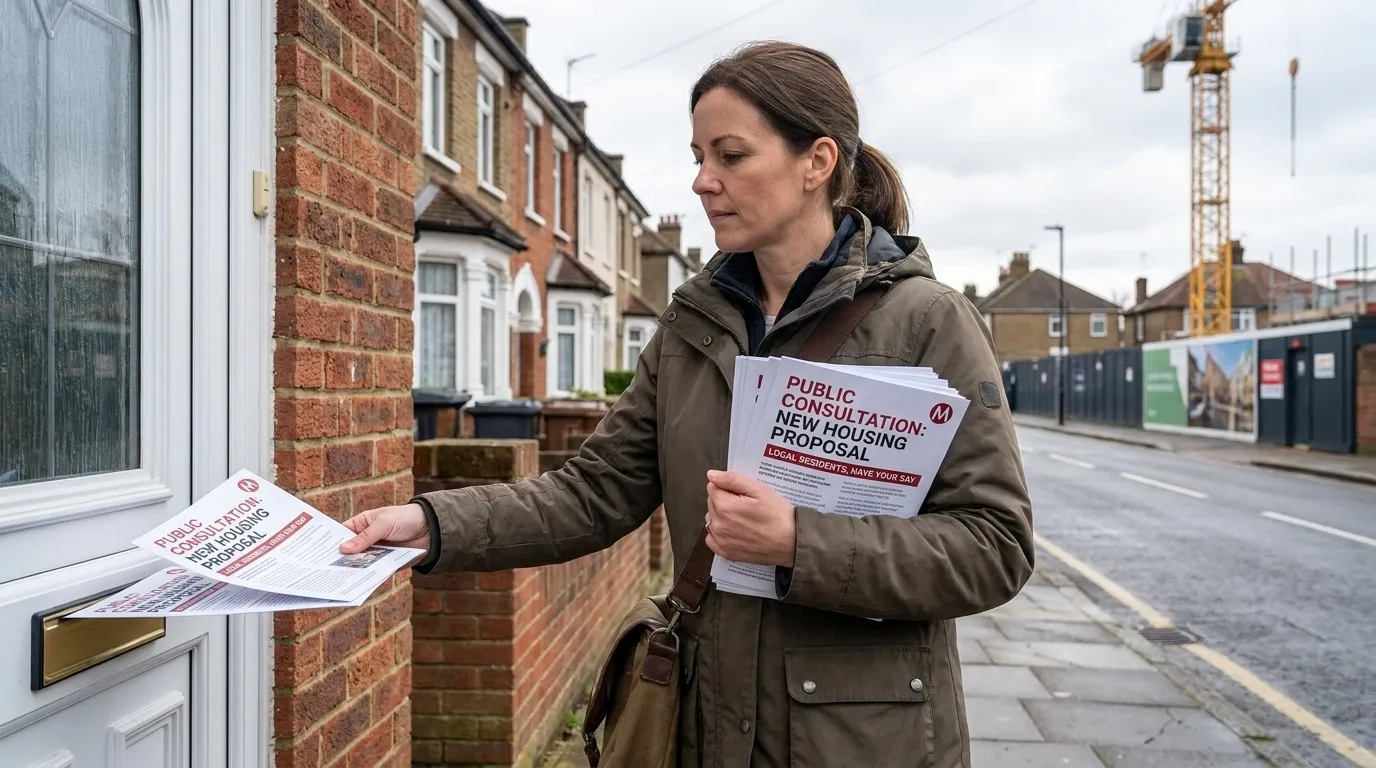
Most leaflet campaigns exist to generate commercial response. You distribute, people receive the material, some of them act on it, you measure the results and decide whether to repeat. The success metric is response rate. The accountability standard is whether the job was done thoroughly enough to produce meaningful results.
Consultation leaflet distribution is a different category of work, operating under different rules with different accountability requirements and different consequences when those requirements aren't met. It isn't a marketing exercise. It's a notification and engagement mechanism - part of a legal or procedural framework that requires affected parties to be informed about something that may directly affect them.
Understanding what consultation leaflet distribution is, when it's required, and why it operates to a stricter standard than commercial door drop campaigns matters whether you're a property developer commissioning a planning notification, a planning consultant managing the consultation process, a local authority communicating civic changes, or a distribution operator being asked to take on this type of work for the first time. This article is part of the consultation and civic distribution series.
What Consultation Leaflet Distribution Actually Is
Consultation leaflet distribution is the delivery of notification material to all properties within a defined area as part of a formal engagement or notification process. The material might be a planning application consultation notice, a public notice about proposed development, a civic communication about changes to local services or infrastructure, or a public engagement document from a housing association or local authority.
The defining characteristic is that it operates within a process - planning, civic, legal, or regulatory - that has requirements attached to it. Someone, somewhere, needs the distribution to have happened properly. Not "mostly happened" or "happened to the best of our knowledge." Properly, with records to demonstrate it.
This contrasts with commercial door drop distribution, where a reasonable non-delivery rate is expected and planned for. In a standard marketing campaign, five to ten percent non-delivery across most areas is entirely normal and factored into planning - properties with "No Junk Mail" signs, genuinely inaccessible addresses, gated properties. This allowance is legitimate and acknowledged. For a full breakdown of how non-delivery allowances work in standard commercial campaigns, and how they're verified, how to avoid leaflet theft and false delivery claims covers the address-level evidence standards that apply across both commercial and consultation contexts.
In planning application leaflet distribution, the expectation is different. Every address in the defined notification area must be attempted. Where a property is genuinely unreachable, the address must be documented with sufficient detail to explain why delivery wasn't possible. The record of attempted delivery, and the explanation of exceptions, becomes part of the formal process record.
When Is Consultation Distribution Required?
The most common context is planning applications. UK planning law requires that applicants notify neighbouring properties when a planning application is submitted. Local planning authorities (LPAs) serve formal neighbour notification letters to immediately adjacent addresses, but the scope of consultation required by both law and planning practice goes beyond immediate neighbours in many cases - particularly for larger or more significant developments.
Planning Application Consultations
For developments of any scale, applicants and their planning consultants are expected to engage with the local community. This often involves distributing a consultation leaflet or public notice distribution to all residential properties within a defined radius of the proposed site - commonly 50 to 200 metres depending on the scale of the development, though this varies significantly by planning authority and development type.
The purpose is both procedural and practical. Procedurally, it demonstrates that the applicant has made genuine efforts to inform affected residents and invite their engagement before the application is formally considered. Practically, it gives residents the opportunity to review the proposals and submit comments to the local planning authority during the consultation period.
When a planning inspector or local authority reviews a planning application - particularly if it's contested or goes to appeal - the question of whether notification was properly carried out can arise. "We sent leaflets to that area" without evidence of systematic delivery to every address is a weaker position than a documented GPS-verified record showing which properties were attempted, which were successfully delivered to, and which were recorded as inaccessible with specific reasons. For the full technical explanation of what GPS-verified delivery captures - coordinates, timestamps, offline data storage, and photo metadata - what is GPS tracked leaflet delivery covers every element.
Environmental and Infrastructure Consultations
Major infrastructure projects - road schemes, utility works, telecoms infrastructure, energy installations - typically involve statutory consultation requirements managed by the project proponent or a public body. These may have formal legal underpinning that specifies not just that consultation must happen but how it must be documented.
Civic and Local Authority Communications
Local authorities distributing information about proposed changes to services, licensing applications, conservation area consultations, or local plan reviews may use leaflet distribution as part of a broader public engagement strategy. The requirement here is less typically legal and more procedurally mandated - the authority's own consultation framework or its statutory obligations may specify that all properties in a defined area must be notified.
Housing Association and Social Landlord Communications
Housing associations and social landlords have ongoing obligations to consult with residents about significant changes - estate regeneration proposals, service changes, redevelopment plans. Distribution to all properties within a defined geographic scope, with records of completion, forms part of the formal engagement trail.
What Makes Consultation Distribution Different in Practice
The operational differences between consultation distribution and standard commercial door drops are significant enough to affect how campaigns are planned, executed, staffed, and documented.
The Coverage Standard
In commercial distribution, a campaign distributed to ninety-two percent of properties in a target area - with eight percent legitimately undeliverable - is a successful campaign. The non-delivery rate is within normal range and the client receives what they expected.
In consultation distribution, a coverage rate of ninety-two percent may not be adequate. The expectation is that every address has been attempted. "Attempted" means the distributor made a genuine effort to deliver - walked up to the property, tried any entry mechanism, and only recorded the property as inaccessible when it was genuinely not reachable by a reasonable person making a reasonable effort. For the capacity figures that inform how long this level of effort takes per area type - and why consultation campaigns take longer per thousand addresses than standard distribution - how many letterboxes a distributor can realistically deliver in a day covers every variable that affects throughput.
The Effort Threshold
In standard distribution, a gated property with no visible letterbox or intercom gets recorded as undeliverable and the distributor moves on. That's a reasonable response in a commercial campaign where speed and coverage efficiency matter.
In consultation distribution, the effort threshold is higher. If there's an intercom, use it. If there's a concierge or managing agent visible, try them. If there's a post box or communal letter facility that wasn't immediately obvious, find it. The distributor should be approaching each property with the intention of finding a way to deliver, not a way to move on quickly.
This higher effort threshold has direct implications for pricing and scheduling. Consultation distribution takes longer per thousand addresses than standard distribution, both because of the additional effort at difficult properties and because of the real-time documentation requirements. For the pricing framework that reflects this honest cost difference - and why consultation campaigns should never be quoted at standard commercial rates - what leaflet distribution actually costs covers the cost components and how effort threshold affects them.
The Documentation Standard
For a standard marketing campaign, a completion report containing GPS coverage data, aggregate delivery statistics, and geotagged photographs distributed throughout the route is good, thorough evidence. For the full breakdown of what a well-structured completion report should contain, how to read a leaflet distribution completion report covers every element.
For a consultation campaign, the non-delivery element of the report matters in ways that commercial reports typically don't address. The non-delivery log should contain specific addresses, specific reasons for non-delivery, timestamps at the time of the attempted delivery, and ideally photographic evidence of the access barrier where one exists. This documentation is what makes the consultation record defensible if the process is subsequently questioned. The GPS-based audit trail that makes each of these elements verifiable - rather than retrospectively assembled - is covered in how to use GPS tracking for campaign analysis.
Why the Stakes Are Higher
For a commercial leaflet campaign, the worst consequence of inadequate delivery is a disappointing response rate and a wasted budget. Those are real costs, but they're financial and operational.
For a consultation campaign, the consequences of inadequate or undocumented delivery can be significantly more serious. A planning application where the consultation process was found to be inadequate may face objections, delays, or challenges on procedural grounds. An infrastructure consultation that didn't demonstrably reach all affected properties may expose the project proponent to challenge. A local authority consultation that can't show it notified all relevant addresses may have its process questioned.
These aren't hypothetical risks. Planning processes are contested. Objectors and their legal representatives look for procedural weaknesses. A clear, documented record of attempted delivery to every address - with specific records of exceptions - is the evidence that demonstrates the process was properly conducted.
This is also why the choice of distribution partner and the verification infrastructure they use matters more for consultation campaigns than for commercial ones. GPS tracking that confirms route coverage, real-time non-delivery logging with address-level specificity, and geotagged photographs that place evidence at precise coordinates are not optional extras in this context. They're the documentation standard the work demands. For the full commissioning framework that puts these requirements in place from day one - before any leaflet is printed - how to commission a leaflet campaign so poor delivery has nowhere to hide covers every structural decision.
Consultation Distribution and How Marketize Approaches It
The infrastructure that makes Marketize's GPS-verified distribution model useful for commercial campaigns makes it particularly well-suited for consultation work. GPS tracking with offline data storage eliminates blank spots in coverage records, ensuring the route data is complete even in areas with poor signal. Real-time non-delivery logging at address level, with timestamped reasons, produces the specific exception records a consultation process requires. Geotagged photographs placed on the coverage map at capture coordinates provide visual evidence of both delivery and access barriers.
For consultation campaigns, the completion report needs to function as a formal process document, not just a client-facing summary. How to evaluate any completion report against this standard - and what the specific elements are that distinguish a document a planning consultant or legal team can rely on from one that looks thorough but isn't - is covered in the consultation and civic distribution series.
The Standard the Work Demands
Consultation leaflet distribution is a distinct, higher-standard category of delivery work with specific requirements around coverage, effort, documentation, and verification. It's required in planning application processes, civic communications, infrastructure consultations, and a range of other formal engagement contexts where demonstrating that notification happened properly matters beyond simply achieving a good response rate.
Understanding what it requires - and making sure the distribution operation you're using can actually meet those requirements - is the starting point for any consultation campaign that needs to withstand scrutiny. For the operational detail of how to manage this work from brief to completion, the operations and distributor management hub covers the distributor management and briefing systems that underpin verifiable full coverage. And for the tracking platform comparison that tells you which tools actually produce the primary GPS and non-delivery data that consultation work requires, how to track distributor performance covers the specific metrics that distinguish verified delivery from claimed delivery.
Ready to commission consultation or civic distribution with GPS-verified coverage and address-level non-delivery records? View campaigns on Marketize - the documentation standard the work demands, built in from the start.