6 May 2026 · 16 min read
Best Practices for Hiring Leaflet Distributors: Building Teams That Actually Show Up and Deliver
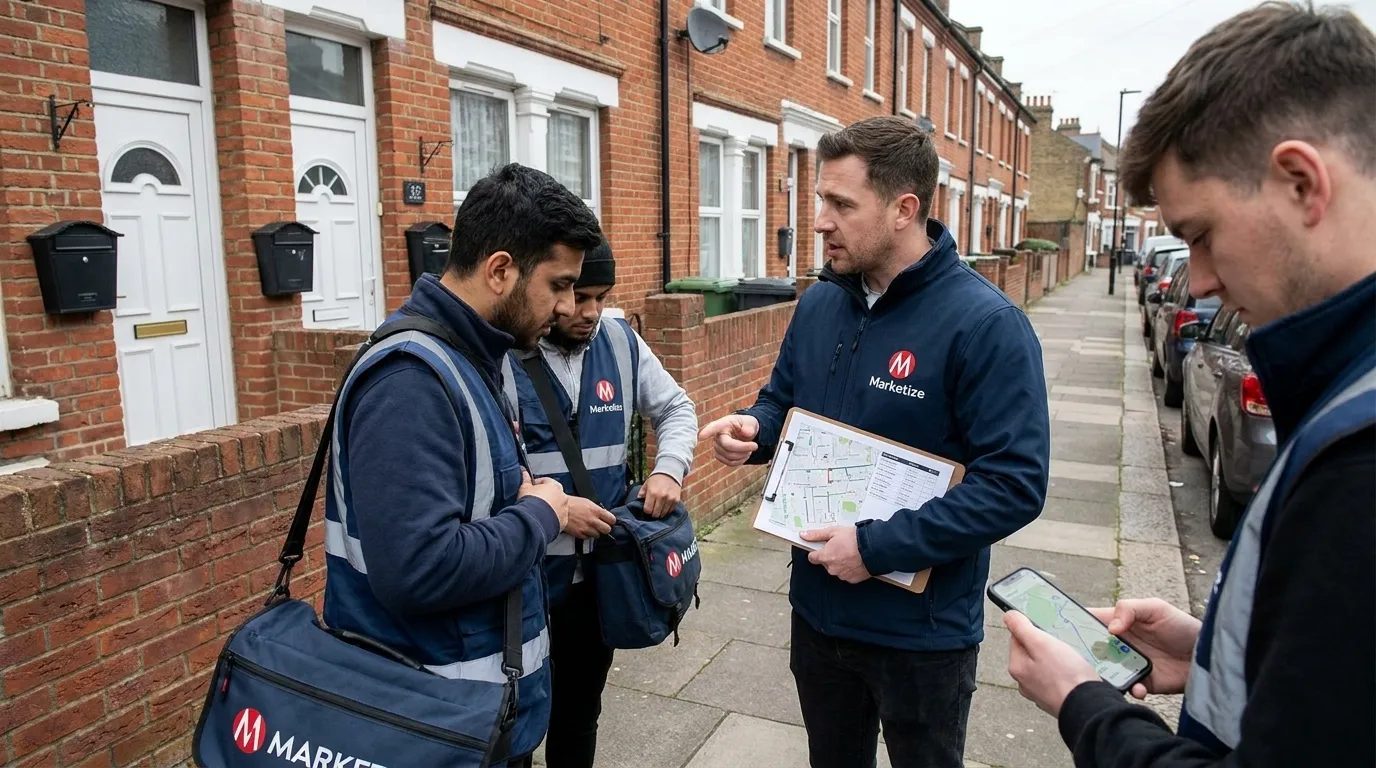
Hire the wrong leaflet distributor and you'll spend weeks chasing them for updates, dealing with client complaints about incomplete coverage, or discovering they binned half your campaign and claimed completion.
Hire the right one and they show up reliably, complete work thoroughly, communicate problems early, and stick around for months becoming someone you trust with premium campaigns.
The difference isn't luck. It's knowing what to look for, how to vet candidates properly, and building onboarding systems that set people up for success rather than confusion.
Most distribution agencies make hiring mistakes early on. They recruit based on whoever applies first, skip proper interviews because they need someone immediately, or trust impressive-sounding experience claims without verification. Then they wonder why half their team disappears after their first campaign or delivers such poor quality work that clients complain.
Best practices for hiring leaflet distributors aren't complicated, but they require process. Know what actually predicts reliable performance, ask the right questions, set clear expectations from the start, and build onboarding that makes good work easy.
This article is part of the broader operations and distributor management framework. For the full picture of managing teams at scale — including performance tracking, payment systems, fraud prevention, and when to remove people — how to manage leaflet distributors covers the complete operational layer. This article focuses on the hiring and onboarding foundation that makes everything else possible.
Here's how to hire distribution teams that scale your business instead of creating endless management headaches.
What Actually Predicts Reliable Performance
Experience distributing leaflets matters less than you'd think. Reliability, local knowledge, and realistic expectations matter far more. If you want to understand the full context of what a leaflet distributor role actually involves from the candidate's perspective — what the work looks like, what attracts good people, what makes someone quit — becoming a leaflet distributor in 2026 covers the complete distributor side of the picture.
Reliability Over Everything
Someone who's never distributed a single leaflet but shows up consistently beats experienced distributors who disappear without notice. Look for evidence of reliability in their work history. Stable employment lasting years suggests they finish what they start. Frequent job changes every few months raise questions about whether they stick around when work gets difficult.
References matter. Someone with good references from previous employers (any industry, not just distribution) demonstrates they worked reliably before. No references or evasive answers about previous employers? Red flag.
Communication during hiring predicts communication during work. Candidates who respond promptly to messages, show up on time for interviews, and follow simple instructions (bring ID, download the GPS app beforehand) will likely communicate well during campaigns. Those who miss scheduled interviews or take days to respond to basic questions probably won't improve once hired.
Local Knowledge
Distributors who live in or near door to door delivery jobs areas work more efficiently and handle problems better. They know which estates have difficult access, where parking is available, which streets have aggressive dogs. This saves time and reduces the "I couldn't complete because I didn't know the area" excuses.
Local distributors can answer client questions about specific coverage. "Did you deliver to the flats behind the shopping center?" isn't a mystery when they know exactly where that is. They're also more likely to stick around. Someone living locally views this as ongoing supplementary income. Someone travelling 30 minutes to reach distribution areas might quit if they find closer work.
Realistic Expectations About the Work
Leaflet distribution is walking for hours carrying weight in all weather, accessing difficult properties, dealing with occasional aggressive dogs or rude residents. Candidates who romanticise "easy outdoor exercise" often quit after their first rainy campaign. Those who understand it's legitimate physical work requiring persistence tend to stick around.
During interviews, be honest: "You'll walk 10-15 miles covering a 5,000-leaflet campaign, carrying 10-15kg in a distribution bag, working in whatever weather happens that day, accessing flats with broken entry systems and houses with barking dogs. Still interested?" The ones who say yes understanding what they're signing up for are far more reliable than those expecting casual strolls through parks.
Smartphone Literacy
Modern distribution requires using leaflet distribution apps for GPS tracking and geotagged photos. If someone struggles with basic smartphone use, they'll struggle with verification requirements. You don't need tech experts. You need people who can open an app, enable location services, take photos, and understand when their phone is tracking properly.
During interviews, ask them to demonstrate: "Pull up the GPS app, show me it's tracking your location, take a photo that includes location data." Sounds simple, but some people genuinely can't do this. Better to find out during hiring than after assigning them a 10,000-leaflet campaign.
Where to Find Quality Distributors
Different recruitment channels attract different quality candidates. For context on what find leaflet distributors through a formal marketplace looks like — including reputation tracking, verified credentials, and built-in verification standards — the leaflet distributor marketplace model explains how modern platforms connect qualified distributors with agencies reliably.
Local Job Boards and Community Groups
Nextdoor, local Facebook groups, community notice boards reach people who live in your distribution areas. These tend to attract stay-at-home parents, retirees, and people seeking local supplementary income — often exactly who you want.
Post clearly: "Flexible leaflet distribution work. Walk residential streets delivering promotional materials. £35-45 per thousand leaflets. Must have smartphone for GPS tracking. No experience needed, training provided. Apply with brief message about your availability and why you're interested."
University Job Boards
Students need flexible work around lectures and exams. Some make excellent short-term distributors (term-time only), though many disappear during holidays or exam periods. Be upfront about the inconsistency if hiring students. Build relationships with several so you're not dependent on one person's academic schedule.
Existing Distributor Referrals
Your best distributors know other reliable people. Offer referral bonuses: "Refer someone who completes three campaigns successfully, earn £50 bonus." People tend to refer friends with similar work ethics. Reliable distributors refer reliable people. Flaky distributors don't stick around long enough to make referrals.
Gig Economy Platforms
Uber Eats, Deliveroo, and similar platforms create pools of people comfortable with app-based work and outdoor delivery. Some seek alternatives to cycling or driving. "Looking for walking-based delivery work? Leaflet distributor jobs offer exercise, no vehicle costs, and flexible scheduling" appeals to this audience.
The Interview: What to Actually Ask
Formal interviews for leaflet distribution feel excessive to some agencies. "It's just delivering leaflets, why interview?" Because 30 minutes interviewing saves 30 hours managing unreliable people. For the complete picture of what reliable distributors look like in practice — what makes them stand out, what causes them to fail, how to identify problems early — how to prevent dishonest leaflet distributors covers the full spectrum of distributor behaviour patterns.
Questions That Reveal Reliability
- "Tell me about a time you had to finish something difficult when you didn't feel like it." Listen for specific examples demonstrating persistence, not vague claims about being hardworking.
- "What's your availability over the next three months?" Vague answers ("pretty flexible") suggest they haven't actually thought about fitting this into their schedule. Specific answers ("Tuesdays and Thursdays generally, plus weekend mornings, but I've got two weeks away in August") show they're serious.
- "Why are you interested in leaflet distribution specifically?" "I need money" is honest but generic. "I want outdoor exercise that pays, fits around childcare, and doesn't require vehicle costs" shows they understand what the work actually offers.
Questions That Check Understanding
- "What do you think leaflet distribution involves day-to-day?" This reveals whether they understand it's physical work or think it's casual walking.
- "How would you handle a street where half the properties have 'No Junk Mail' signs?" The correct answer: skip those properties and return those leaflets, because the 5% undeliverable allowance exists for exactly this reason. Someone who says "deliver anyway" hasn't understood compliance.
- "What would you do if you encountered a property you genuinely couldn't access?" Looking for: "Take a photo showing the access issue, note the address, move on, report it when I finish." Not: "Skip it and hope no one notices."
Red Flags to Watch For
- Can't provide references or gets defensive when asked. Everyone has someone who can vouch for their reliability — previous employer, teacher, community leader. "I've never needed references before" or "That's invasive" suggests problems in their work history.
- Overpromises capacity. "I can easily do 20,000 leaflets per week" from someone who's never distributed before. Experienced distributors know their limits. Overconfident newcomers create problems when reality doesn't match promises.
- Focuses entirely on payment without asking about the work. "How much do I get paid?" is normal. Asking only about payment while showing zero interest in what the job involves suggests they won't care about quality.
- Resistance to GPS tracking or verification requirements. "Why do you need to track me?" or "Can't you just trust I did it?" Modern distribution requires verification. Anyone resisting this either doesn't understand industry standards or plans to cut corners. What GPS tracked delivery actually involves explains the full technical layer so you can discuss it confidently during interviews.
Setting Expectations From Day One
Most distributor problems stem from unclear expectations. They thought one thing, you expected another, conflict follows. Make everything explicit during hiring.
Verification Is Mandatory
Leaflet distributor jobs now require GPS tracking and photo proof throughout distribution. Explain: "Every campaign requires GPS tracking throughout distribution and geotagged photos spread across your route. Payment releases only after we verify coverage. This protects you from false accusations and proves to clients their campaigns were completed."
Platforms like Marketize hold payment in escrow-style protection releasing only after GPS, photos, and letterbox count verification confirm completion. Distributors need to understand this protects everyone, not just clients.
The 5% Undeliverable Allowance
Be clear: "Every area contains roughly 5% undeliverable properties — 'No Junk Mail' signs, broken entry systems you can't access, genuinely dangerous situations. This is normal and expected. Return those leaflets rather than forcing delivery or dumping them. The allowance factors this into planning."
Prevents the scenario where they deliver to 4,750 of 5,000 properties, get accused of theft for returning 250, then quit in frustration.
Quality Over Speed
"We care about thorough delivery more than fast completion. Rushing through 5,000 leaflets in three hours by shoving them halfway into letterboxes creates client complaints. Taking six hours to deliver properly creates repeat business. Work at sustainable pace."
Communication Expectations
"If you encounter problems during distribution — road closures blocking access, entry systems you can't get through, running short on leaflets — message immediately. Don't finish poorly and hope we won't notice. Early communication solves problems. Silence creates disputes."
Payment Timing and Process
"Payment releases 24-48 hours after we verify your GPS trail, photos, and coverage. We review verification promptly, but we don't pay same-day. Plan your cash flow accordingly."
Prevents the "where's my money, I finished this morning" messages three hours after completion. For detailed information on what market rates actually look like across the UK, leaflet distribution prices 2026 gives you reliable benchmarks so you can quote confidently during interviews.
Onboarding: Make Success Easy
Hiring someone is step one. Turning them into a reliable distributor requires proper onboarding. For the full system of how to build comprehensive distributor management infrastructure — from onboarding through to payment and dispute resolution — how to manage leaflet distributors covers the complete framework. Here's the onboarding layer specifically:
Start With Small Test Campaigns
First job should be 500-1,000 leaflets in an easy residential area with good access. This lets you evaluate: Do they follow GPS tracking instructions? Are photos taken properly and spread throughout the route? Does completion timing seem reasonable? Do they communicate problems or just muddle through? Is coverage complete or are there obvious gaps?
Someone who completes a small test job well gets larger campaigns. Someone whose test shows problems gets additional training or doesn't get hired permanently.
Walk Them Through First Distribution
Ideally, accompany new distributors on their first small route. Show them how to start GPS tracking properly (before leaving, not halfway through distribution), when and where to take photos (one per 500-1,000 leaflets spread evenly), how to handle entry systems (press call buttons systematically, photograph inaccessible systems, move on), what actually counts as undeliverable ("No Junk Mail" signs yes, flats behind broken entry systems yes after genuine attempts, barking dogs no), and proper letterbox technique (fully through, not half-in half-out).
Provide Written Guidelines
Give them documentation covering GPS tracking requirements and how to use the app, photo verification standards (how many, where, what to show), how to handle common access challenges, what qualifies as genuinely undeliverable, who to contact with questions during distribution, and payment process and timing.
Prevents "I didn't know I was supposed to do that" excuses. Everything's documented.
Check In After First Few Campaigns
Don't just assign jobs and disappear. After their second and third campaigns, ask: "How's it going? Any questions? Anything unclear about the process? Any challenges you're running into repeatedly?" This catches problems early before they become patterns. Some people genuinely struggle with specific aspects (finding all the flats in a complex, navigating estates efficiently) and just need guidance.
Building Pay Structures That Attract Quality
Payment matters. Too low and you'll only attract desperate people willing to cut corners. Too high and margins disappear. For comprehensive market data on what leaflet distributor jobs are actually paying across different campaign types and regions, UK distribution prices 2026 gives you reliable benchmarks so you can set competitive rates.
Industry-Standard Rates
Typical UK distributor rates run £25-40 per thousand for shared distribution (leaflet bundled with 2-3 non-competing businesses), £35-50 per thousand for solus (leaflet delivered alone). Rates adjust for area density (high-density urban pays less per thousand than rural because distributors cover more homes per hour), difficulty (flats with entry systems, areas requiring driving between streets warrant higher rates), and experience and reliability (Tier 1 proven distributors can command £5-10 more than newcomers).
Payment Timing
Prompt payment matters enormously for distributor retention. Verify completion within 24-48 hours, release payment immediately after verification confirms the work. Distributors who wait a week for payment while you eventually get around to reviewing their GPS trail start looking for agencies that pay faster.
Escrow systems on platforms like Marketize automate this — payment releases automatically once verification thresholds are met, eliminating manual processing delays. This is particularly important if you're trying to find leaflet distributors in competitive markets where payment speed is a differentiator between agencies.
Performance Bonuses
Consider bonuses for consistent quality: Complete 10 campaigns with zero client complaints = £50 bonus. Perfect verification (GPS, photos, coverage) on 20 campaigns = £100 bonus. Referral bonus = £50 for every person you refer who completes three campaigns. This rewards reliability and creates incentive for distributors to maintain high standards.
Managing Multiple Distributors at Scale
One distributor is easy. Ten requires systems. For the full operational framework covering team management, performance tracking, payment systems, and scaling, the operations and distributor management hub covers everything working together as a system.
Tiered Performance Tracking
Segment distributors based on track record: Tier 1 (Proven) — 15+ campaigns completed, consistent good verification, positive client feedback. Assign premium jobs and pay upper end of rate range. Tier 2 (Developing) — 5-15 campaigns, generally reliable with occasional minor issues. Standard jobs, standard rates. Tier 3 (Probationary) — 1-4 campaigns or past problems being given second chance. Small jobs with close monitoring. Tier 4 (Problematic) — Pattern of incomplete work or poor verification. No new assignments until issues resolve.
This prevents treating all distributors identically regardless of performance.
Communication Systems
Use platforms with built-in job assignment and messaging rather than trying to coordinate ten distributors through individual texts. Written job assignments showing coverage area, quantity, deadline, payment, and verification requirements prevent "I thought you meant..." misunderstandings. Campaign dashboards showing which distributors have which jobs, completion status, and verification review status keep everything visible rather than scattered across message threads.
Building Team Leads
Once you reach 10+ distributors, identify top performers and elevate them to team lead roles overseeing 5-10 others. Team leads handle first-line questions, review verification before you see it, provide guidance to newer distributors. You manage team leads, they manage individuals. Pay team leads slightly more (£5-10 per thousand extra) for the additional responsibility.
When to Fire Someone
Despite good hiring and onboarding, some distributors don't work out. For a comprehensive guide covering fraud detection, payment disputes, and verification-based evidence gathering, how to avoid leaflet theft and false delivery claims covers the full picture of what problems look like and how to handle them fairly with data.
Clear Grounds for Removal
- Repeated incomplete coverage despite warnings. GPS and letterbox counts consistently showing missed streets or properties.
- False completion claims. Claiming they finished when verification clearly shows otherwise.
- Multiple client complaints. One could be misunderstanding. Three about the same person is a pattern.
- No-shows. Accepting jobs then disappearing. Once with valid reason (emergency) is forgivable. Repeated no-shows aren't.
- Verification resistance. Refusing to use GPS properly, not taking required photos, pushing back on industry-standard requirements.
The Conversation
Be direct and fact-based: "Your GPS data shows coverage gaps on four of your last six campaigns despite training and warnings. We can't continue working together." Don't negotiate or argue. Pay for any verified work completed, part ways professionally.
Building Reliable Teams
Best practices for hiring leaflet distributors come down to valuing reliability over experience, being honest about what the work involves, setting clear expectations from day one, and providing onboarding that makes success easy rather than confusing.
The tools exist — GPS verification, photo proof, escrow payment, performance tracking. Combined with sound hiring processes, these build leaflet distributor marketplace teams that scale your business rather than consuming your time with constant problems.
For resources on fraud prevention, payment systems, and the full operational framework, the operations and distributor management resource hub provides comprehensive guides built from decades of distribution industry experience. And if you want to understand the distributor perspective — what attracts good people, what causes experienced distributors to quit, what makes someone successful in this role — becoming a leaflet distributor in 2026 covers the complete picture from the other side.