10 September 2026 · 12 min read
How to Document Non-Deliveries for a Consultation Campaign
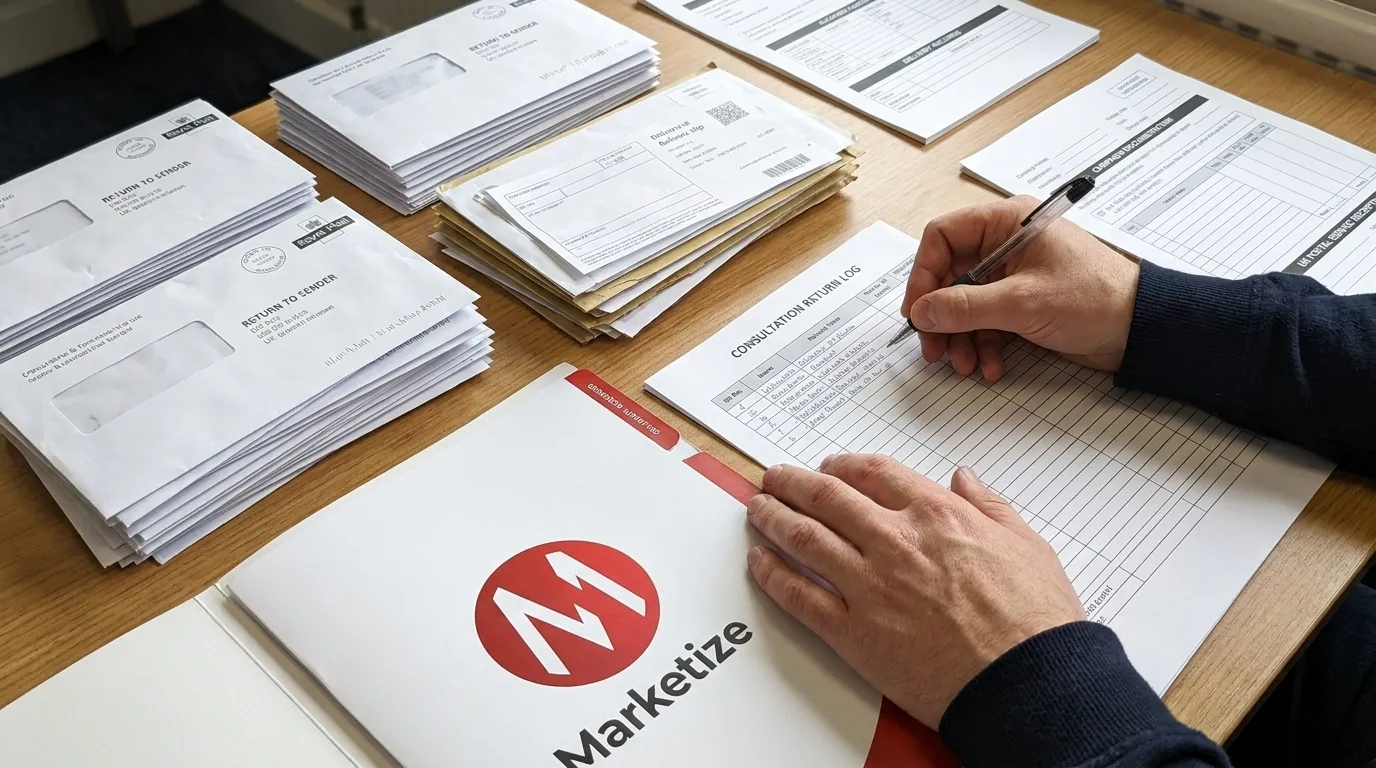
In a commercial leaflet campaign, a non-delivery is a property that gets skipped and recorded. The record is useful - it justifies the gap between leaflets distributed and letterboxes counted - but it doesn't have to withstand any particular scrutiny beyond showing the number is within the expected range. An aggregate figure is adequate. A percentage is fine. The record serves accounting purposes, not evidential ones.
In a consultation leaflet distribution campaign, the non-delivery record is a different document entirely. It's part of the formal process evidence. If the adequacy of your consultation is ever questioned - by an objector's solicitor, by a planning inspector, by the local planning authority reviewing your Statement of Community Involvement - the non-delivery log is what demonstrates that properties weren't reached because they couldn't be reached, not because the distributor couldn't be bothered.
The difference between these two standards is significant, and most people commissioning consultation distributions underestimate it until they need to rely on the documentation. This article is the third in the consultation and civic distribution series. The preceding articles - what consultation leaflet distribution is and when it's required and legal and procedural requirements for planning application leaflet drops - establish the broader context. This one covers the non-delivery record specifically.
Why Non-Delivery Documentation Matters More in Consultation
In commercial distribution, the non-delivery record protects the relationship between the client and the distribution company. It explains why you're returning leaflets, prevents disputes about whether the delivery was complete, and provides context for response rate analysis. The full commercial evidence standard for non-delivery logging is covered in how to avoid leaflet theft and false delivery claims - what's required in consultation work applies that standard with additional rigour.
In planning application leaflet distribution, the non-delivery record protects something more significant: the validity of the entire consultation process.
Planning applications are contested. Neighbours object. Community groups challenge. Solicitors representing objectors or other interested parties look for weaknesses in the procedural record. "The applicant says they distributed to the entire notification zone" is an assertion. A timestamped, address-level non-delivery log with specific reasons for each undeliverable property is evidence.
The practical question the non-delivery record needs to answer is this: for every property within the defined notification zone that didn't receive a leaflet, can you demonstrate that it wasn't reached because it genuinely couldn't be reached - and can you show specifically why? If the answer to that question is yes, your non-delivery record is doing its job. If the answer is "we have a percentage figure and some notes," it may not be adequate.
What a Consultation Non-Delivery Record Must Contain
The minimum standard for a non-delivery record in a consultation leaflet distribution context is specific, not aggregate. This is the fundamental difference from commercial practice.
Address. Every property that wasn't successfully delivered to needs to be individually identified by address. Not "approximately 12 properties on Oak Street were inaccessible" but the specific addresses.
Reason for non-delivery. A specific, factually accurate reason for each address. Not a generic category ("inaccessible property") but a description of the actual situation encountered: "No visible letterbox. Gated front access. Entry system present - no response on two attempts." The reason should be the one that actually applied, recorded at the time.
Timestamp. When the delivery attempt was made. This should be generated automatically by the recording system rather than added manually afterward, because a timestamp added retrospectively has less evidential weight than one embedded at the point of recording. For the full explanation of how platform-generated timestamps differ from retrospective records in terms of evidential integrity, what is GPS tracked leaflet delivery covers how timestamps, coordinates, and photo metadata are embedded at the point of capture.
Geolocation. Where possible, the location data associated with the non-delivery record - either from the device used to record it or from the GPS trail showing the distributor's position when the record was made. This confirms the distributor was at the address they claimed couldn't be reached.
Photographic evidence of the access barrier. For properties where the reason for non-delivery is a physical obstruction - a gated entrance, a broken entry system, a building with no visible letterbox - a photograph taken at the address adds significant weight to the record. The photograph should be geotagged and timestamped.
Valid Reasons for Non-Delivery in a Consultation Context
The reasons that justify a non-delivery in a commercial campaign and the reasons that justify one in a consultation context are not identical.
Valid in both contexts
- Gated property with no accessible letterbox, post box, or intercom
- Entry system present, no response after reasonable attempts
- Property with no visible letterbox or post facility of any kind
- Access presenting a genuine safety hazard (unstable surface, dangerous approach)
- Property demonstrably derelict or unoccupied (no letterbox, boarded windows)
Valid in consultation context with additional effort expected
- Communal entrance with entry system: attempt the intercom. If there's a concierge, speak to them. If there's a managing agent sign, note it. Only record as non-deliverable after genuine attempts to find an access route.
- High-rise building with restricted access: attempt the main entrance. If there's a call panel, use it. Document each attempt.
- Large residential estate with multiple entrances: cover each entrance point systematically before recording any section as non-deliverable.
Not valid in consultation context
- "No Junk Mail" sign. This is consultation material, not commercial marketing. Consultation notices are not junk mail - the resident's right to be informed about planning matters affecting their area takes precedence.
- Property appeared difficult to access or approach looked inconvenient.
- Distributor ran short of time.
This is important. The threshold for what constitutes a legitimate non-delivery in consultation work is higher than in commercial distribution. The capacity implications of this higher effort threshold - and why consultation distribution always takes more time per address than standard commercial delivery - are covered in how many letterboxes a distributor can realistically deliver in a day. Briefing distributors to understand this distinction before the campaign starts is covered in how to manage leaflet distributors.
The Process: Recording Non-Deliveries in Real Time
The most common mistake in consultation distribution documentation is retrospective recording. The distributor completes the delivery, returns to base, and then writes up their non-deliveries from memory or rough notes.
This produces records that are less reliable and evidentially weaker than real-time recording for several reasons. Memory degrades. Specific details get lost. Timestamps, if added retrospectively, are estimates rather than records of when the attempt actually occurred. And a log assembled after the fact can't be cross-referenced against the GPS trail to confirm the distributor was at each address at the time claimed.
Real-time recording - logging each non-delivery at the address, using a platform that embeds timestamps and location data automatically - produces a record with inherent integrity. The timestamp is the moment the entry was made. The location data confirms where the distributor was. The reason recorded is what was observed in the moment. If the log is later cross-referenced against the GPS trail, the two sources should be consistent with each other. For the framework that uses this kind of GPS-non-delivery consistency check to identify anomalies across a campaign, GPS tracking for campaign analysis covers the analytical methodology.
For platforms like Marketize, the non-delivery recording function is integrated into the same app that manages GPS tracking and photo capture. A distributor at an inaccessible property enters the reason, and the entry is timestamped and geolocated automatically. That record flows into the campaign completion data as a primary entry, not a retrospective addition. The technology stack that makes this integration possible - offline data storage, auto-geotagging, and platform-generated reports - is covered in the technology behind modern leaflet distribution.
Photographing Access Barriers
For consultation leaflet distribution campaigns, the practice of photographing access barriers at non-deliverable properties is worth establishing as a standard rather than an optional extra.
A photograph of a gated entrance with an intercom showing "no entry" does more evidential work than a log entry saying "gated, intercom, no response." Not because the log entry is inadequate, but because the photograph is harder to dispute and makes the record visually demonstrable rather than purely textual.
The photograph should:
- Be taken at the property it relates to. Photographs taken from a distance or in a way that doesn't clearly show the specific access barrier at the specific address are less useful.
- Be geotagged and timestamped. The metadata embedded in the photograph should place it at the relevant address at the time of the delivery attempt. Where a platform automatically embeds location data in photographs - with photos appearing as pins on the GPS map at their capture coordinates - this happens without any additional action from the distributor.
- Show the specific barrier. A photograph of the gate. A photograph of the entry system with no accessible letterbox. A photograph of the building entrance showing that no communal letterbox is available. The photograph should make clear why delivery was not possible.
Be taken for each property where the reason for non-delivery is a physical barrier. Where the reason is something different - a confrontational resident, an aggressive animal - a photograph may not be appropriate, but the reason still needs to be clearly recorded in the log.
Structuring the Non-Delivery Log for Formal Submission.
At the end of a consultation distribution campaign, the non-delivery log needs to be in a format that can be included in or appended to a formal planning consultation document.
The structure that works for formal purposes:
- A summary at the top: total properties in the notification zone, total delivered, total non-delivered, and a percentage breakdown. Letterbox counting tools that produce accurate totals for the notification zone are covered in letterbox counting tools explained - these figures should be established before the campaign starts, not estimated afterward.
- A table or list of non-deliverable properties: address, reason for non-delivery, date and time of attempt, and whether photographic evidence was taken.
- A provenance note: If the non-delivery log was generated through a platform that timestamps and geolocates each entry, include a note to that effect - "Non-delivery records were generated in real time using [platform] with automatic timestamping and geolocation at the point of recording."
- Photographic evidence as an appendix: If photographs were taken, include them with captions identifying each by the address and date it relates to.
The non-delivery log should be submitted alongside - not instead of - the GPS coverage map and overall completion documentation. Together, these three elements (GPS coverage, completion report, non-delivery log) form the formal record of the consultation distribution. For the full breakdown of what a planning-compliant completion report must contain beyond the non-delivery log, how to read a leaflet distribution completion report covers every element.
What Happens When the Non-Delivery Record Is Questioned
If a planning application is challenged, or if a concern is raised about the adequacy of the consultation process, the non-delivery documentation is what gets examined.
"Were all properties within the notification zone delivered to?" The answer, supported by GPS coverage and the non-delivery log: "All properties were attempted. Those successfully delivered to are confirmed by GPS coverage data. Those not reached are recorded individually in the attached non-delivery log."
"Why weren't certain properties delivered to?" The answer comes from the individual records: specific reasons, specific addresses, with timestamps and location data confirming the attempts were made.
"Can you confirm when the non-delivery records were created?" If records were created in real time with embedded timestamps, the answer is unambiguous. If they were compiled retrospectively, this question is harder to answer credibly.
"Is there photographic evidence for properties that weren't reached?" If you've photographed access barriers as described above, yes. If you haven't, this is a gap in the record that may require explanation.
The robustness of your non-delivery documentation determines how confidently these questions can be answered. For the commissioning framework that builds the right documentation structure into the campaign from day one - what to specify, what to require from the provider, and how payment structures should align with evidence review - how to commission a leaflet campaign so poor delivery has nowhere to hide covers every structural decision. Applied to consultation work, the stakes at each decision point are higher.
The Non-Delivery Record Is Part of the Process, Not a Postscript
Non-delivery documentation for consultation leaflet distribution campaigns is not an administrative afterthought. It's part of the formal process record. Getting it right - specific addresses, real-time recording, embedded timestamps, photographic evidence of barriers - is what makes the difference between a consultation process that can demonstrate its adequacy and one that's vulnerable to challenge.
For distribution operators taking on consultation and civic distribution work, the performance tracking framework that confirms whether distributors are recording non-deliveries correctly - and catching gaps before the campaign ends rather than after - is covered in how to track distributor performance. And for the briefing standards that ensure every distributor understands the higher effort threshold before they start, best practices for hiring leaflet distributors covers the screening and briefing process that puts the right people on consultation campaigns.
Ready to commission a consultation distribution campaign where the non-delivery record is generated automatically, in real time, with embedded timestamps and geolocation? View campaigns on Marketize - the documentation standard that formal consultation processes demand, built into the platform rather than assembled afterward.