2 October 2026 · 9 min read
How Honest Non-Delivery Recording Protects Your Professional Reputation
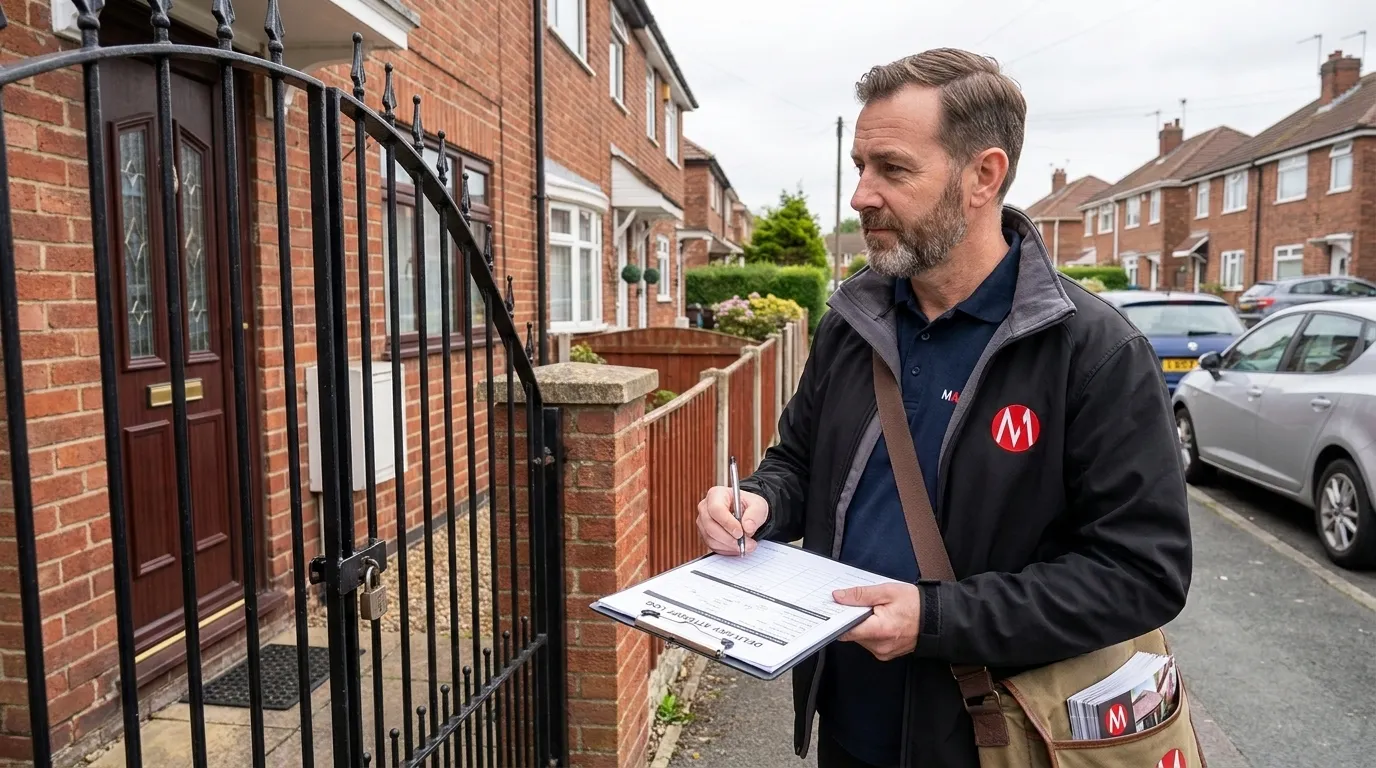
Here's a situation that happens to distributors more often than you might expect. A client or agency questions whether a particular area was properly covered. Maybe a street produced no response. Maybe someone called the client saying they didn't receive anything. Maybe the client has driven past and formed an impression that certain sections looked untouched. The question comes back to you.
If you have a thorough, honest, real-time non-delivery recording log - specific addresses, specific reasons, timestamps, cross-referenceable against your GPS trail - you can answer that question directly from the data. If you don't, you're left defending yourself with words against someone else's impression.
This is why non-delivery recording isn't just an administrative requirement. It's the thing that protects honest distributors when questions arise. And given that this industry has a long history of false accusations alongside real ones, having that protection matters more than most people starting out realise.
What Non-Delivery Recording Actually Is
When you're distributing leaflets, not every property in your area will receive one. Some display "No Junk Mail" signs - and those must be respected without exception. Some are genuinely inaccessible: gated properties with no letterbox or intercom, broken entry systems on flat blocks that can't be accessed, properties where the approach presents a real safety concern. These situations are normal. Across most residential areas, they typically account for around five percent of addresses, sometimes a little more in areas with higher concentrations of "No Junk Mail" properties.
Non-delivery recording is the process of logging each of these properties individually, at the time, at the address, with the reason recorded. Not a rough note at the end of the shift. Not an approximate count on a piece of paper. A specific entry made in the moment, using the app's dedicated recording function, with the timestamp and location data embedded automatically.
That last part is what makes the record meaningful. A timestamped, geolocated entry created at the property carries evidential weight that a retrospective list simply can't match. It feeds directly into the completion report that clients review - and a report backed by real-time non-delivery data tells a very different story from one that isn't.
The Two Threats Non-Delivery Records Protect Against
Honest non-delivery recording defends against two distinct problems that sit at opposite ends of the honesty spectrum.
The first is false accusations. A client who expected a hundred percent of their campaign area covered - who may not understand that a five percent non-delivery rate is a completely normal and expected feature of residential distribution - might interpret returned leaflets or lower-than-expected response as evidence that the job wasn't done properly. Without a detailed non-delivery log, you have nothing specific to point to. With one, you can show exactly which properties weren't delivered to, and precisely why. The full picture of how false delivery claims arise and how to avoid them is worth understanding before you encounter one.
This matters enormously if a dispute is raised. When a neutral third party reviews the situation, they're looking at GPS data, photos, and non-delivery records. A distributor who has logged genuine non-deliveries accurately is in a very different position from one who has no record at all. The good vs great distributor guide covers how this standard of accuracy distinguishes the best operators in the field.
The second threat is self-inflicted, and it's worth naming plainly: the temptation to use the non-delivery recording function as a way to reduce workload. Recording properties as undeliverable when they weren't actually undeliverable - properties that were simply inconvenient, had a slightly difficult letterbox, or were on a street that required a bit more walking - is something that platforms monitor actively. Letterbox counting tools and cross-referencing can identify when non-delivery figures are notably higher than expected for a given area - and will investigate.
Using the recording function dishonestly to inflate non-deliveries doesn't protect you. It exposes you. And it's the kind of thing that ends a distributor's relationship with a platform very quickly.
What to Record and What Not To
The threshold for a legitimate non-delivery has a test that's worth keeping in mind: would another reasonable distributor, looking at this property, agree that delivery was genuinely not possible?
If the answer is yes, record it and move on. If you're not sure, make the delivery.
Properties that legitimately qualify as non-deliverable include those displaying a clearly visible "No Junk Mail" or "No Circulars" sign, gated properties where there's no accessible letterbox, intercom, or communal post facility, buildings where entry systems are broken and there's no way in despite reasonable attempts, situations where an aggressive or audible animal presents a genuine risk, confrontational or threatening residents, and approaches with serious safety hazards like unstable surfaces or genuinely dangerous access.
Properties that don't qualify include those with slightly awkward letterboxes that require a bit more effort, houses with long driveways, buildings that have intercoms you'd rather not use, or streets that are simply less convenient to cover. A long driveway is not an inaccessible property. A stiff letterbox is not a reason to skip. These are part of the job.
The distinction matters because the record you build over time reflects your judgement. A non-delivery rate that's consistently within the expected range, applied to genuinely problematic properties, shows a professional who understands the standard. The distributor career path series covers how this kind of professional standard compounds into a commercially valuable reputation over time.
How to Record Non-Deliveries Correctly
The mechanism is the app's dedicated recording button. Use it at the property, not retrospectively.
When you reach an address you can't deliver to, tap the button, enter the reason, and move on. The entry is timestamped automatically to the moment you create it, and geolocated to your position. This means it can be placed on the GPS tracking map and compared against your route - confirming that you were at that address at that time.
Be specific about the reason. "No Junk Mail sign" is better than just "could not deliver." "Entry system not functional, no communal letterbox accessible" tells a clear story. "Aggressive dog visible in garden, gated access" explains the situation without ambiguity. The reason needs to be accurate - and it needs to describe what was actually there, not what was convenient to say.
Where possible, take a photograph of the access barrier at the same time. A photograph of the gate, the broken entry system, or the sign - geotagged and timestamped - adds visual evidence to the log entry. On platforms like Marketize, these photos appear as pins on the GPS map at the exact coordinates where they were taken. That kind of corroboration is powerful if a dispute ever arises. It's also very hard to fake convincingly.
Understanding how GPS tracking feeds into campaign analysis helps you appreciate why every detail of the record matters - not just for disputes, but for building a data-driven distribution record that clients and agencies trust.
What Happens to Returned Leaflets
When your round ends with unused leaflets - because legitimate non-deliveries reduced the deliverable area - those leaflets go back. All of them.
This is non-negotiable, and there are two things you must not do: discard them, and post multiple leaflets through the same letterbox to reduce your remaining count. Both are detectable. Letterbox counting tools flag delivery figures that don't match the properties covered, and platforms monitor these patterns. The consequences - financial and reputational - aren't worth whatever time they appeared to save.
Returning unused stock honestly is the correct response to a legitimate non-delivery rate. When your non-delivery log accounts accurately for the returned quantity, the numbers tell a coherent, verifiable story. Client ordered 5,000. Distribution area contained approximately 4,750 deliverable properties (accounting for the standard non-delivery allowance). Distributor delivered 4,750. Non-delivery log shows the specific reasons for the remaining addresses. Records are consistent.
That consistency is also what agencies look for when tracking distributor performance across campaigns. A distributor whose numbers always add up is a distributor worth booking again.
The Cumulative Value of Clean Records
One shift's non-delivery log matters. But what really builds professional value is the pattern across many shifts.
A distributor whose non-delivery records are consistently accurate - within expected ranges for the area types they cover, specific and well-reasoned for each entry, corroborated by GPS data and photos - develops a track record that speaks for itself. Agencies managing distributor teams look at that record when allocating premium jobs, time-sensitive campaigns, or work in areas where they need someone they can trust without close monitoring.
The honest truth is that most disputes in leaflet distribution go against distributors who have thin or inconsistent records, not because they necessarily did anything wrong, but because they can't show that they didn't. Honest, detailed, real-time non-delivery recording is the single most effective professional protection available to a distributor - and it costs nothing beyond the few seconds it takes to use the recording function properly at each property.
Marketize's platform is built around exactly this kind of primary data: GPS-tracked delivery records, timestamped photo evidence, and real-time non-delivery logs that together create a completion record the client can review directly. For verified leaflet distributors operating within that framework, honest recording doesn't just protect you from disputes - it demonstrates, repeatedly and verifiably, that you're the kind of person worth commissioning again. That's the economics of honest distribution in practice: doing the job properly builds something that compounds.
Agencies and clients use best practices for hiring leaflet distributors to separate reliable operators from unreliable ones. A clean non-delivery record is one of the clearest signals they look for. Understanding how many letterboxes a distributor can realistically cover in a day also helps you set honest expectations with clients - and avoid the trap of over-committing and under-delivering.