28 October 2026 · 10 min read
Can You Physically Do This Leaflet Distribution Job? An Honest Self-Check
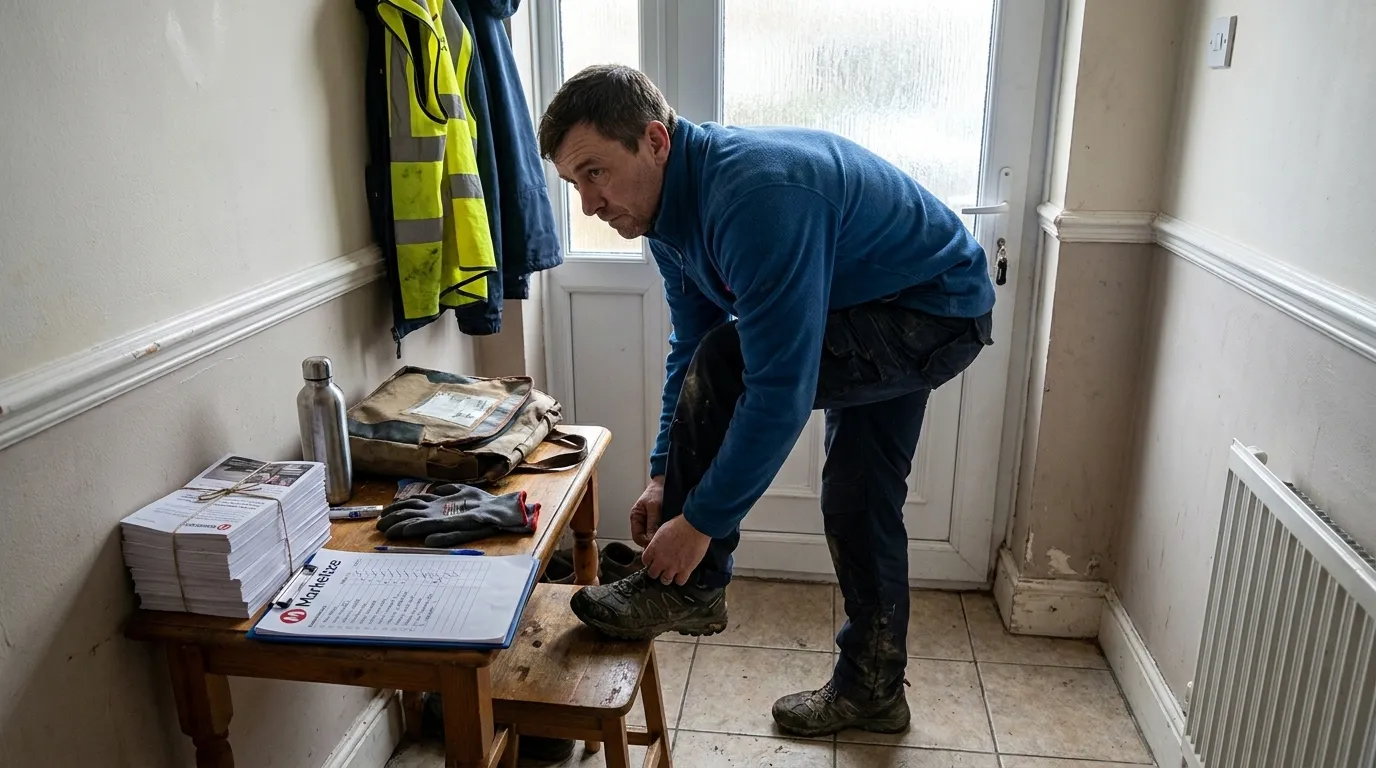
Leaflet distribution is often described as easy outdoor work. Flexible hours. Fresh air. Good exercise. All of that is true - but it's the kind of description that skips over what a full distribution shift actually involves, which is hours of sustained physical effort carrying weight in whatever the British weather decides to do that day.
Most people who try it and find it harder than expected aren't unfit. They're unprepared. They said yes to a job without thinking concretely about what a full shift demands from their body, and they found out the answer midway through a long road in the rain with two hours still to go.
This article is a practical self-check. Not a test you pass or fail, but a set of questions worth sitting with honestly before you accept work - particularly your first job, or a job that's larger or more demanding than what you've done before.
What a Full Distribution Shift Actually Involves
Before assessing whether you can do it, you need a realistic picture of what you're assessing yourself against. Understanding the fundamentals of leaflet distribution work makes the rest of this self-check more concrete.
A full distribution day means continuous walking for five to eight hours, depending on the job size and area type. Not a gentle stroll. Walking at a consistent pace, stopping at each property, returning down driveways, managing a bag that starts heavy and lightens gradually as you deliver. Over the course of a day, you might cover ten to fifteen kilometres. In some areas and some jobs, more.
You're doing this carrying weight. A thousand standard A5 leaflets at typical paper weight is roughly one kilogram. If you're starting with 3,000 or 5,000 leaflets before your first reload, you might be carrying five kilograms or more of material before you add your bag, your water, and any food. A well-fitted backpack distributes this better than a shoulder bag, but the weight is real regardless.
You're doing this on whatever day the job falls. UK weather is not negotiable. Leaflet distribution happens in rain, in cold, in wind, sometimes in heat. A rain cape is not optional. Neither is appropriate footwear. There's no practical shelter during the shift beyond what you encounter incidentally.
And you're doing it alone. There's no one to pace you, no team to carry part of the load, no manager to check in with. The self-discipline to keep moving at the right pace, manage your route efficiently, and maintain quality through the last hour is entirely on you - and that discipline shows up directly in your GPS-tracked delivery record and non-delivery documentation, both of which form your professional reputation over time.
That's the job. Measured against that description, the self-check questions below become more useful.
The Self-Check Questions
How Far Can You Walk Without Stopping?
Not how far you've walked before on a nice day - how far you can walk on a working day, at a steady pace, carrying weight, on terrain that may include hills, long paths, and uneven surfaces.
Experienced distributors working efficiently might cover 800 to 1,000 letterboxes in a full day on dense urban streets. In suburban or lower-density areas, the same physical effort produces fewer deliveries per hour - more walking between properties, longer approaches, more variable terrain.
If a five-kilometre walk is a significant physical effort for you, a fifteen-kilometre distribution shift will be very hard. That's not a disqualification - people build up to more demanding jobs over time - but it's a reason to start with a smaller, less demanding job while you find your baseline.
How Does Your Body Respond to Repetitive Movement?
Letterbox delivery involves a specific repeated motion: approach, post, withdraw, move on. Across hundreds of letterboxes in a day, this puts consistent low-level strain on your dominant hand and wrist, your back from bending at varied heights, and your knees and hips from the cumulative impact of several hours of walking.
Most people adapt to this reasonably quickly across their first few jobs. But if you have a pre-existing condition affecting your wrists, hands, back, knees, or hips, it's worth thinking about honestly. A bad back that's manageable on a normal day may not be manageable on day two of a cold, wet distribution shift.
This isn't a reason to rule out the work. It's a reason to take your first job on a smaller, gentler area before committing to something demanding.
How Do You Manage on Uneven or Challenging Terrain?
Leaflet distribution doesn't happen on a treadmill. It happens on pavements that are sometimes poorly maintained, on gravel driveways, on paths with steps, on roads with no pavement at all in lower-density areas. Wet leaves in autumn. Ice in winter. Uneven surfaces throughout.
Different area types present very different terrain challenges - a well-kept suburban estate is a very different physical environment from a low-density rural area with unmaintained footpaths. Looking at the area in Street View before accepting can give you a reasonable sense of what the terrain is like.
Can You Sustain Effort for Several Hours?
This is different from whether you can walk far. Some people can cover distance but find it hard to maintain consistent effort over a long period. Leaflet distribution doesn't have a natural break point built in - you stop when you've finished the section you're working, or when you reach a logical reload point, not at a set interval. Some people find this kind of open-ended sustained effort much harder than a clearly bounded activity.
Be honest about how you respond to this. If you find your energy, focus, or motivation drops significantly after two or three hours of sustained activity, a six-hour job is a harder ask than a shorter one. That's not a permanent limitation - endurance builds with experience - but starting with a job scaled to what you can currently manage comfortably is better than taking on something that pushes you past your limits on your first attempt.
How Do You Handle Weather?
The honest answer here matters. Distribution jobs don't get cancelled because of light rain or cold. They happen on the scheduled day unless conditions are genuinely dangerous. If you accept a Friday job and Friday is wet and cold, you go out in the rain or you pull out of the job - and pulling out at that stage has real consequences for your professional record.
Some people genuinely manage outdoor physical work in poor weather well, with appropriate kit. Others find it significantly more draining. Wet conditions on a long distribution shift are harder than the same shift in dry weather. Cold hands slow your letterbox technique. Rain adds to the general difficulty of a job that's already physically demanding.
Ask yourself honestly: in the winter months, when many distribution jobs run, can you manage a full shift in rain and five-degree temperatures? If you're not sure, try a short job first in reasonable conditions before committing to a long one in a difficult season.
What's Your Fitness Baseline Right Now?
Not at your best historically - right now. This matters because people often assess physical tasks against how they once performed rather than where they currently are.
If you've been sedentary for a while, if you're recovering from illness, if you haven't done sustained physical activity recently, your first distribution shift will feel harder than it would have six months ago. That's not a reason to avoid the work. Distribution can build fitness fairly quickly, and starting with smaller jobs is exactly how you build toward more demanding ones without overloading yourself.
The problems come when people accept large, demanding jobs based on an optimistic assessment of their current fitness, and then find themselves unable to complete the work professionally. Understanding how the per-thousand rate translates to actual day earnings is directly connected to this: the calculation only holds if you can realistically complete the volume at the pace the rate assumes. A 5,000-leaflet job in a low-density suburban area on your first attempt is a significant physical undertaking. A 1,000-leaflet job in a compact urban area is considerably more manageable as a starting point.
What Preparation Helps
If your self-check tells you that some of the demands above are on the edge of what you can currently manage, that's useful information rather than a reason to stop. Several practical things help.
A well-fitted backpack makes a significant difference to how the weight sits across a long shift. A bag that digs into your shoulders or puts all the weight on one side of your body will cause pain that a properly distributed load wouldn't. If you're using a shoulder bag or a carrier that isn't designed for sustained weight-bearing over hours, it's worth getting a backpack before your first job.
Appropriate footwear is non-negotiable. Comfortable, waterproof shoes or boots that you can walk in for six hours. Not the shoes you wear for a short commute. Not trainers that'll soak through in the first rain. This is one of the most consistent pieces of advice from experienced distributors: bad footwear ruins a long shift in a way that good footwear simply doesn't.
Water and food need to be planned. Dehydration affects your pace and concentration more quickly than most people expect, particularly on warmer days or when you're exerting sustained effort. If the distribution area doesn't have convenient shops, plan to have what you need with you before you start. The economics of honest distribution include these preparation costs - treating them as part of running a professional operation, not afterthoughts.
A rain cape that actually works - not an afterthought, but a proper piece of kit that keeps you dry enough to work comfortably in typical UK rain - is part of professional preparation. Getting soaked halfway through a shift and having to cut it short costs you more than the price of a decent cape.
Before the job, use letterbox counting tools to plan your coverage area and understand the volume you're taking on in the context of the streets you'll be working. Knowing the job in advance is part of being physically prepared for it.
Starting Where You Actually Are
Leaflet distribution is genuinely good work for people who go into it prepared. It's active, it's flexible, it's outdoors, and it builds a verifiable professional record over time. People at a wide range of fitness levels do it regularly and do it well - including those looking for gentler routes into distribution work that suit their current capacity.
But starting where you actually are, rather than where you'd like to be, is the difference between a positive first experience and a difficult one. A first job that's within your current capacity - a smaller volume, a compact accessible area, a reasonable day - sets you up for a second job. A first job that overextends you sets you up for the opposite. What separates good distributors from great ones often comes down to exactly this kind of honest self-assessment and incremental progress.
Marketize's platform allows you to find local leaflet distribution jobs near you and filter for jobs that suit your area and capacity. If you're new to distribution, read the full guide on how to become a leaflet distributor in 2026 and explore the distributor career path series for where the work can take you. This article is part of the Before You Say Yes series on assessing a leaflet job.