2 June 2026 · 12 min read
Best Areas for Leaflet Distribution in Birmingham
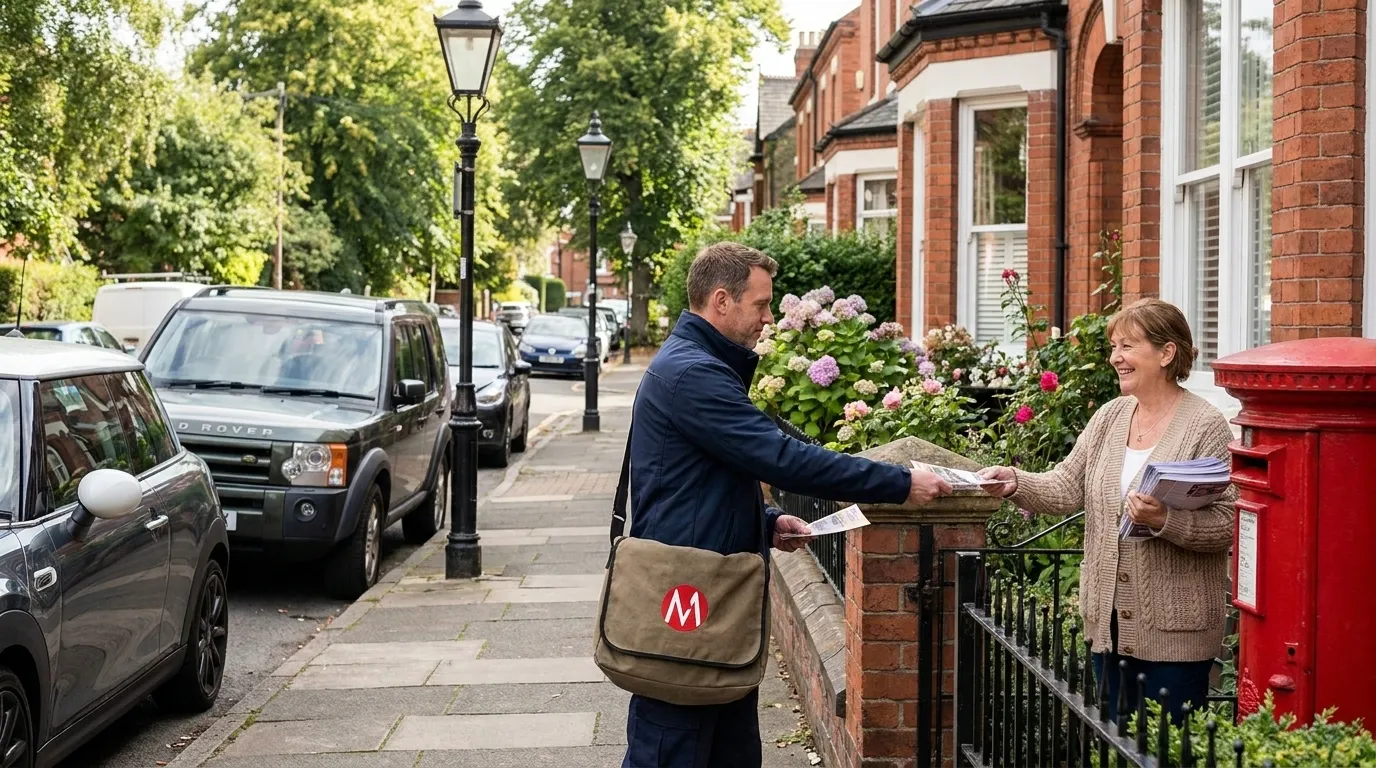
Birmingham is the UK's second largest city and one of the most varied. A city of distinct neighbourhoods - affluent suburbs to the south and north, dense inner-city residential areas in the east, student zones, culturally diverse communities, regenerating creative quarters - it rewards businesses who treat it as a collection of different markets rather than a single geographic block.
The best areas for leaflet distribution Birmingham depend entirely on who you're trying to reach. A plumber should be targeting different postcodes than a student accommodation provider. A premium salon in Harborne has a different audience than a takeaway in Sparkhill. Get that targeting right and flyer distribution Birmingham can be one of the most cost-effective forms of local marketing available. Get it wrong and you'll cover a lot of ground without converting anyone.
This guide breaks down Birmingham's key areas for leaflet distribution, explains which neighbourhoods suit which business types, and covers campaign planning, costs, and distribution logistics across the city. For the full targeting methodology that underpins all of these neighbourhood recommendations - demographic filters, property type selection, and proximity logic - how to choose leaflet distribution areas covers the framework you'll apply to whichever Birmingham areas you select.
Why Birmingham Works Well for Leaflet Distribution
Birmingham's housing stock is one of the most practical in any major UK city for letterbox campaigns. A high proportion of terraced housing, particularly across inner south, east, and north Birmingham, means dense residential streets with direct letterbox access. Compared to London, there are fewer high-rise tower blocks with locked communal entry systems causing access problems. Door to door leaflet distribution Birmingham typically moves faster per property and encounters fewer genuine access barriers.
The city's population of approximately 1.1 million within the city itself - and more than 2.4 million across the wider West Midlands conurbation - offers extraordinary reach for any business serving a local or regional market. And Birmingham's demographic diversity, the highest ethnic minority population of any UK city, means messaging and area selection need to be thoughtful. Businesses that align their campaign areas with their actual customer profile consistently outperform those that simply cover the nearest streets. For context on how leaflet distribution in 2026 performs as a channel against digital alternatives, that guide covers the comparative ROI picture across business types.
North Birmingham: Sutton Coldfield, Erdington, Great Barr, and Perry Barr
Sutton Coldfield
Sutton Coldfield is Birmingham's most affluent suburb and one of the most productive areas for leaflet distribution in the entire region. Property values are high, homeownership rates are strong, and the resident demographic - established families, professionals, retirees - responds well to services that reflect their lifestyle and spending capacity.
For home improvement tradespeople, premium restaurants, estate agents, private healthcare, fitness studios, and financial services, Sutton Coldfield represents excellent territory. The B72, B73, B74, and B75 postcode areas contain long stretches of semi-detached and detached housing with good letterbox access. Four Oaks and Streetly, at Sutton's northern edge, sit among the most affluent residential streets in the West Midlands and are worth targeting specifically for premium services. For these high-value, homeowner-focused campaigns, what is a good leaflet ROI gives you the benchmarks to set realistic expectations - home services in affluent areas typically reach 5:1 to 20:1 on mature campaigns.
The challenge with Sutton Coldfield is lower density than inner Birmingham - you cover more ground per thousand leaflets delivered - but the demographic quality typically justifies the slightly higher cost per thousand.
Great Barr and Perry Barr
Sitting west and south of Sutton Coldfield, Great Barr and Perry Barr offer solid residential coverage with a more mixed demographic profile. Semi-detached housing dominates, density is reasonable, and letterbox access is generally good. For businesses offering broad household services - energy efficiency, home maintenance, local food delivery, fitness - these areas provide volume reach at competitive distribution costs.
Erdington
Erdington has a long-established residential character with a mix of family housing and rental accommodation. Distribution here tends to be efficient given the terraced and semi-detached housing density. Good for value-oriented services, takeaways with delivery radius reaching into north Birmingham, and businesses targeting a wide demographic range.
South Birmingham: Edgbaston, Harborne, Moseley, Kings Heath, Bournville, and Selly Oak
South Birmingham is arguably the most strategically important part of the city for businesses targeting higher-income households and young professionals.
Edgbaston
One of Birmingham's most prestigious postcodes, Edgbaston (B15, B16) combines large Victorian properties, leafy streets, and a resident demographic that includes senior professionals, academics, and established families. The University of Birmingham's campus sits within the area, adding a secondary demographic of academic staff and postgraduate students. Estate agents, premium clinics, private schools, and quality local restaurants consistently find strong response here.
Harborne
Harborne has transformed significantly over the past decade and now rivals Moseley as one of Birmingham's most desirable addresses for young professionals and families. Independent restaurants, quality bars, boutique fitness studios, and premium home services all perform well in the B17 postcode. Housing is predominantly terraced and semi-detached Victorian stock with good direct letterbox access. Monthly drops to Harborne work particularly well for businesses building brand recognition over time - how often you should deliver leaflets covers why response rates in areas like this typically improve 20-40% by the third or fourth consecutive campaign.
Moseley and Kings Heath
These neighbouring south Birmingham communities share a character - independent, diverse, creatively inclined - that makes them receptive to local business marketing. Moseley (B13) in particular has a strong culture of supporting local businesses, and residents who respond to authentic, community-focused messaging rather than corporate advertising. Gyms, yoga studios, independent food businesses, ethical services, and local events all find engaged audiences here. Kings Heath (B14) is slightly more family-focused, with good housing density and a strong local high street.
Bournville and Stirchley
Bournville's Cadbury heritage has left it with some of the most attractive housing stock in the city - tree-lined streets, well-maintained homes, a genuinely community-minded resident population. It's not the densest area for distribution but the quality of the audience makes it worthwhile for premium home services, family businesses, and quality food brands. Neighbouring Stirchley is gentrifying rapidly, with a younger professional demographic moving in alongside established residents - an interesting dual-targeting opportunity.
Selly Oak and Bournbrook
The University of Birmingham's position means Selly Oak and Bournbrook carry a large student population, particularly during term time. This is strong territory for takeaways, food delivery services, budget fitness, student-focused events, and any service with a strong value proposition. Population turnover is high - refreshing significantly each September - so the window for building long-term recognition within this specific cohort is limited, but the sheer density and responsiveness to food-related offers makes it productive. For student-area campaigns, timing strategies for leaflet delivery covers why September/October and January drops dramatically outperform mid-term distribution.
East Birmingham: Sparkbrook, Sparkhill, Hall Green, and Acocks Green
East Birmingham's inner and outer suburban belt is characterised by high-density terraced housing, strong cultural diversity, and some of the highest concentrations of South Asian, Caribbean, and Eastern European communities in the UK.
Sparkbrook and Sparkhill
Dense, culturally rich, and intensely residential, the B11 and B12 postcode areas contain some of the highest household concentrations in Birmingham. For businesses with broad appeal across diverse demographics - food delivery, home services, clothing, financial services - this area offers excellent volume at cost-efficient distribution rates. The restaurant and food economy in this part of Birmingham is significant; local takeaways and food delivery businesses compete intensively, and consistent leaflet distribution remains an effective differentiator. Letterbox counting tools are especially useful here, where household density per street can be far higher than the geographic area suggests.
Hall Green and Acocks Green
Moving further south and east, Hall Green (B28) and Acocks Green (B27) offer more suburban family housing with a slightly older, more settled demographic profile. Homeownership rates are higher than in inner east Birmingham. Good territory for home improvement services, family-focused healthcare, estate agents, and businesses targeting established household decision-makers.
West and North-West Birmingham: Handsworth and Smethwick Borders
Handsworth (B20, B21) is one of Birmingham's most historically significant communities - diverse, densely populated, primarily terraced residential with very good letterbox access. Distribution is efficient per hour. This area suits businesses with broad demographic reach: food delivery, local retail, household services, and businesses with community-facing messaging.
The Smethwick border and surrounding Sandwell areas technically extend beyond Birmingham City Council boundaries but are effectively continuous with the west Birmingham residential fabric. For businesses with service areas that extend west of the city, these postcodes are worth considering as part of a wider West Midlands leaflet delivery service campaign.
The Jewellery Quarter, Digbeth, and Inner City Areas
Birmingham's regenerating creative quarters - the Jewellery Quarter (B3), Digbeth (B5), and Eastside - have grown significantly as residential areas, particularly for young professionals and creatives. Apartment development has been rapid, which means communal letterbox rooms are more common than individual street access. Distribution in these areas requires more careful route planning, and GPS-verified delivery matters more here than in traditional terraced areas - confirming exactly which apartment blocks were accessed and which couldn't be.
For businesses targeting young urban professionals - premium fitness, food delivery, lifestyle services, event promotion - these areas can be productive. Hand-to-hand distribution on the approach streets around Digbeth and the creative district's public spaces can supplement letterbox campaigns where access is more complex.
Matching Your Campaign to the Right Birmingham Areas
Rather than thinking about Birmingham as a city to blanket, most businesses get better results by identifying two or three high-priority neighbourhoods and targeting them consistently. The campaign strategy and planning hub covers how to build this targeted, consistent approach into a structured programme. Here's a practical summary by business type:
- Home services and tradespeople: Sutton Coldfield, Harborne, Edgbaston, Bournville, Hall Green, Acocks Green. Focus on homeowner-heavy streets with established family housing.
- Restaurants and food delivery: Match your campaign area tightly to your actual delivery radius. Dense inner areas like Sparkbrook, Handsworth, Erdington, and the student zones around Selly Oak provide volume. Consistent monthly drops within a defined delivery boundary outperform broad sporadic coverage.
- Estate agents and lettings: Valuation campaigns belong in owner-occupier areas - Sutton Coldfield, Harborne, Edgbaston, Kings Heath. Lettings campaigns should focus on areas with high rental demand - Selly Oak, Moseley, inner south Birmingham.
- Gyms and fitness studios: Target within realistic travel distance of your location. The university zones provide student membership opportunity; Harborne, Edgbaston, and Sutton Coldfield provide the premium membership demographic.
- Salons and local services: Hyper-local targeting within 15-20 minutes of your location. Three to four consistent monthly drops to the same postcodes build the recognition that converts.
Campaign Planning for Birmingham: Practical Considerations
Birmingham's housing patterns mean letterbox counting is particularly useful before committing to print runs. Some inner-city postcodes contain significantly more deliverable households than their geographic size suggests; some suburban postcodes cover much more ground per household. Letterbox counting tools - which cross-reference your target area against actual deliverable address data, accounting for the standard 5% undeliverable allowance - prevent the common mistake of printing too few or too many leaflets. For the full quantity calculation methodology, how many leaflets do I need? works through the maths step by step.
GPS-verified distribution gives you certainty that your campaign reached the postcodes you paid for, not approximately the right area. In a city as large as Birmingham, where a distributor might cover multiple postcodes per shift, knowing exactly which streets were covered (and which weren't) matters for calculating response rates and planning the next campaign. How to avoid leaflet theft and false delivery claims covers how GPS and photo verification protect your investment against incomplete coverage.
Campaign costs across Birmingham typically run £28–40 per thousand for shared distribution, £38-55 per thousand for solus, with some variation by area density. Print for 10,000 A5 leaflets typically adds £80–130. A 10,000-leaflet shared campaign in south or north Birmingham would typically cost £350-500 for distribution. For UK-wide benchmarks across all area types, the leaflet distribution prices guide for 2026 gives you reliable figures before budgeting.
For most Birmingham businesses, running monthly campaigns of 5,000-15,000 to consistently targeted postcodes - rather than one large sporadic drop - builds better results over a six-month period than any single high-volume campaign. Tracking those results properly is what tells you which areas to scale: how to measure leaflet campaign performance covers the tracking setup that turns each campaign into intelligence for the next.
Birmingham Rewards Precise Targeting
The best areas for leaflet distribution Birmingham aren't the same for every business. Sutton Coldfield's affluent homeowners, Moseley's independent-minded professionals, Selly Oak's student population, and Sparkbrook's dense residential streets all represent genuinely different opportunities. Matching your campaign area to your actual customer profile - and then hitting it consistently rather than just once - is what turns cheap leaflet distribution from a cost into a measurable marketing channel.
For distributors looking for work across Birmingham and the wider West Midlands, leaflet distribution jobs near you connects you with verified campaigns across the region. And if you're considering becoming a leaflet distributor in 2026, Birmingham's scale and consistent campaign volume make it one of the most active distributor markets outside London.
Ready to plan your Birmingham campaign? View campaigns and get started on Marketize - letterbox counting, demographic targeting by Birmingham postcode, GPS verification, and campaign reporting all included as standard across the West Midlands.