19 May 2026 · 14 min read
How to Track Conversions From Leaflets: Methods That Actually Work
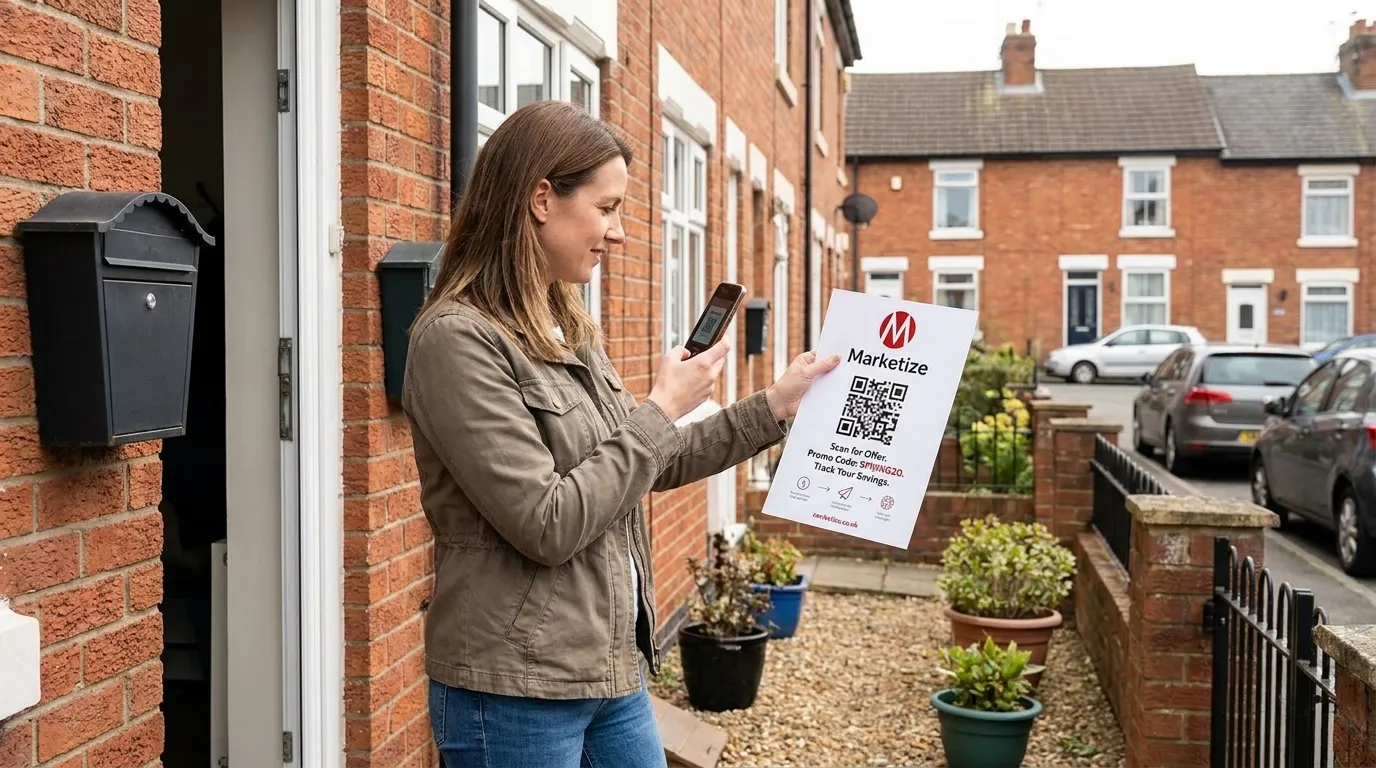
Here's the problem with most leaflet campaigns: the leaflet does its job, reaches the right person at the right moment, creates interest - and then nothing gets recorded. The customer calls your main number, visits your website, or walks through your door. The leaflet distribution played its part. But because there was no tracking mechanism in place, you'll never know.
Tracking conversions from leaflets isn't complicated, but it requires deliberate setup before a single leaflet gets printed. After distribution happens, it's too late. You can't reverse-engineer attribution. You can only measure what you planned to measure in advance.
How to track conversions from flyer distribution campaigns effectively means understanding what a conversion actually is for your specific business, building tracking mechanisms into every campaign before it launches, and using a combination of online and offline methods to capture as many responses as possible. Perfect attribution isn't achievable - but actionable data absolutely is.
This article focuses on the conversion tracking layer specifically. For the broader measurement framework - baseline setting, ROI calculation, lifetime value analysis, and post-campaign data interpretation - how to measure leaflet campaign performance covers every step. And for context on what good conversion rates and ROI actually look like by business type, what is a good leaflet ROI gives you the industry benchmarks to judge your results against.
Whether you run a takeaway, lettings agency, gym, or retail store, these methods will show you where responses are coming from, which areas convert best, and whether your campaign is worth repeating or scaling.
What Counts as a Conversion?
Before tracking anything, define what you're tracking. A conversion is different depending on your business model:
- Pizza delivery takeaway: A conversion is a first-time order from a new customer identifiable through a promo code.
- Gym or fitness studio: A trial membership signup, a free class booking, or a paid membership sale.
- Plumber or tradesperson: An inquiry call or a booked job.
- Lettings agent: A valuation request, a viewing booking, or an instruction to sell or let.
- Event organiser: A ticket purchase or registration.
Get specific. "Someone showed interest" isn't a conversion. A tracked, attributable action that moves someone toward revenue is a conversion. Define it clearly for each campaign before you set up tracking, because the mechanism you choose depends entirely on what action you're trying to capture. The campaign strategy and planning hub covers how conversion definition fits within the broader campaign planning framework - setting SMART objectives before deciding on distribution areas, quantities, and tracking methods.
Build Tracking In Before Distribution Starts
This is where most businesses go wrong. They distribute 10,000 leaflets, notice business seemed busier, and try to figure out after the fact whether the leaflets caused it. They can't. Without pre-set tracking, there's nothing to go back to.
Every conversion tracking method requires something to be set up before the leaflet is printed. The tracking code, phone number, QR code, or landing page URL has to appear on the leaflet itself - because that's how you connect the physical piece of paper to the customer action that follows. Think of tracking mechanisms as the bridge between distribution and conversion. No bridge, no attribution.
Pre-campaign setup sits alongside other decisions made before printing: how many leaflets to order, which areas to target, and when to distribute. How many leaflets do I need? covers the quantity calculation, and how to choose leaflet distribution areas covers demographic targeting - both decisions affect which tracking mechanisms make sense and how you'll interpret area-level conversion data afterward.
Online Conversion Tracking Methods
Unique Promo Codes
The most widely used tracking method for door to door leaflet distribution. Print a code on the leaflet - MARCH25, LOCAL10, SPRING50 - and instruct customers to use it when ordering, booking, or paying. Every redemption is an attribution. When someone enters MARCH25 at checkout, you know they came from the leaflet. No guesswork. No estimation. Clean, direct proof.
Set up codes through your POS system, online ordering platform, or booking software before printing. Make sure the discount or offer attached is meaningful enough to motivate use - a 5% discount often gets ignored; 20% off a first order gets redeemed.
Where this works best: Takeaways, restaurants, online retailers, gyms, salons, clinics - any business with digital ordering or booking systems.
Where it struggles: Higher-consideration purchases where people research extensively before committing. A solicitor or property developer won't book through a promo code. Different tracking method needed.
Campaign-Specific Landing Pages
Create a URL that only appears on this campaign's leaflets. It could be yoursite.co.uk/spring or yoursite.co.uk/localarea. Once you have the page, connect it to your analytics platform and set up conversion goals - form submissions, purchases, phone call clicks, bookings. Every visit and every conversion from that URL is attributable to the leaflet campaign.
The critical rule: That URL must appear nowhere else. Not in your emails, not on your social media, not on your website menu. The moment it appears on another channel, attribution is destroyed. For a comprehensive guide on how campaign landing pages integrate with retargeting audiences and digital attribution models - including how leaflet scan data feeds Facebook Pixel and Google Ads remarketing - how to combine leaflets with digital marketing covers the full technical approach.
QR Codes With Tracking
Real time delivery tracking data from GPS-verified campaigns becomes even more powerful when combined with area-specific QR codes. Generate unique codes for different distribution zones - Zone A in postcodes SW6-SW10 gets one code, Zone B in SE1-SE5 gets another. When you analyse conversions, you'll know which zones converted best, informing exactly where to focus your next campaign's budget.
Most QR code generator tools allow UTM parameter tracking, which connects directly to Google Analytics. This means you can see not just that someone scanned, but what they did afterward - how long they stayed, which page they visited, whether they converted.
Practical note: Print the QR code large enough to scan easily and test it before sending to print. A QR code that doesn't scan on the finished leaflet is useless and costly to fix.
Dedicated Campaign Email Addresses
Less common but effective for B2B or consultation-based services. "Email us at newclients@yourbusiness.co.uk" with that address appearing only on the leaflet. Every email to that address is a leaflet conversion. Works particularly well for professional services (solicitors, accountants, consultants, property developers) where the conversion action is an inquiry rather than an immediate purchase.
Offline Conversion Tracking Methods
Not every customer responds digitally. Plenty of people - particularly older demographics - prefer picking up the phone or walking in. If you're only tracking digital conversions, you'll undercount results significantly.
Dedicated Campaign Phone Numbers
Set up a tracking number specific to this campaign. The number forwards to your main line, so no calls are missed. But every incoming call to that number is recorded as a leaflet conversion. UK telecoms providers and services like CallRail, Ruler Analytics, or basic virtual number services provide these cheaply - often £10-30 per month.
Track not just call volume but call outcomes. Inquiry only? Booked appointment? Sale completed? This gives you conversion-to-close rate, which is more useful than inquiry volume alone.
Important: Use a local-area number where possible. National 0800 or 03 numbers work, but a local 020, 0161, or similar often generates higher response rates, particularly from residential campaigns, because it signals local presence.
Walk-In Attribution
For businesses with physical locations - salons, gyms, clinics, retail stores - train front-of-house staff to ask every new customer the same question: "How did you hear about us?" This sounds basic because it is. But most businesses ask this question sporadically, only when someone remembers to ask. If it's not systematic, it's not useful data.
Create a short script, add it to the onboarding process, put it in the booking form, make it part of the standard new customer experience. Record answers consistently, categorise them, and review weekly. "Saw your leaflet" becomes a tracked conversion. Some businesses add this as a required field in their booking software or consultation form - "how did you find us?" with "leaflet/flyer" as one of the dropdown options.
Voucher Cut-Outs
Include a voucher or coupon on the leaflet that customers physically bring in or redeem. "Bring this voucher for 20% off your first appointment." Every voucher handed over is a tracked conversion. You can also track by date received to understand response timing - how many came in week one versus week four.
This method has a natural self-selection aspect: people who bother cutting out and bringing a voucher tend to be more motivated buyers, often converting at higher rates than code-only customers who might use the code impulsively.
Multi-Channel Attribution: Handling the Grey Areas
Here's the honest truth about conversion tracking: you won't capture everything. And that's fine. Someone receives your leaflet, looks you up online, finds your Google Business listing, and calls your main number. The leaflet started the journey. But unless they used your tracking number or mentioned the leaflet, that call looks like organic Google traffic in your data.
Perfect attribution doesn't exist for offline marketing. What you can do is triangulate - use multiple methods simultaneously to capture as much as possible, then use baseline comparisons to estimate the rest. If your baseline is 40 new customers per week and you see 65 during campaign weeks (only 20 of whom used a tracking mechanism), those additional 25 likely had some leaflet influence.
Build your conversion tracking around two layers: direct attribution (tracking code, campaign number, QR scan, landing page visit) and modelled attribution (baseline uplift above normal volume during campaign period). Together they give you a realistic picture. The full methodology for combining these layers - including how to weight modelled attribution and how to compare across campaigns - is covered in how to measure leaflet campaign performance.
Tracking Across Different Business Types
Takeaways and Food Delivery
Best methods: Promo code through online ordering platform + campaign landing page.
Most food delivery is already digital, making code tracking particularly clean. Just Eat, Uber Eats, and most independent ordering systems accommodate promo codes natively. Conversion tracking is as simple as code creation and reporting.
Gyms and Fitness Studios
Best methods: QR code to booking page + dedicated phone number + walk-in voucher.
Fitness decisions are often made in person or by phone. Don't rely solely on digital tracking. A motivated prospect might scan the QR code, browse, then call to ask questions before booking. Campaign phone number catches that call. For context on when gym campaigns convert best - January and September peak windows produce 3-4x higher response rates than off-season - timing strategies for leaflet delivery covers seasonal benchmarks by business type.
Tradespeople and Home Services
Best methods: Dedicated campaign phone number + ask at quote stage.
Most home service inquiries start with a phone call. Campaign numbers are the primary tracking method. Add a script question at quote stage: "Can I ask how you found us?" Record every answer.
Real Estate and Lettings
Best methods: Campaign landing page + dedicated email + valuation request form.
Property inquiries tend to be email or form-based. Campaign landing pages with embedded valuation request forms capture these naturally. Include the campaign-specific email as alternative contact.
Retail with Physical Stores
Best methods: Voucher cut-out + promo code for online purchases + walk-in attribution.
Retail needs multiple methods because responses come through multiple channels. Some people walk in with the voucher. Others use the promo code online. Others walk in without mentioning the leaflet. Cover all three tracking methods to capture as much as possible.
Professional Services (Clinics, Solicitors, Consultants)
Best methods: Campaign-specific email address + dedicated phone number + form source field.
Professional services rarely convert through promo codes. People research, then contact directly. Track that contact by making campaign touchpoints visible - email address on the leaflet, specific phone number, and always include a "how did you hear about us" field in new client intake forms.
Using GPS Verification to Strengthen Conversion Data
Conversion tracking only makes sense if you know distribution actually happened. Paying for 10,000 leaflets and receiving 6,000 means your conversion rate is being calculated against the wrong denominator. For a full explanation of what GPS verification captures - route trails, timestamps, offline data storage, geotagged photo proof - what is GPS tracked leaflet delivery covers every element of how the audit trail works.
GPS proof of delivery data from verified distribution platforms provides complete route coverage: which streets were walked, when, at what pace. This tells you exactly which homes received leaflets, not which homes were supposed to receive them.
When combined with area-specific QR codes or tracking numbers, you can cross-reference GPS coverage with conversion responses to identify your highest-performing neighbourhoods. Zone B converted at 2.1% while Zone C converted at 0.6%? That's intelligence you can act on for your next campaign. For the methodology of using this geographic performance data to choose areas in future campaigns, how to choose leaflet distribution areas covers how to find demographically similar areas to your best performers and systematically expand there.
The fraud tactics that inflate your apparent distribution volume - reducing your real conversion rate without you knowing - are covered in how to prevent dishonest leaflet distributors. Letterbox counting tools provide the accurate denominator that makes conversion rate calculation reliable: verified deliverable addresses in your area, not printed quantities.
What to Do With Conversion Data
Tracking conversions is only valuable if you use the data.
- Review weekly during campaign window. Don't wait until a campaign ends to look at results. Monitoring response timing tells you whether to adjust future distribution scheduling.
- Compare by tracking channel. If 80% of conversions came through the QR code and 20% through the promo code, your audience prefers mobile engagement. Design future leaflets accordingly.
- Compare by area. If you used area-specific tracking mechanisms, identify which postcodes performed strongest. These get priority budget in the next campaign.
- Calculate actual conversion rate. Divide total attributed conversions by verified deliveries. If GPS data shows 9,500 homes received leaflets (accounting for the standard 5% undeliverable allowance) and 190 tracked conversions occurred, that's a 2% conversion rate — useful context for future campaign expectations.
- Feed back into lifetime value analysis. Tag leaflet-acquired customers in your CRM. Track how much they spend over six or twelve months. This shows you the real ROI of acquisition campaigns, not just first-transaction value.
For context on what those conversion rates and ROI figures should look like - and whether your numbers signal a channel worth scaling or one worth reconsidering - what is a good leaflet ROI gives you the industry benchmarks by business type, from first campaigns through to mature performance targets.
Attribution Is a System, Not an Afterthought
Tracking conversions from leaflets requires deliberate mechanisms built into every campaign before distribution starts - unique promo codes, dedicated phone numbers, campaign landing pages, QR codes, walk-in scripts, and voucher cut-outs working together to capture as many attributed responses as possible. No single method captures everything, which is why combining direct tracking with baseline uplift analysis gives you the most complete picture of what your campaigns are actually generating.
The measurement data you collect across campaigns compounds over time. By campaign three or four, you know which areas, offers, and timing windows produce the best conversions for your specific business. That institutional knowledge - built on verified leaflet delivery service data and systematic tracking - is what separates agencies and businesses that consistently scale their leaflet distribution near me campaigns from those stuck running the same guesswork campaigns repeatedly.
Ready to run a campaign you can actually track? View campaigns on Marketize - every campaign includes GPS verification, photo proof, and letterbox count data as standard, giving you the verified delivery foundation that makes conversion rate calculations meaningful.