19 March 2026 · 12 min read
What Is Proof of Delivery and Why It Matters in Leaflet Distribution
Ask someone who ran leaflet campaigns in the 1990s how they knew their leaflets actually got delivered, and you'll get some version of the same answer: "We trusted the distributor."
That was it. The entire system ran on trust. You handed over your leaflets, paid the invoice, and hoped the person you'd never met before would spend the next eight hours walking streets posting them through letterboxes instead of dumping them in the nearest industrial bin.
Sometimes they did the work. Sometimes they didn't. You had no way of knowing.
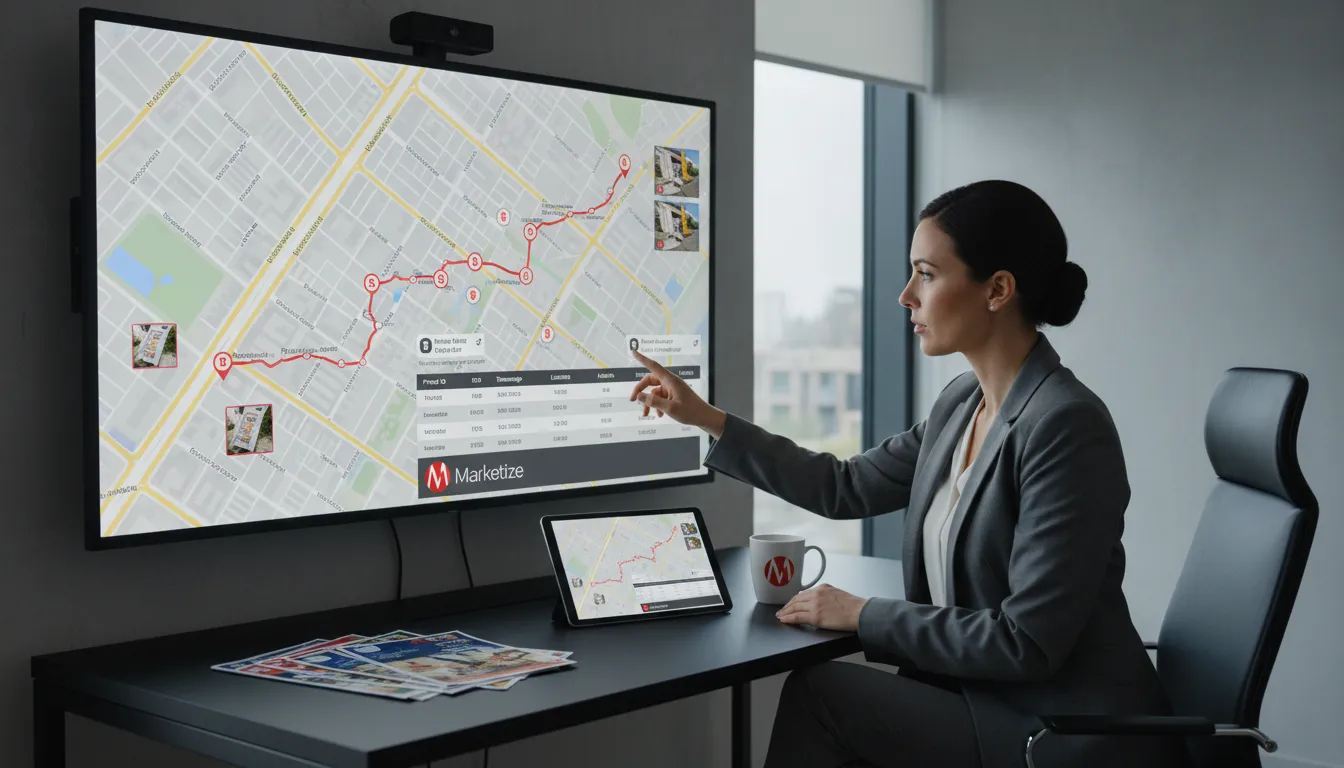
GPS proof of delivery changes that entirely. It's the collection of verifiable evidence that shows your leaflets were actually distributed to the specified area - not just collected and claimed as complete. Real time delivery tracking, timestamped photos, route verification, and letterbox counting combine to create an audit trail that makes fraud essentially impossible and honest work provable.
If you're planning a leaflet campaign now, understanding what constitutes valid proof of delivery isn't optional. It's the difference between measurable marketing and expensive guesswork.
What Proof of Delivery Actually Means
In leaflet distribution, GPS proof of delivery is the documented evidence showing your campaign actually happened the way you agreed it would. It answers three fundamental questions:
Where were the leaflets delivered? GPS tracking shows the exact route walked, which streets were covered, and whether the distributor actually reached your specified areas.
When were they delivered? Timestamps show start time, completion time, and how long the distributor spent in each section of the route--revealing whether the work was done properly or rushed through unrealistically fast.
Did delivery actually happen? Geotagged photos taken during distribution show leaflets going into letterboxes or being held at verifiable locations throughout the route, proving the distributor carried leaflets the entire time rather than walking empty-handed.
This three-part verification - location, timing, and visual evidence-forms complete proof of delivery. Any single element alone leaves room for doubt. Together, they create accountability.
Why Proof of Delivery Matters
The obvious reason is fraud prevention. Without proof, dishonest distributors can collect your leaflets, claim they've finished the job, and pocket payment for work they never actually did. It happened regularly in the industry's unverified era and still happens when businesses work with distributors who resist tracking.
But proof of delivery matters beyond just preventing outright fraud.
It Allows Accurate ROI Measurement
When a leaflet campaign underperforms, you need to know why. Was it poor distribution? Weak offer? Bad timing? Ineffective design?
If you can't verify distribution actually happened, you're guessing. Maybe your 1% response rate means your offer needs improvement. Or maybe only half your leaflets actually got delivered, meaning your real response rate was 2%-perfectly acceptable.
Real time delivery tracking kills that uncertainty. GPS tracking and photos confirm complete coverage—so you know distribution wasn't what went wrong. Focus your optimization efforts elsewhere: refine your targeting, strengthen your offer, or improve your creative. No point wasting time wondering whether the basics even happened.
It Protects Payment for Honest Distributors
Having no proof hurt honest distributors just as much as it hurt honest clients dealing with dodgy ones. Before GPS tracking became standard, a distributor could complete a job perfectly and still face non-payment from a client who simply claimed the work wasn't done.
The distributor had no defense. Their word against the client's word. Often, they lost.
GPS Proof of delivery flips this completely. Platforms like Marketize hold payment in escrow-style protection until the distributor submits GPS tracking and photos that prove completion. Once it's verified, payment releases automatically. Distributors don't chase invoices or argue about whether the work actually happened—the data does the talking.
This protection pulls in more professional, reliable workers who used to avoid the industry because payment was such a gamble.
It Enables Performance Comparison
If you run multiple campaigns or test different areas, proof of delivery lets you compare distributor performance objectively.
Distributor A covered 5,000 homes in six hours with complete GPS coverage and 95 timestamped photos. Distributor B covered the same quantity in four hours with patchy GPS data and 40 photos. The data suggests Distributor A probably did more thorough work
You're not judging based on how charming someone is or how well they sell themselves. You're looking at verifiable performance data and picking accordingly next time.
It Satisfies Compliance Requirements
Some industries have to meet regulatory requirements around marketing accountability. Estate agents promoting new developments, political campaigns during elections, businesses making specific claims about reach - they all benefit from documentary proof that the distribution they claimed actually happened.
GPS trails, timestamped photos, and route verification give them that documentation. If challenged, you can produce an audit trail showing exactly where, when, and how distribution happened.
What Constitutes Valid Proof of Delivery
Not all "proof" is created equal. Some methods provide genuine verification; others are easily faked or incomplete.
GPS Tracking (Essential)
Valid GPS tracking records the distributor's location continuously throughout the job - typically every few seconds - creating a complete trail of everywhere they walked.
The data should show:
- Full route coverage of your specified area
- Logical movement patterns (not just wandering around or staying put)
- Timing that makes sense for the quantity and area density
- No major gaps from signal loss (platforms like Marketize store GPS data offline and sync when signal comes back, so you get no blank spots)
GPS tracking alone doesn't prove leaflets were actually delivered - someone could walk the route empty-handed. But it's the foundation. Without it, you've got no leaflet distribution proof of coverage.
Timestamped, Geotagged Photos (Critical)
Photos give you visual evidence that leaflets were actually carried and delivered. Valid photo proof includes:
Geotags: GPS coordinates embedded in each photo showing exactly where it was taken
Timestamps: Exact time each photo was captured, matching the distribution timeframe
Visual content: Images showing leaflets going into letterboxes or the distributor holding leaflets at recognizable locations
Frequency: Photos taken at regular intervals (typically every 50-100 letterboxes) spread evenly across the route
Platforms like Marketize display these photos as clickable pins on the GPS map. Click a location, see the photo taken there. This integration prevents fraud - you can't upload old photos from your camera roll because the geotags wouldn't match the real time delivery tracking trail.
Letterbox Count Verification (Advanced)
This cross-references the distributor's GPS route against known letterbox density data. Say they claim to have delivered 5,000 leaflets but their GPS trail only covered streets with 3,200 letterboxes—the math exposes the problem straight away.
Platforms with letterbox counting tools perform this verification automatically. The system knows how many deliverable addresses exist on every street. It calculates which streets the GPS trail covered and compares that to the reported quantity.
This catches selective skipping--where a distributor walks the route but deliberately avoids difficult properties (flats with entry systems, houses with dogs, properties with "No Junk Mail" signs beyond the standard 5% undeliverable allowance).
Completion Reports (Supporting Evidence)
A comprehensive proof of delivery package includes:
- Full GPS route map showing complete coverage
- Photo gallery with all geotagged images
- Timing summary (start, end, duration, average speed)
- Distance covered
- Coverage statistics comparing specified area to actual route
- Notes or flags from the distributor about any issues encountered
This becomes a permanent record attached to the campaign - the complete leaflet distribution proof package.. If questions arise later - Did we cover that area last month? How long did 10,000 leaflets typically take? - the data is archived and accessible.
How the Technology Creates Proof
Understanding how proof of delivery gets generated helps you evaluate its validity.
During Distribution
The distributor opens the tracking app on their smartphone and starts the job. The app starts recording GPS coordinates continuously, enabling real time delivery tracking from the very first step. As they walk their route, the phone stores location data even when there's no mobile signal, then syncs it automatically once connection comes back.
Every 50-100 letterboxes (or whatever's been specified), the distributor stops to take a photo. The smartphone camera bakes GPS coordinates and timestamp directly into the image file's EXIF metadata. The app uploads these photos to the platform, where they appear on the GPS map at the coordinates where they were captured.
The distributor continues until the route is complete, then marks the job finished in the app. The complete GPS trail uploads (it's been syncing in the background, but this confirms final submission). The system processes the data: calculates distance, checks timing, verifies photo distribution, and compares route coverage to letterbox counts.
After Completion
The platform generates a GPS proof of delivery report pulling everything together. The client reviews it - usually within 24-48 hours - and either confirms completion or raises concerns.
GPS shows complete coverage or it doesn't. Either the photos are geotagged correctly or they aren't. Either the timing is realistic or it isn't.
If everything checks out, payment releases from escrow to the distributor. If there are gaps in coverage, timing that doesn't add up, or not enough photo proof, the client can challenge completion before payment goes through.
If a dispute kicks off, the platform steps in as neutral third party. It reviews the GPS data, photos, any messages between client and distributor, and the original job specs. Based on that evidence, it decides whether completion was satisfactory, partial, or inadequate, and releases payment accordingly.
The technology kills subjectivity.Either the GPS shows complete coverage or it doesn't. Either the photos are geotagged correctly or they aren't. Either the timing is realistic or it isn't.
What to Look for When Reviewing Proof
When you receive your leaflet distribution proof package, what actually matters?
Route Completeness
Compare the GPS trail to your specified distribution area. Does it cover every street you paid for? Are there obvious gaps?
Small gaps might be legitimate--roads closed for construction, private estates with no access, or areas where the 5% undeliverable allowance applies. Large gaps suggest incomplete work.
Timing Realism
Check total duration against quantity delivered. Industry benchmarks:
- Urban high-density: 150-200 letterboxes per hour
- Suburban medium-density: 100-150 letterboxes per hour
- Rural low-density: 50-100 letterboxes per hour
A 5,000-leaflet suburban job should take roughly 6-8 hours. If the GPS shows completion in three hours, something's wrong. Either properties were skipped, or the quantity claimed doesn't match reality.
Unrealistically slow completion (15 hours for 5,000 leaflets) might indicate padding time to inflate charges or inefficiency that suggests inexperience.
Photo Distribution
Are photos spread evenly across the route? This is a key indicator in any credible real time delivery tracking review. Photos clustered in one area suggest the distributor took them all at once rather than during actual distribution.
Do photos show consistent content (leaflets going into letterboxes or held at different recognizable locations)? Repetitive photos from similar angles at the same location raise red flags.
Are photo timestamps logical? If ten photos supposedly taken over four hours all have timestamps within five minutes of each other, they weren't taken during distribution.
Letterbox Count Match
If the platform provides letterbox verification, check whether the route covered enough properties to match what was reported. Big discrepancies need explaining.
When Proof Reveals Problems
Sometimes proof of delivery surfaces problems you need to deal with.
Incomplete Coverage
GPS shows the distributor missed three streets in your specified area. Could be legitimate - road closures, safety concerns - or it could just be an oversight. Either way, you shouldn't be paying for distribution that didn't happen.
Most platforms hold payment until these issues get sorted. The distributor can complete the missing coverage, you can agree to a proportional payment reduction, or the platform can mediate a fair resolution. This is exactly what robust GPS proof of delivery systems are built to handle.
Suspicious Patterns
Photos all taken at the start of the route, then none for hours, then a cluster at the end. GPS shows they moved unrealistically fast. Timing doesn't match letterbox count.
These patterns suggest fraud or corner-cutting. The data gives you grounds to withhold payment and request explanation. Without proof, you'd have paid and never known.
Quality Concerns
The distributor completed the route but photos show sloppy work: leaflets shoved partially into letterboxes, left on doorsteps, or visibly damaged.
This is harder to address--technically the leaflets were delivered, but quality was poor. Proof of delivery platforms typically include rating systems where you can flag quality issues and choose different distributors for future campaigns.
Why Proof of Delivery Is Now Standard
Ten years ago, real time delivery tracking for leaflet distribution was rare. Five years ago, it was becoming common. Now, it's expected.
Any distributor who refuses GPS tracking is either technically incompetent or deliberately avoiding accountability. Neither is someone you want handling your marketing budget.
The technology costs nothing - smartphones have GPS built in, apps are free to distributors on platforms like Marketize, and data storage barely registers. There's no legitimate reason not to provide it.
Clients who don't require leaflet distribution proof are leaving themselves vulnerable to the same fraud that plagued the industry for decades. The tools exist. Use them.
The Trust Evolution
Proof of delivery fundamentally changed the relationship between clients and distributors.
Previously, that relationship required trust. You trusted the distributor to do the work. They trusted you to pay. Often, one party got burned.
Now, it requires evidence. GPS proof of delivery either shows complete coverage or it doesn't. Photos either prove delivery or they don't. Payment releases based on verification, not trust.
This benefits everyone. Honest distributors stand out through proven track records. Clients put money in confidently because they know they'll get what they're paying for. The whole industry gets more professional because accountability is baked into how it works.
Platforms like Marketize were specifically designed around this principle - escrow-style payment protection, mandatory real time delivery tracking, letterbox counting integration, and neutral dispute resolution all working together to eliminate the need for trust entirely.
For more detail on how the tracking technology works and what data gets captured, Marketize's website offers comprehensive guides built from 44 years of combined industry experience. The leaflet distribution proof is there. The accountability is real. The guessing is over.